When you look around at big cities across the globe, you will see our advancing universe and the growing skin tones everywhere, as well as the new creative challenges and advantages it offers for today’s portrait painter. Artists can no longer idealize the unique beauties evolving around us. We are no longer limited with paints—we have the colors to paint almost any figure, so we need to take advantage of our new skills, styles and movements to help us paint our beautiful growing skin tones. I hope the tips in this article help you enjoy our changing universe, for the age of beautiful skin tones is here. May colorists and figurative painters share the beauty they see when they paint people. Below, I’ll be discussing ideas and tips to help today’s portrait painters.

Samuel Adoquei, Skin tones and flesh tones study, oil on linen, 40 x 54" (101 x 137 cm)

Samuel Adoquei, Melancholia (Theresa) (detail), oil on panel.
Skin Tones and Flesh Tones
Skin tones, sometimes called complexion, refers to the actual color of a sitter’s skin (black, brown, red, yellow, white, etc.). In art we often call this local color. Flesh tones, on the other hand, refer to the different nuances within the actual color. Within the black, brown, red, yellow or white skin color, there are several subtle combinations, or nuances, that are known as flesh tones. Like the yin and yang idea, many colors come together to make one color, and in one color exists many different colors. A sum of those nuances makes a local color.
If you wish to explore beautiful skin tones in order to create successful paintings of people, you must understand that the method, which explains techniques that capture true natural colors of flesh tones, is impressionism. The works of Joaquín Sorolla, Claude Monet and Paul Cézanne are more revealing than any other colorists. Impressionism forces you to put colors close to each other—or to “juxtapose” them—in order to compare, relate and judge the colors, allowing you to get your colors as accurate as possible. I’ve based this on the idea that in life colors shimmer and look the way they do because of what’s next to them. To be good at skin tones, the artist must train to develop three skills: to observe in order to see well; to mix correct and natural colors; and to use color effectively. These are the methods and skills used by Sorolla, Monet and Cézanne.

Three skin tones studies by Samuel Adoquei, painted for World Skin Tones Day. From left: grisaille, color study and study in nuance.
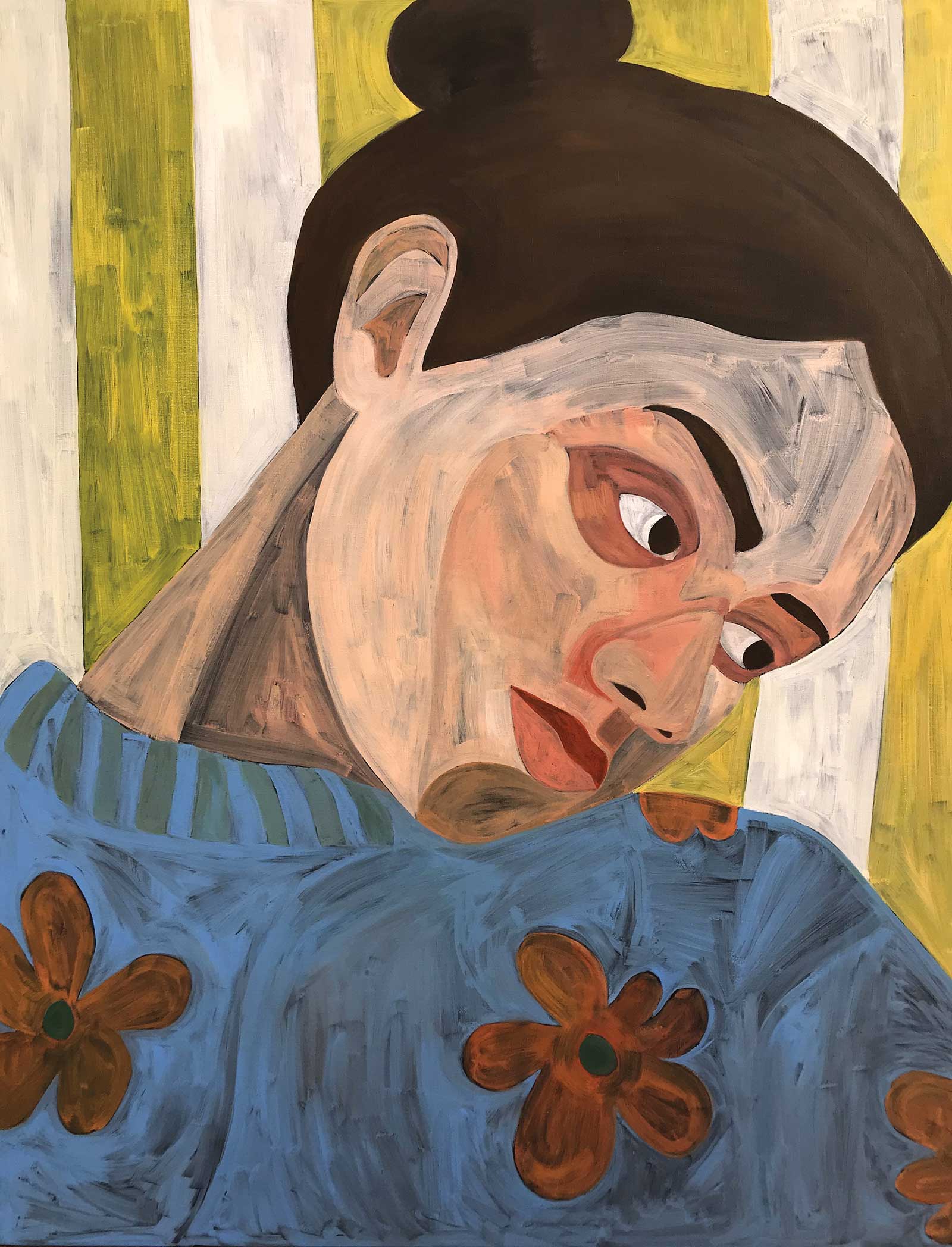
Inès Longevial, Waiting for the sun, 57.4 x 44.8" (146 x 114 cm)
The Colorist’s Approach to Painting
The art and science of mixing natural skin colors begin with the acceptance that local colors change due to influences like the color of light as well as the color of nearby objects that reflect into the local color. Thus, a skin tone retains its original color, but the nuances that form its local color will vary. Local colors travel back and forth within light and dark, and while making the trip, they get interrupted, changed, interfered with, influenced, adapted and reflected into, according to the light source, surrounding objects and the environment. Because of this, it is unnatural for any color to remain the same when put next to or into another color under any light conditions.
The impressionistic approach to painting portraits differs a bit from other traditional styles. The entire canvas is always attacked right from the start of a painting. This makes it easy for the artist to compare, relate and judge the colors amongst themselves. For example, a nuance on a forehead is put down and related to other parts of the face. Nothing is put down without considering its relationship to other parts of the skin. This is done with the philosophical idea that colors look or appear to look a certain way because of where they are. And the only way to achieve this is by constantly comparing and relating every color. My motto for understanding this technique is as follows: compare carefully and relate religiously. It is not how many colors you have, but how well you observe and aim for a desired color (that is, the way you see, mix and use that color).
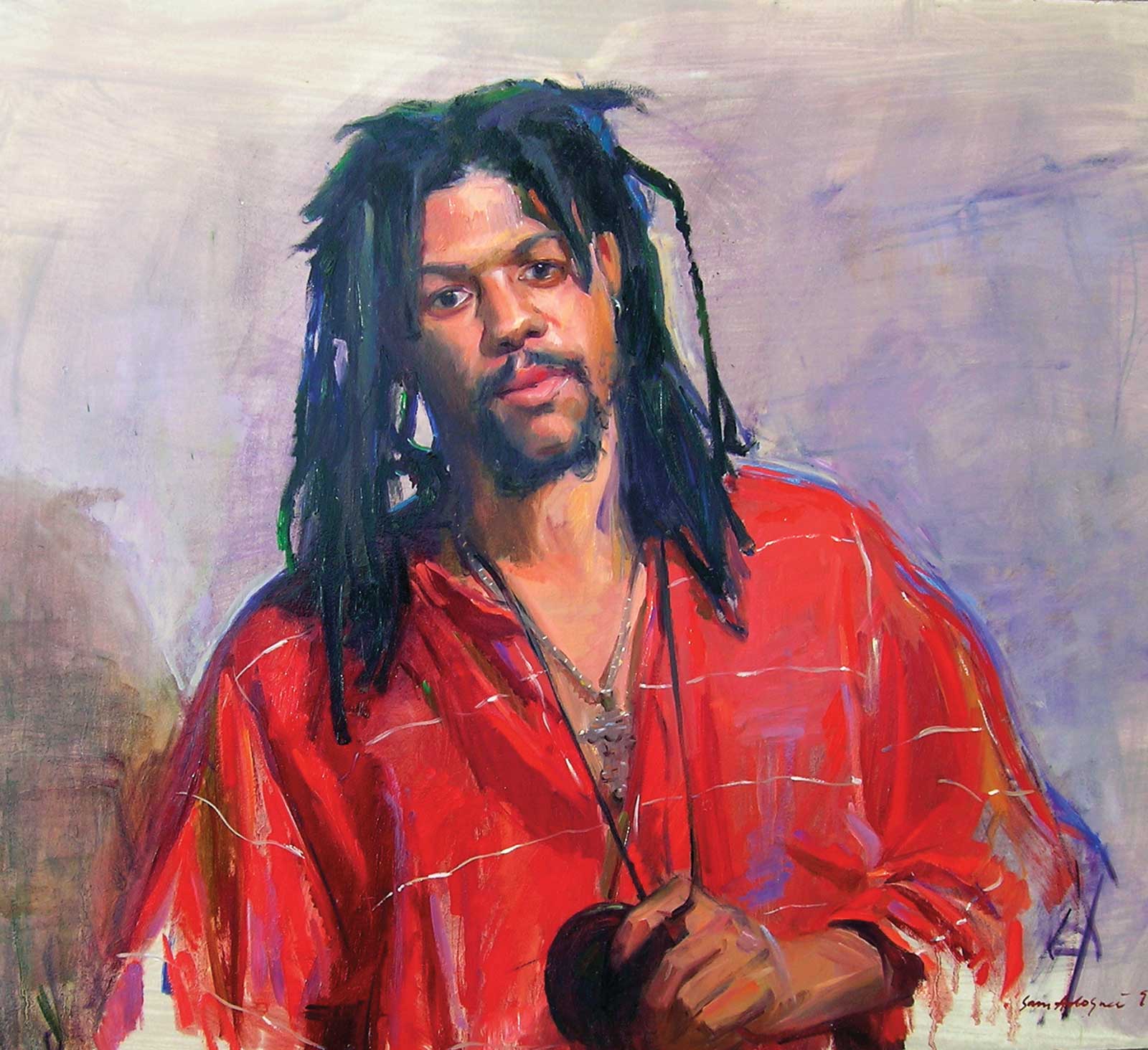
Samuel Adoquei, Portrait of Rodney in red, oil on panel, 24 x 30" (60 x 76 cm)
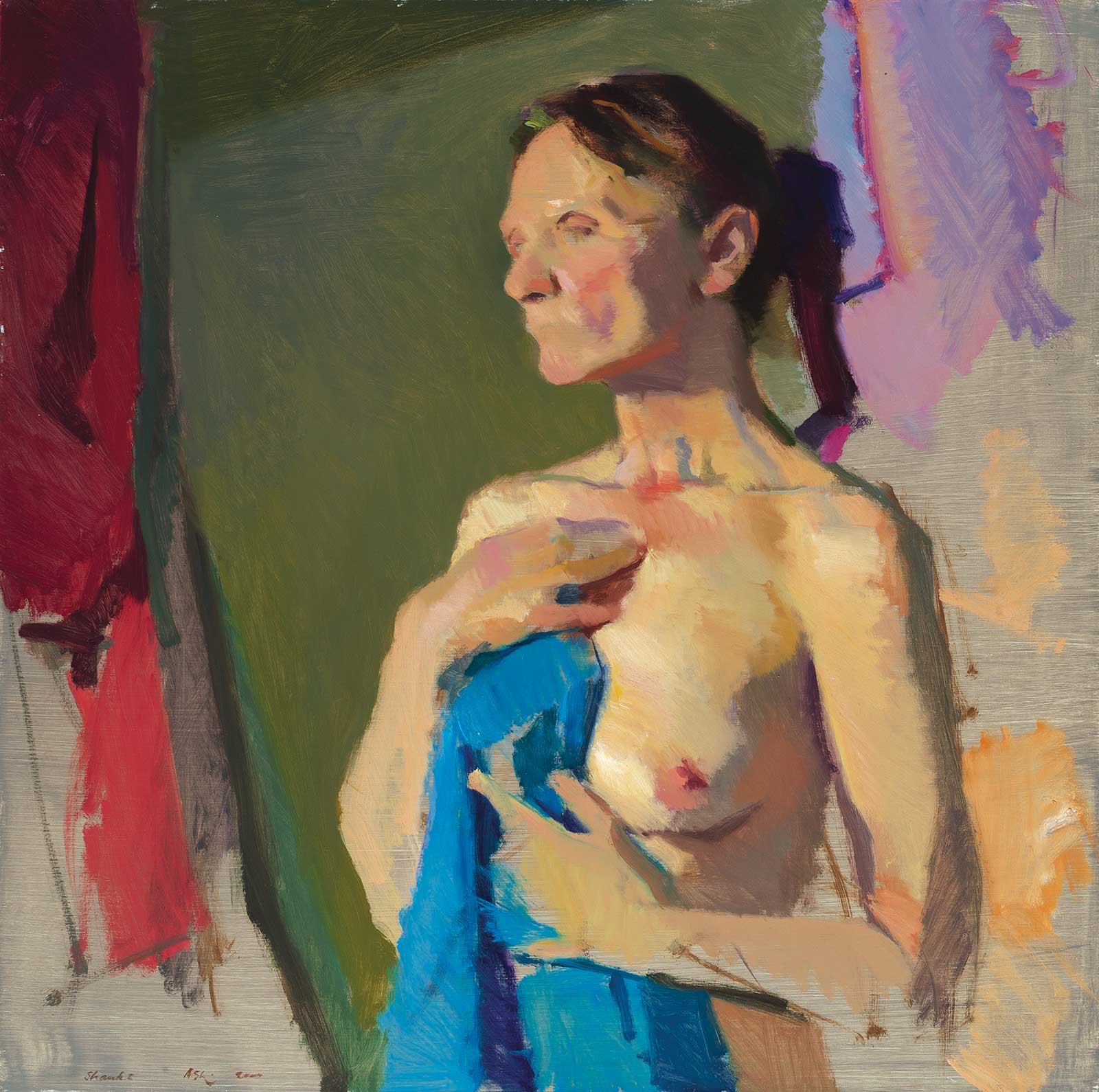 Nelson Shanks (1937-2015), Nina, oil on linen, 24 x 24" (60 x 60 cm). Demo at the New York Academy of Art.
Impressionism
Compared to expressionism, traditional and realistic styles, an impressionistic style is the best method and approach to capturing the true nuances of skin tones. Monet, Cézanne and Sorolla are the masters of this approach. It comes from the belief that what the artist sees in nature is the illusion of many combinations or mixtures of rays of colors coming together to form the illusion of reality. For example, what the mind thinks of as orange is actually many complex tones of yellows and reds coming together, forming one general orange color. In this sense, the trained eye generally sees correctly, but the polluted mind constantly interferes and gets in the way. It is, therefore, the goal of a true impressionist to shut off the mind in order to look for the nuances of nature.
How to Accurately Paint Skin Tones
My basic suggested colors: lemon yellow, cadmium yellow medium, yellow ochre, raw sienna, cadmium orange medium, cadmium red, burnt sienna, alizarin crimson, dioxazine purple, ivory black, ultramarine blue, cobalt blue, viridian green, permanent green and cadmium green light or permanent green light. For whites: Permalba white and cremnitz white.
- Use a Grisaille I use a grisaille for my foundation, structure and placement of the portrait. I aim for accurate proportions and a good grisaille to solve value problems and patterns of light and shade. Arrangements of the features and their relationships to the face and head. This is where good likeness resides.
- Local Color Carefully block in masses of colors, judging, relating and comparing the differences of nuances. The aim is to help observe and carefully mix your colors, values, lights and darks. The secret is to pay attention to the local color (complexion) of the subject, no matter how it may change. Study how nuances of flesh tones change from light to dark and how surrounding objects affect, bounce off or reflect and affect nuances.
- Likeness To achieve accurate proportions, slow down a bit to carefully check your drawing, your proportions and relationship of the features to the face and head. Pay attention to the patterns of light and shade, as well as the accuracy of the structure of the head. Render the form to make sure the planes and direction of the light source are reading on all the features. The aim is to help you pull everything together: colors, skin and flesh tones, values and lighting.
- Fine Tuning the Features Slowly correct the drawing, cleaning up color nuances. Aim for the patterns of light and shade. Sculpting the shapes of light and shade help to achieve resemblance and complex features in the face. Remember to constantly compare values, colors and light.
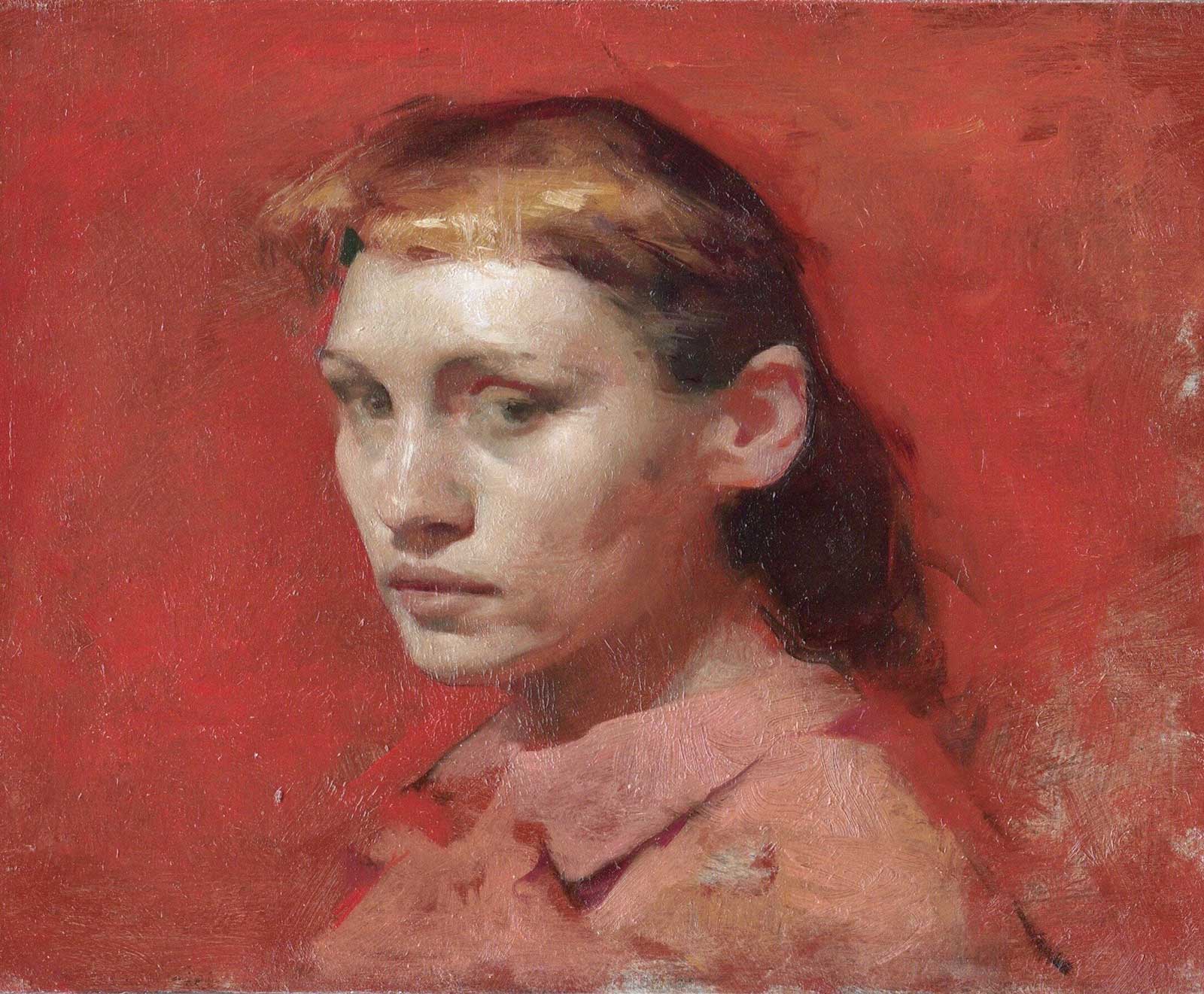 Colleen Barry, Study for Sea Change - Self-Portrait of the Artist, oil on linen, 16 x 20" (40 x 50 cm)
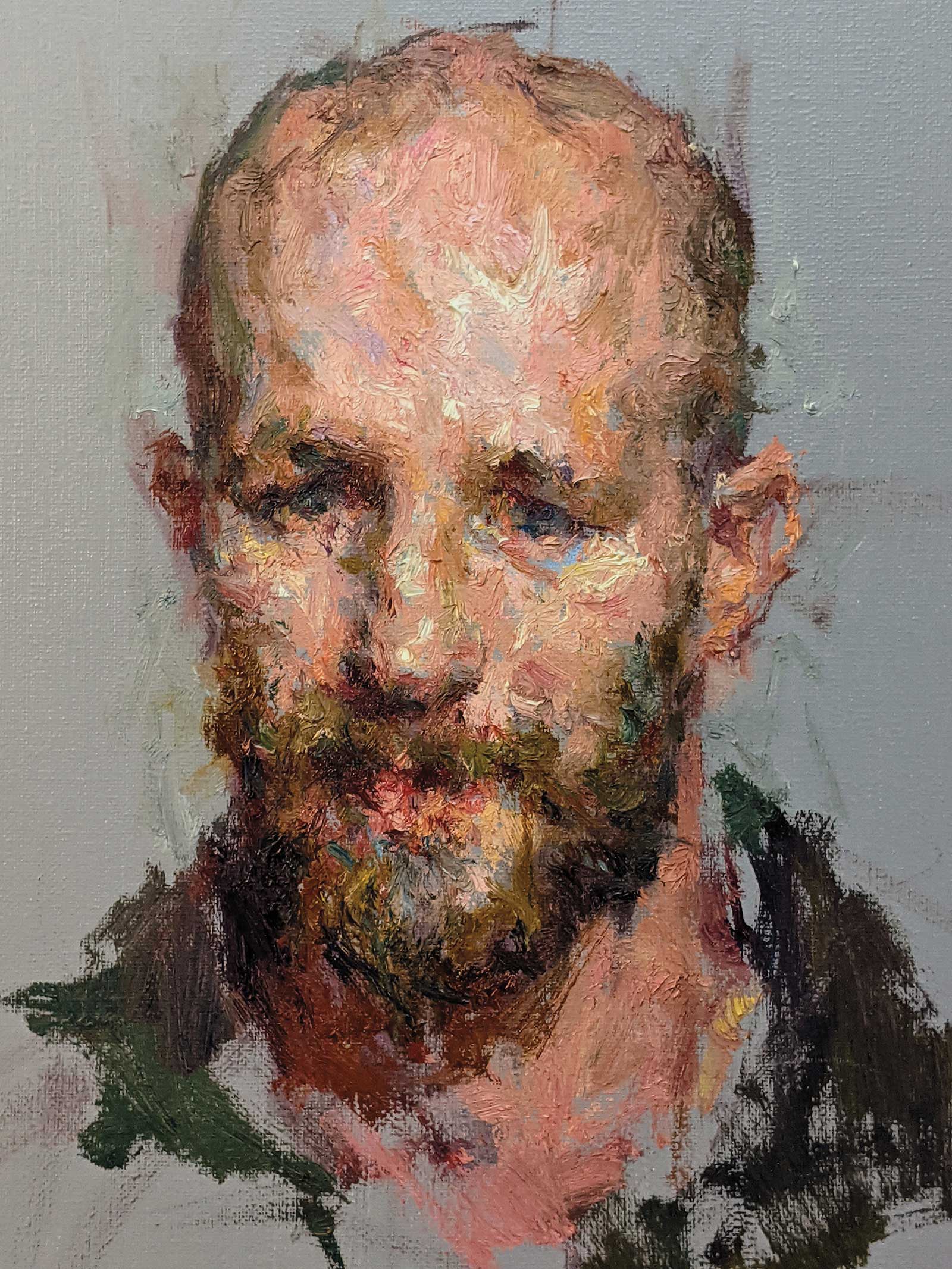
A portrait in oil by artist Dan Thompson.
There is no one way of truly finishing a painting in the impressionistic approach. You can only continue to adjust, improve and clarify the light, values and color until you’re satisfied. While the techniques of painting people have changed over the millenia, the human form has not.
Moving forward, the artist’s most important works come from their conception and knowledge of nature, not in tools and materials. —
About the Artist
 Samuel Adoquei
Artist, author and educator Samuel Adoquei, born in Ghana, follows the historical traditions of the creative minds who challenged themselves with unfamiliar territory. Upon Adoquei’s arrival to the United States, while still a student, he won several international awards including the Gold Medal in Oil Painting and Best Traditional Oil Painting awards at the Knickerbockers Artists Annual International Exhibition. He is the first and only African artist in Western art to teach in all of the prestigious art institutions and academies in New York City. His publications include A Short Story of Skin Tones in Art; How Successful Artists Study; Origin of Inspiration; and Brushstrokes in Painting. Adoquei’s paintings have appeared on the covers of books and in magazines and newspapers, including the New York Times.
Contact at
info@samadoquei.com, www.samadoquei.com
About The Skin Tones Project
Created by Samuel Adoquei, The Skin Tones Project is a worldwide movement that celebrates the beauty of people across the globe. A combination of both contemporary and historic portraiture, the project aims to spread “universal love of our human race” through exhibitions and paintings inspired by the unique and endlessly complex colors of skin tones. Learn more at www.theskintonesproject.com.