None of us knows the future fate of our paintings and sketchbooks. They may end up as valued family relics, they may find their way to a museum collection or they might be sold in a yard sale.
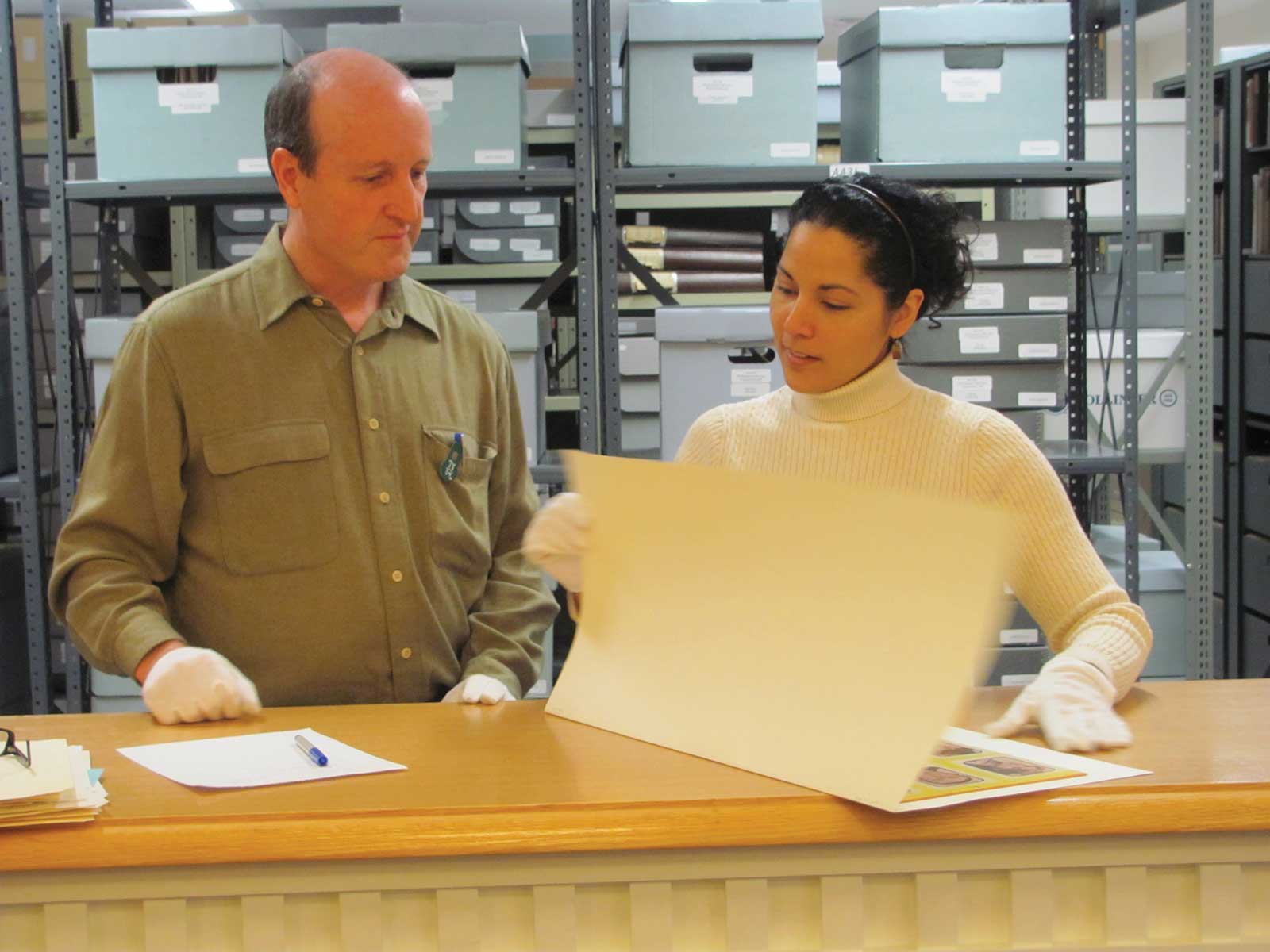
James Gurney with archivist Venus Van Ness at the Norman Rockwell Museum.
Whatever happens, people in the future will thank you for taking a few key steps to prepare and preserve your work for posterity. I realize that most of us are so preoccupied by the challenge of creating new artwork that it’s easy to overlook the fact that each of us is the first and most important archivist for our own artistic legacy.
How to Be a Better Conservator
To learn from an expert, I met with Venus Van Ness, the archivist of the Norman Rockwell Museum. We put on cotton gloves, and she showed me the acid-free folders in which each of Norman Rockwell’s tearsheets, letters and drawings are carefully preserved. The air was perfectly climate controlled to an ideal humidity and temperature.
“My studio doesn’t look like this,” I admitted to her, a little sheepishly. This was a meeting of two different worlds. One was the world of the artist, a fear-zone of gummy tape, dog-eared pages, blazing sun, coffee spills, marauding pets and slumping portfolios. The other was the world of the archivist, a temperate realm of safety, where a piece of paper has a chance at immortality.
Can these two worlds meet halfway? I wondered. Most artists will never take such care with their own work, but maybe there are some basic, reasonable things we can do to save a lot of grief for future conservators (assuming hopefully that our work might end up in such a place).
Taking Care of Your Art
• Get art and books out of the basement and attic Basements are dark and damp, often leading to mildew. Dehumidifiers can help. Attics can get very hot and very cold, which accelerates decay.
• Keep the art out of direct sun The sun has a large amount of ultraviolet radiation, which fades pigments and makes paper yellow and brittle. The goal is to reduce chemical degradation. Ideally the temperature should be below 72 degrees Fahrenheit (22 degrees Celsius), with low humidity, and protection from the UV rays of the sun.
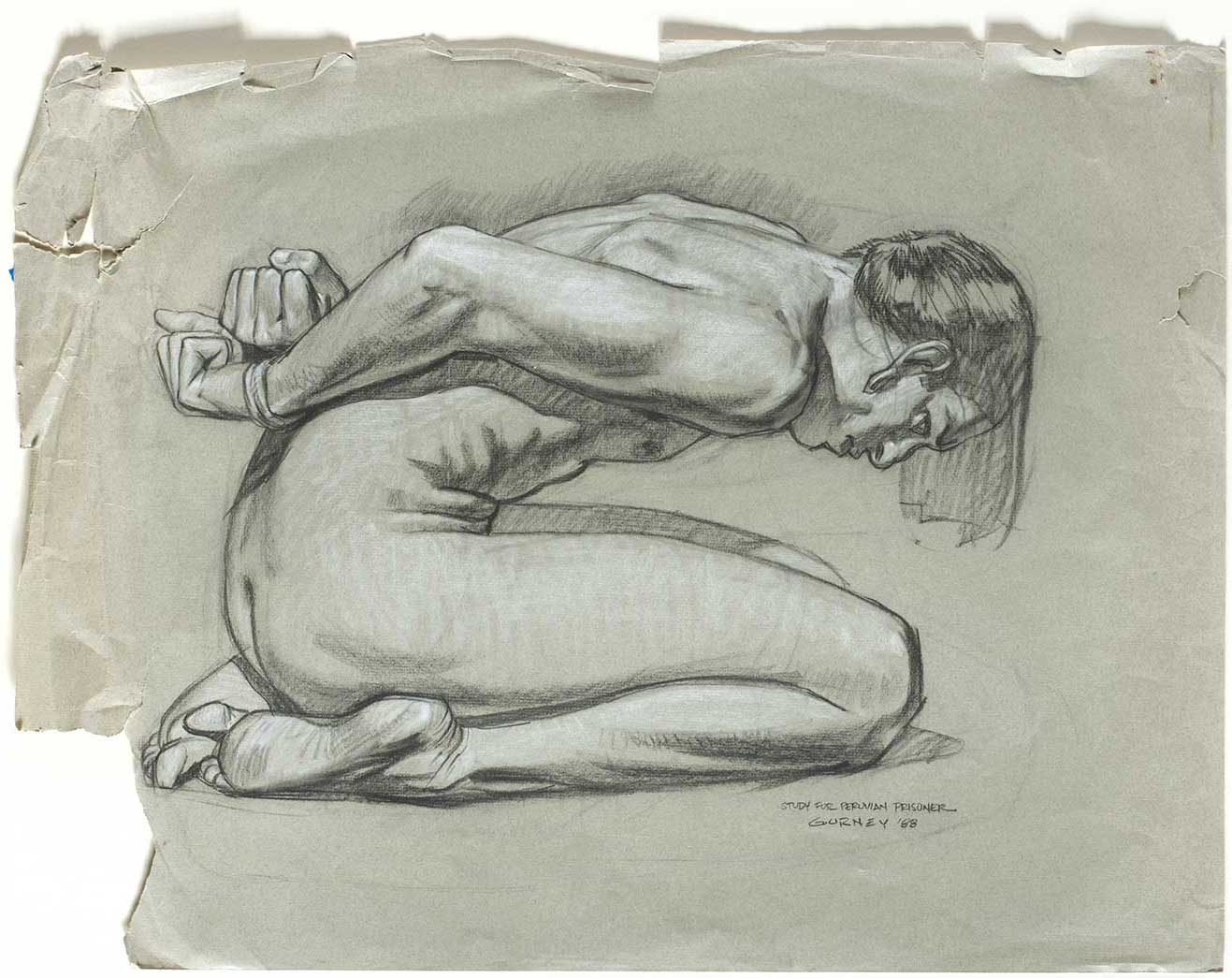
Study for Peruvian Prisoner, 1988, charcoal and white chalk on gray paper, 19 x 25" (48 x 63 cm). I’m no role model for getting this stuff right. This drawing lived for years sticking out of a portfolio, which was standing up at the edge of my studio.
• Store paper art flat and unfolded Sketches, drawings, watercolors or other works on paper should be supported horizontally in acid free folders, ideally protected in a flat archival cardboard box, and placed in a flat file or in boxes on shelves. Paintings can be framed or matted in acid-free materials, wrapped in glassine and bubble pack, and stored vertically on a big set of shelves.
• Use gloves and keep liquids away Have a set of white cotton gloves for handling paper. Hand oils are remarkably destructive.
• Don’t use tape If you must use commercial, pressure sensitive tape, use tape that’s made for museum conservators and remove it as soon as you can. If you need to hold the corners of paper or board onto a backing, you can make little paper corners to hold your object.
• Protect from dust and mold Paper is composed of a large organic molecule that can quickly degrade. Protect important works with preservation framing with UV-protected glass or acrylic. Rotate the works that you display so no single piece suffers too much from the light. Books fare better when they are kept in glass-fronted cases.
Use a pencil rather than a pen or marker Many kinds of pens and markers can continually bleed through the paper. Pencil is more stable, and you can erase it. Conservators prefer materials and methods that are reversible.
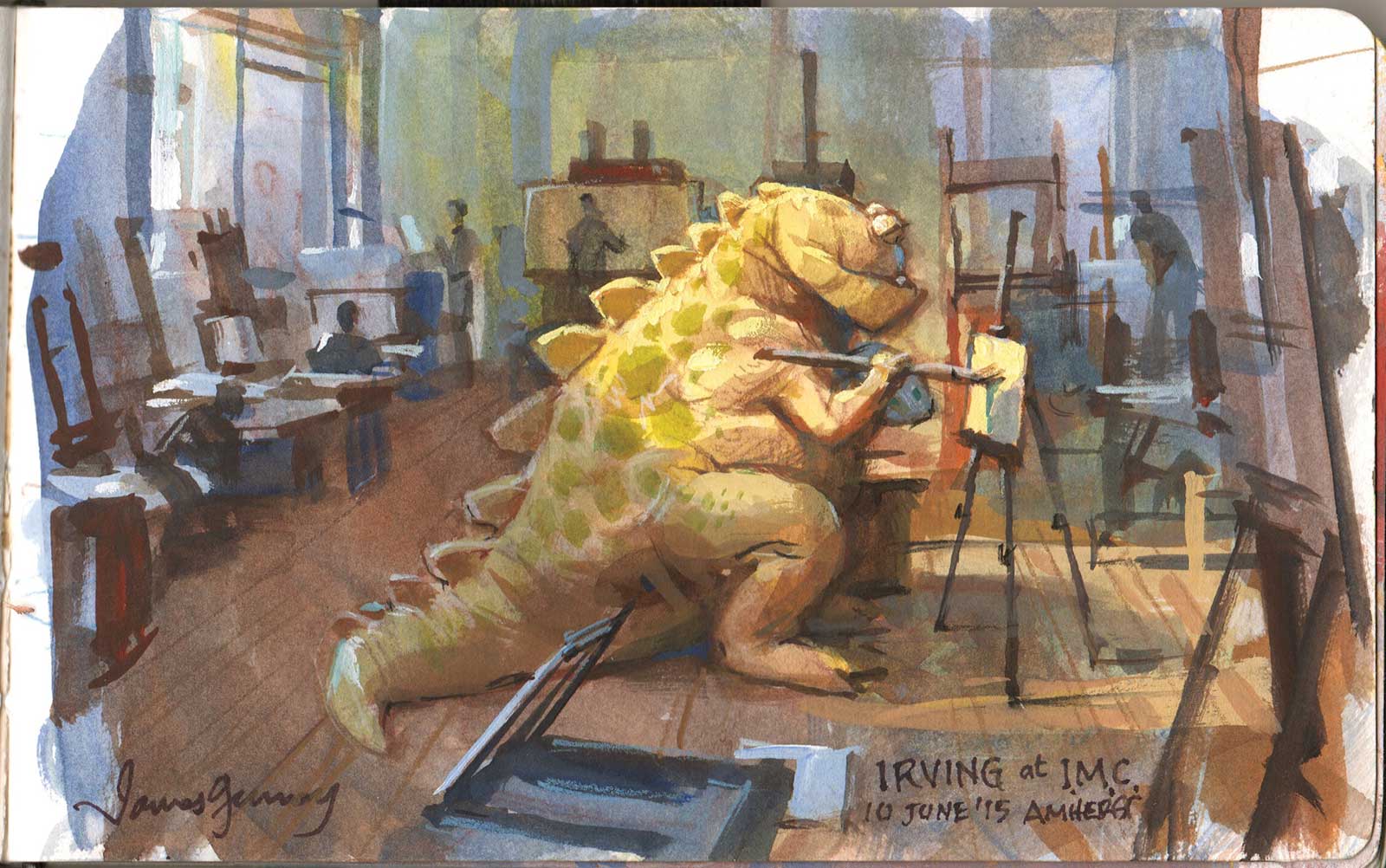
Irving at IMC, Amherst, acrylic gouache, 5 x 8" (12 x 20 cm). I painted this friendly monster as a demo for a workshop in Amherst, Massachusetts. I wanted to try out the idea of combining observation with imagination in an observational painting. As I did the demo, I made up a backstory for the kaiju. By naming him Irving, the story evolved in my mind of a particular shy, artistic creature who dreams of being an artist.
• Photocopy thermal faxes If your documents date back before 2000, they may include faxes. Thermal faxes fade fairly quickly. Photocopies are relatively more stable.
• Shoot your art and store the files elsewhere Modern cameras are higher resolution than professional cameras were 20 years ago, so you can shoot them yourself. Consider what you’d be able to retrieve, if your house were to burn or be washed away in a flood.
• Back up your computer work Print out whatever key digital files you can, upload them to the cloud, burn them on a disk or load them on a thumb drive. You don’t want to lose them if your computer dies. Have an action plan for preserving correspondence, lists, sketches, image files, spreadsheets, videos, audio files, Photoshop files and social media posts.
Tie Your Art to a Story
Preserving your artwork is just the beginning to helping future generations appreciate your artwork. The second key is to associate your art with a story. Exhibitions are built out of stories, paintings are sold with stories and social media posts go viral with stories. So it’s important to connect each artwork with the people and events surrounding its creation.
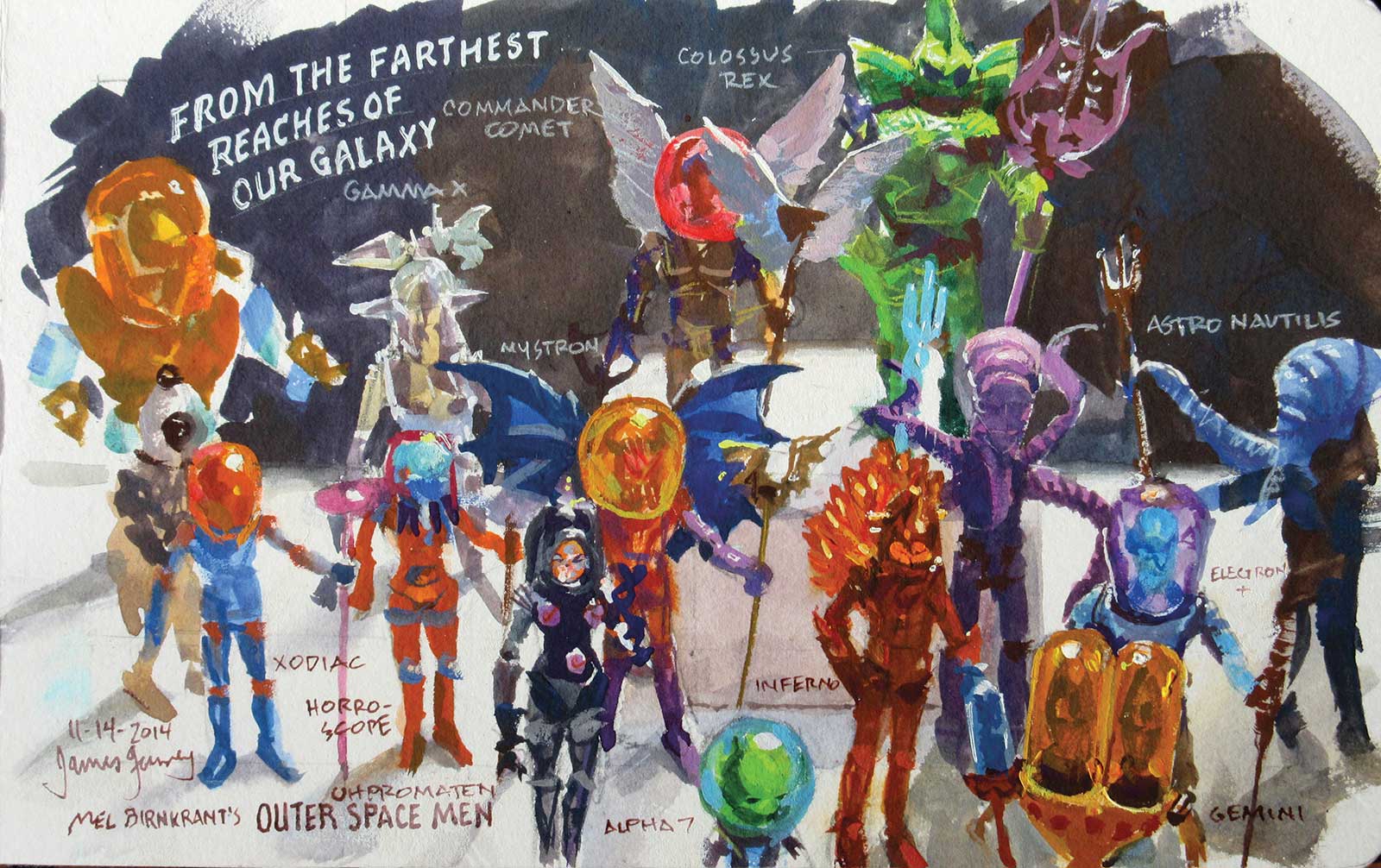
Outer Space Men, acrylic gouache, colored pencil and white gel pen, 5 x 8" (12 x 20 cm). I painted this color study in the home of toy inventor/collector Mel Birnkrant, who created the first bendy action figures called Outer Space Men in 1969. He told me they were a huge hit until the moon landing the following year killed enthusiasm for space toys. The romance for space aliens disappeared when people realized the moon was actually just a lifeless rock. Birnkrant explains, “Space toys fell down to earth with a thud, and ‘one giant step for mankind’ turned out to be one foot in the grave for the Outer Space Men!”
• Sign each standalone piece Adding a signature can dramatically increase the value of a piece and help greatly in its identification.
• Add a date somewhere The date is a valuable biographical clue to place the work in the context of what was going on in your life and in the world around you.
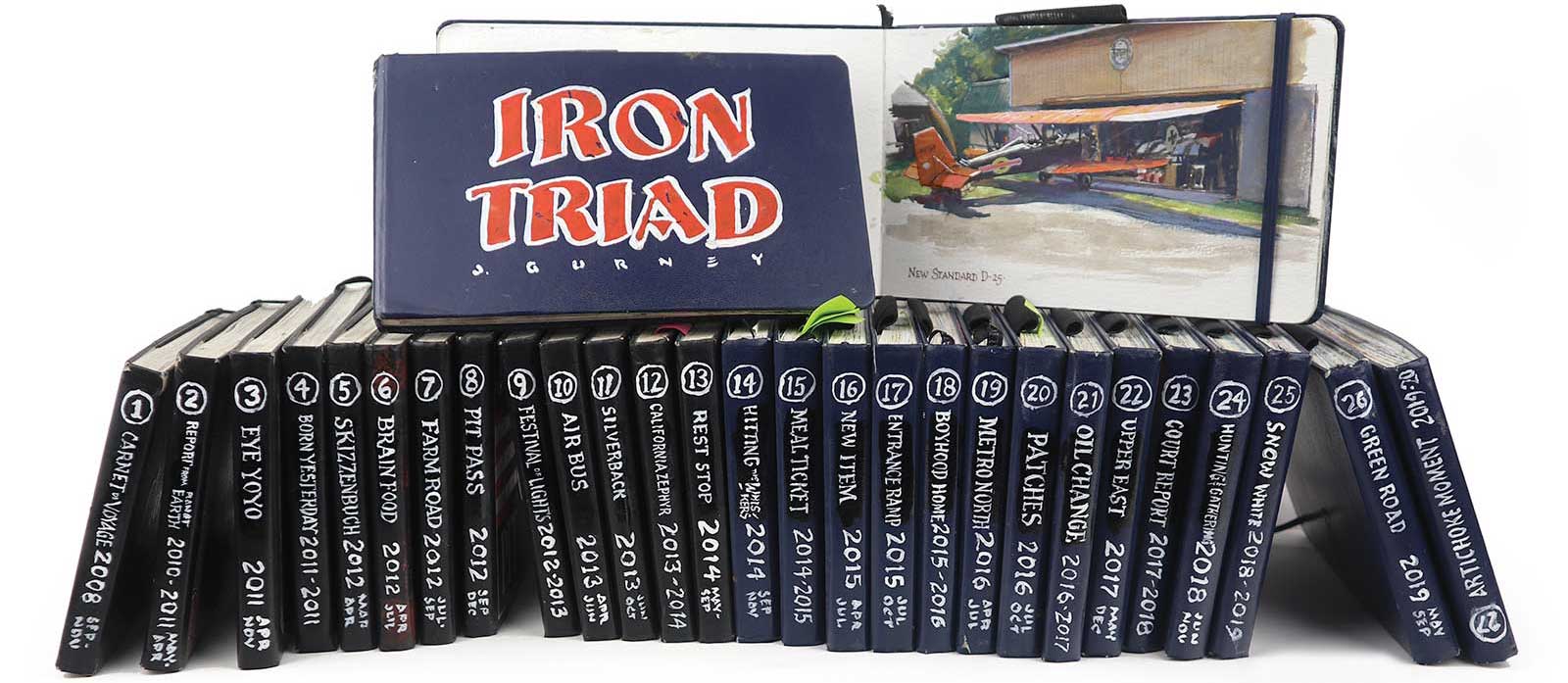
• Put a title on the spine of the sketchbook Write the title of the sketchbook and the date range on the spine of the book. You can paint a fancy title on the cover of the book, too.
• Who, what, where and why? If a particular person is portrayed in a portrait, write their name somewhere on the piece. (Otherwise it might become just “Portrait of a Lady.”) Indicate where you painted the picture. If it’s a street scene, note down the nearest street sign. All that information will help someone in the future who may have no idea what they’re looking at.
• Where to write random notes If the art is in a sketchbook, you can write those notes on the page itself next to the image. Don’t write it on a facing page, because unfortunately sketchbooks are sometimes cut up. You can put this information on a label on the back of the piece, or write it in a blank studio journal.
• Capture info with your phone A voice recording app can record your notes or interview clips. You can shoot video at the location where you are painting or gathering your reference.
• Edit it later If you execute your paintings later in the studio, having the raw captures will help you reconstruct the full impression of the place for social media posts, and it will give you material for making a video.
• Consider non-visual senses Don’t overlook the sounds that you hear as you sketch, what you ate at a restaurant, or the colors, textures or smells of the animal or plant you’re sketching.
• When you hear a story, write it down Write down the stories people tell you about what you’re sketching. If it’s an old building in a town you’re visiting, ask an old timer about their memories of the place. Do it while you’re still on the spot and the memory is fresh.
• Think like a curator Curators put art in context and connect one piece of art to another. Give them something to work with. Provide them with raw material. They’ll thank you for it.—
About the Artist
 James Gurney
James Gurney dropped out of art school to ride the freight trains across America, leading to his first book The Artist’s Guide to Sketching (1982), which he co-authored with Thomas Kinkade. He is the author of Color and Light: A Guide for the Realist Painter and the Dinotopia series, and there’s a dinosaur named after him: Torvosaurus gurneyi.
Contact at www.jamesgurney.com