Tracing paper is a versatile art supply, used for creating transparent image layers. Although there are synthetic materials available, you can still buy various kinds of translucent papers similar to what artists used centuries ago, made from rice, wood pulp or cotton fibers. I have used tracing paper for refining compositions, working out perspective, making corrections, and have even tried it as a unique drawing surface. Let’s look at some examples of preliminary drawings on tracing paper paired up with finished oil paintings.
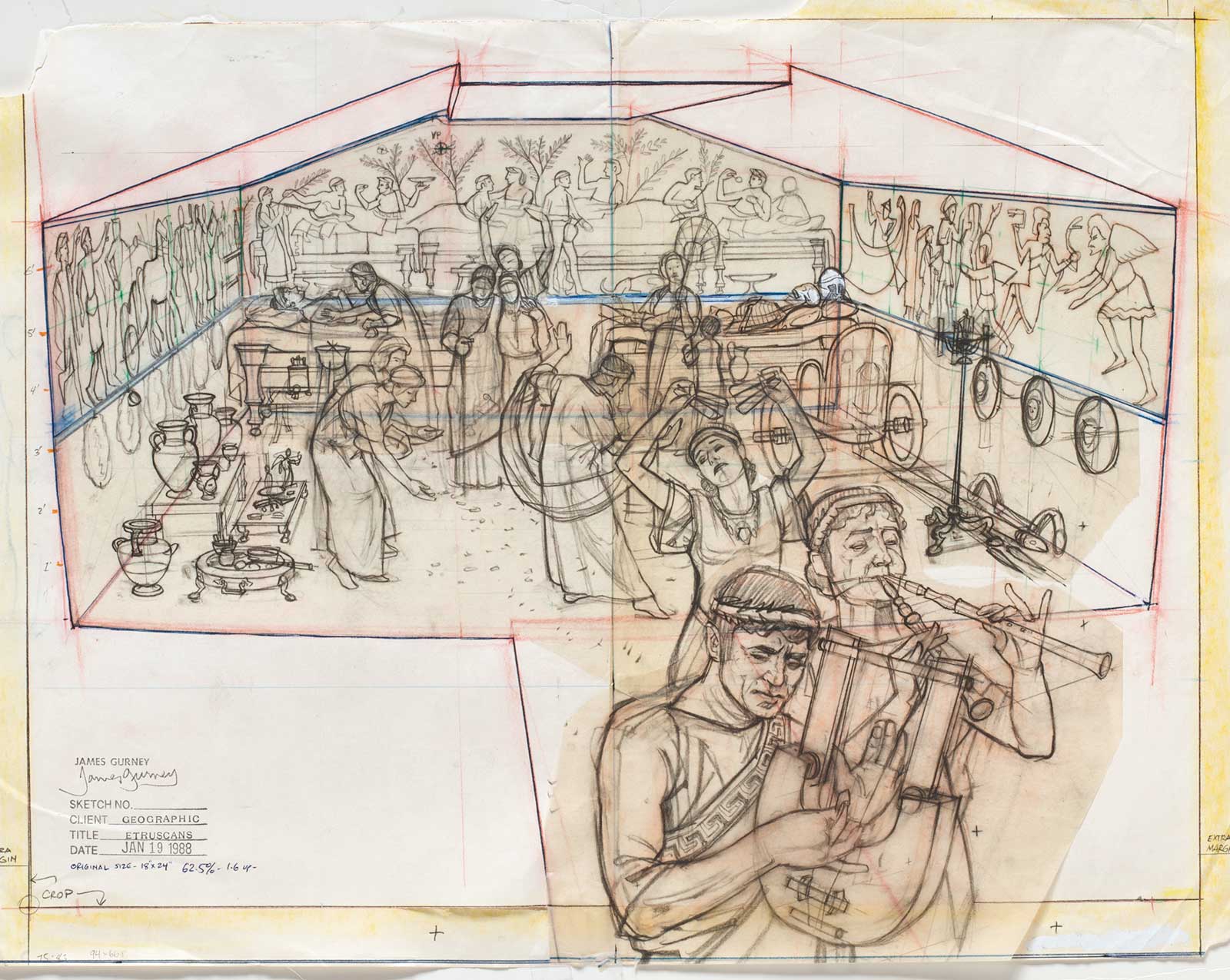
Drawing on multiple layers of tracing paper, 18 x 24" (45 x 60 cm)
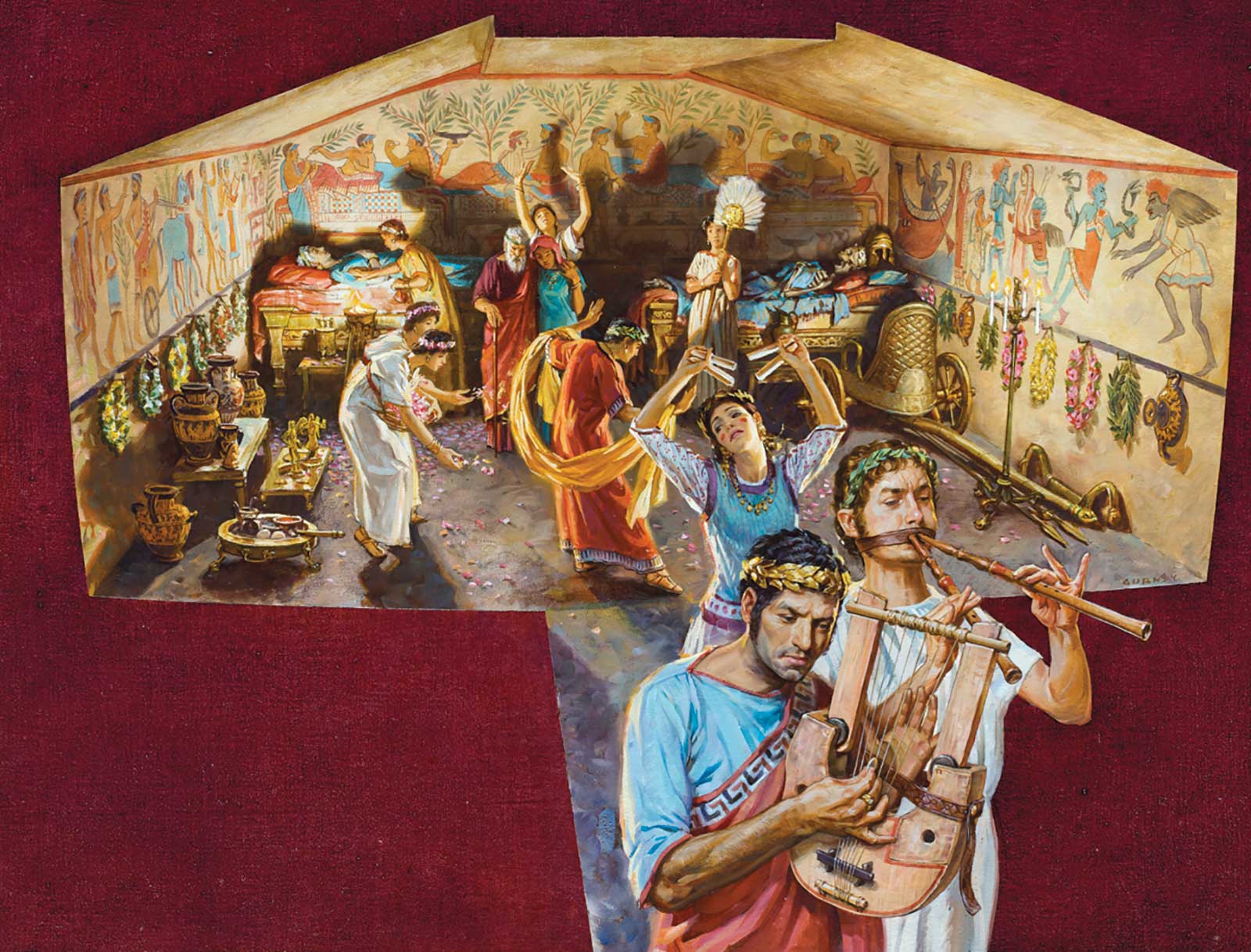
Tarquinian Tomb, oil on canvas mounted to board, 18 x 24" (45 x 60 cm)
A Scene with Overlapping Figures
National Geographic sends me on assignment to Italy to reconstruct a newly discovered Etruscan tomb. We descend a ladder into the tomb, which unfortunately has recently been emptied by robbers. My painting takes us back to around 700 BC to show a family departing the tomb, accompanied by musicians and dancers. I hire models, and I draw each figure—or pair of figures—on a separate layer of tracing paper. That way I can draw the entire pose, including the parts that are hidden. By putting each figure on a different level, I can move key elements of each pose into the silhouette. Of course I could do all this digitally, but using the layers of tracing is deliciously tactile and just as fast.
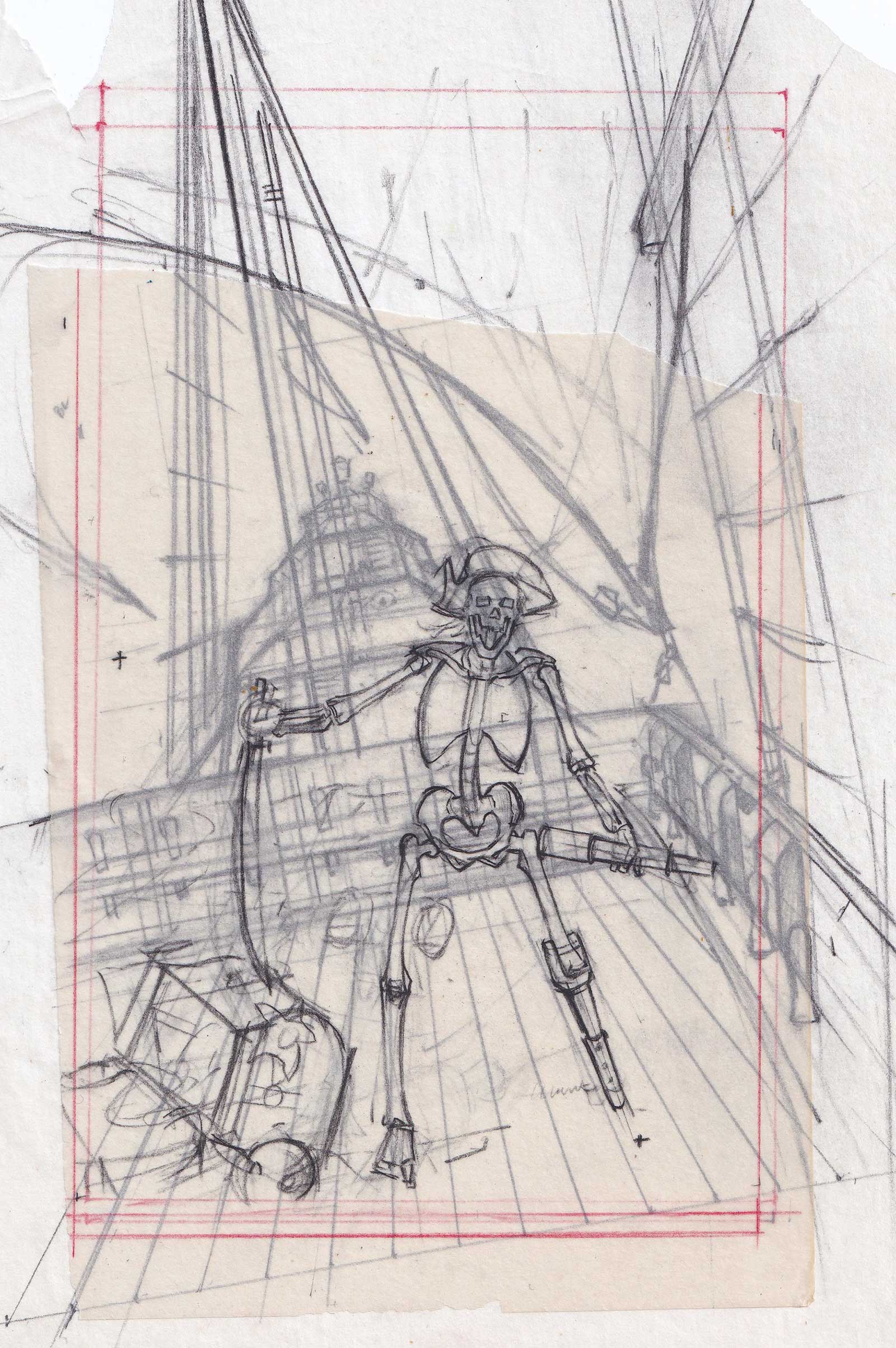
Skeleton in perspective, pencil on tracing paper, 10 x 8" (25 x 20 cm)
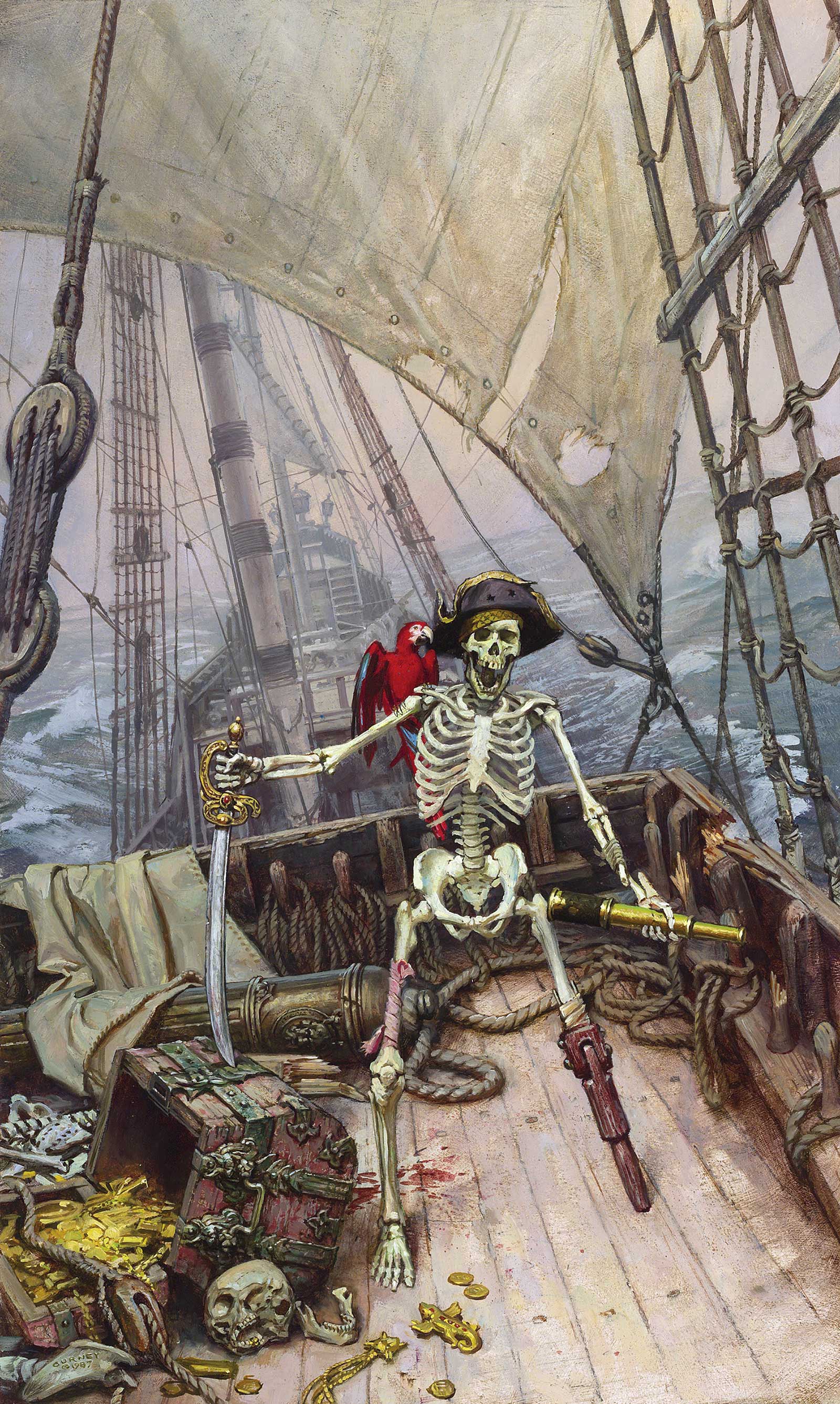
Skeleton Pirate (also known as Shiver Me Timbers), oil on board, 17 x 11" (43 x 27 cm)
Note: This painting will be featured in the upcoming exhibition at the Hunter Museum in Chattanooga, Tennessee called Enchanted: A History of Fantasy Illustration from May 20 to September 5.
A Stage for The Actor
His right leg is held together with a strip of cloth, and his missing left leg is replaced with the end of an oar, whittled into a simple hinge for his knee. He is a pirate who refuses to die. I draw the scene in layers of tracing paper, taking care to work out the perspective of the derelict pirate ship independent of the skeleton figure. This allows me to try out different positions of the character without disturbing the careful drawing of the ship’s rigging and deck details. I draw past the edges of the composition and figure out the red crop lines. Once I decide on the final arrangement, I trace the drawing onto a single layer and project it onto the canvas with an opaque projector. With all those planning stages worked out, the final painting is a pleasure, and I can concentrate on all the details.
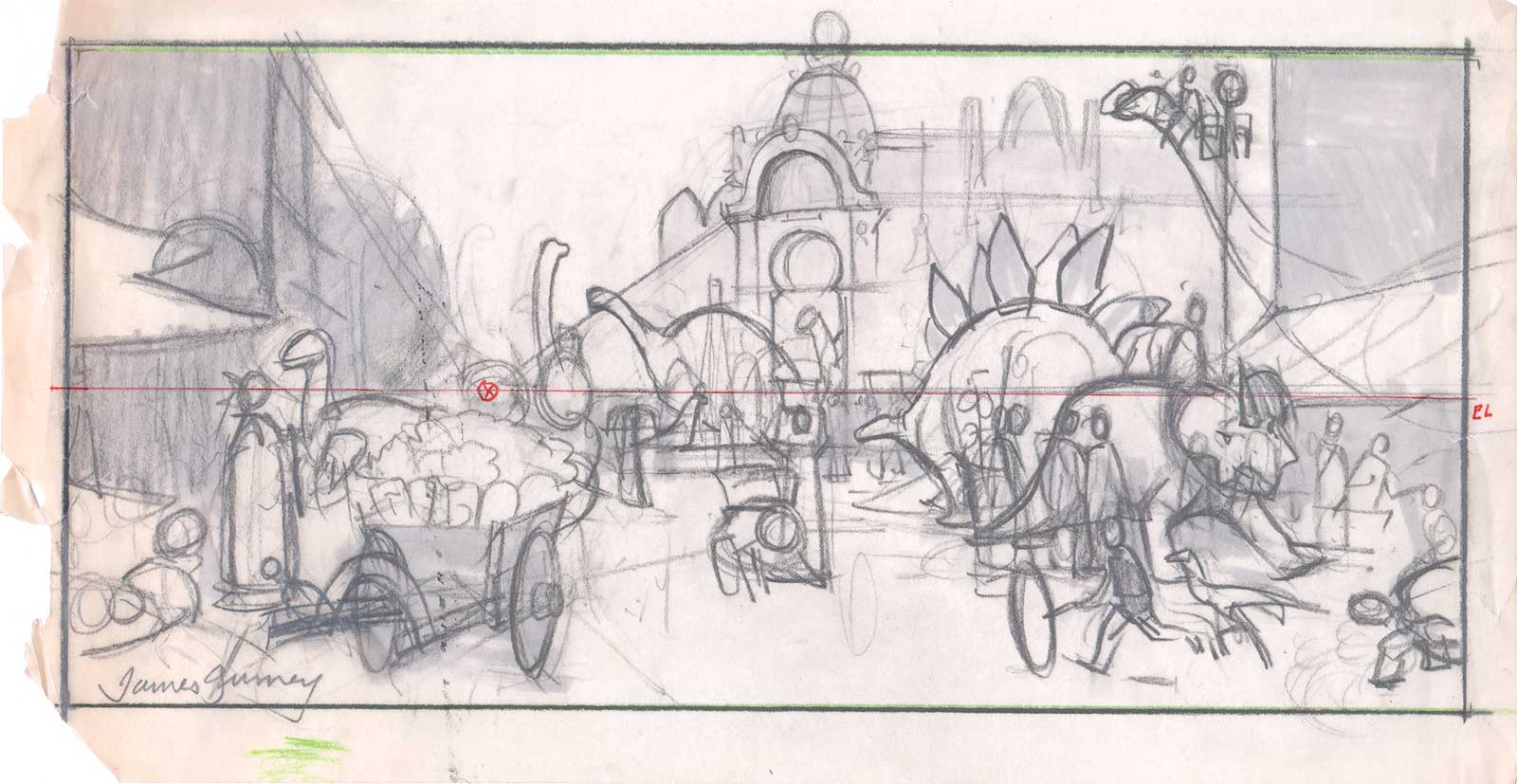
Dinosaur Boulevard compositional study, pencil on tracing paper, 8 x 10" (20 x 25 cm)
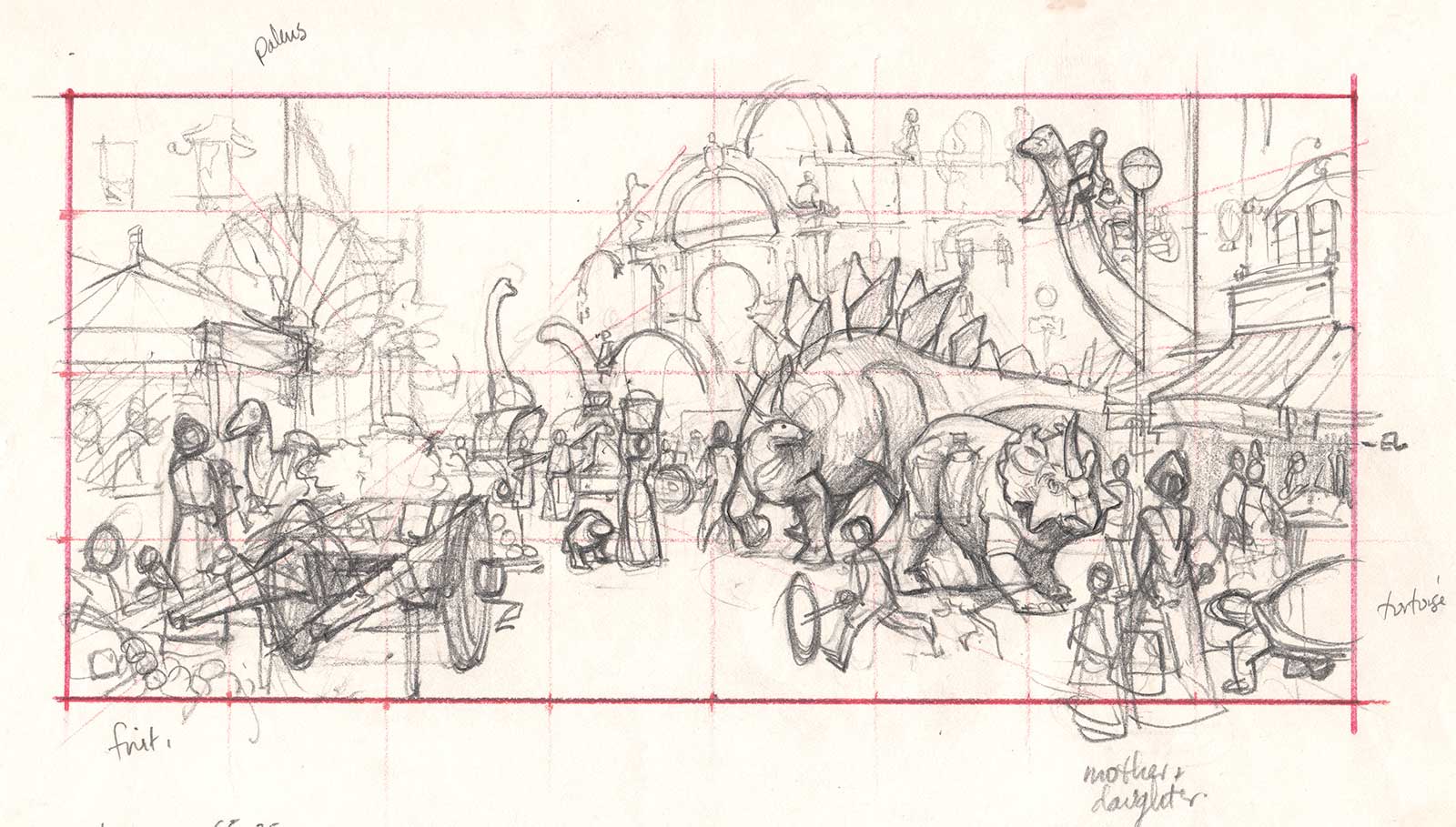
Dinosaur Boulevard drawing, pencil on tracing paper, 4½ x 9½" (11 x 24 cm)
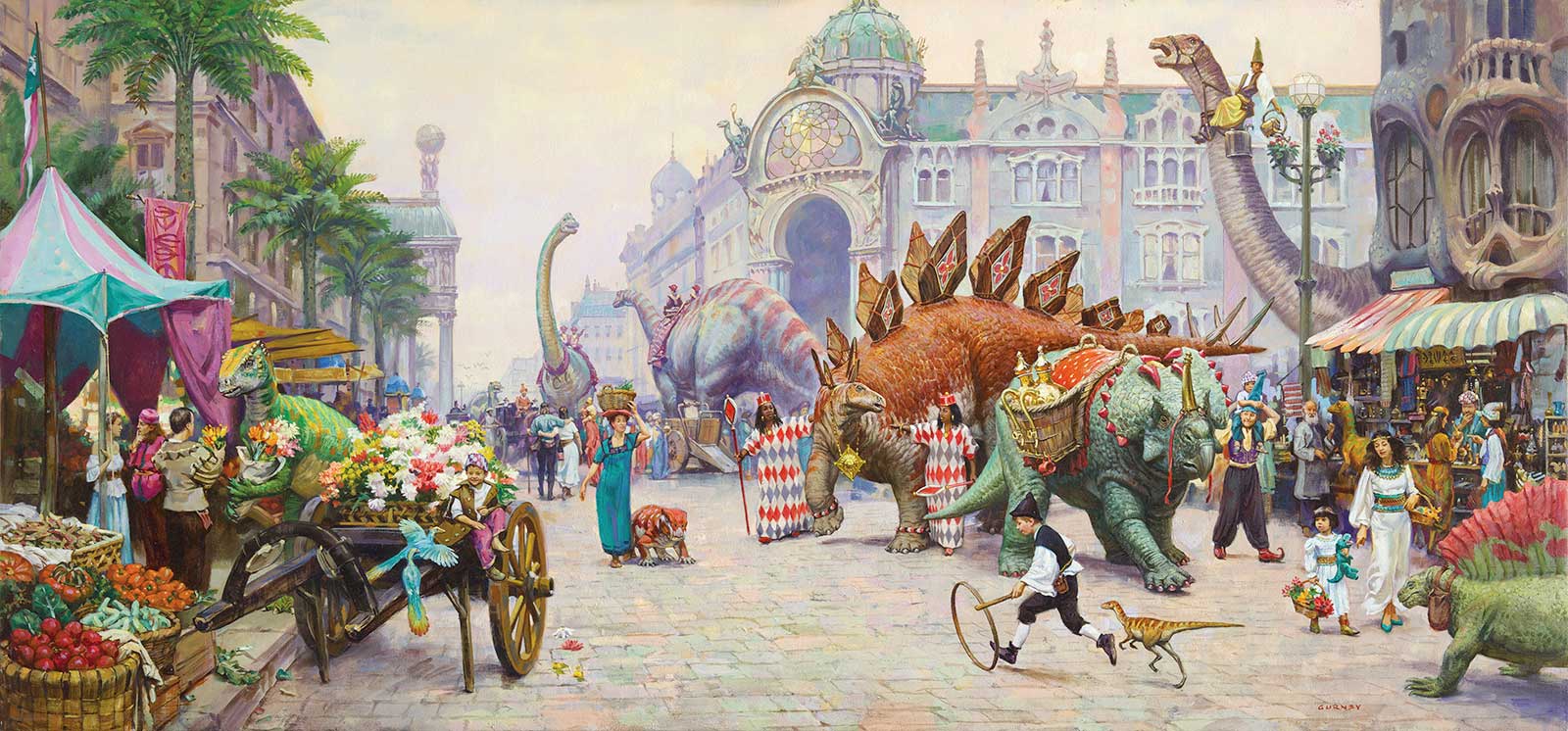
Dinosaur Boulevard, Oil on canvas mounted to board, 26 x 54" (66 x 137 cm)
Perspective and Placement
This boulevard scene shows a lot of different dinosaurs and figure groupings. Each grouping tells a little story: the boy rolling a hoop with a Compsognathus running alongside, the mom whose daughter is holding a dino plush toy, and the traffic guards leading a Stegosaurus with poor vision. My first task is to figure out big-picture questions, such as the height of the eye level, how much street, sky and buildings to show, and which types of dinosaurs to include. I draw each of these exploratory sketches on tracing paper, refining over a rougher version from a previous iteration. These two sketches are just the tip of the iceberg. All this thinking is completed before I hire models and build maquettes.
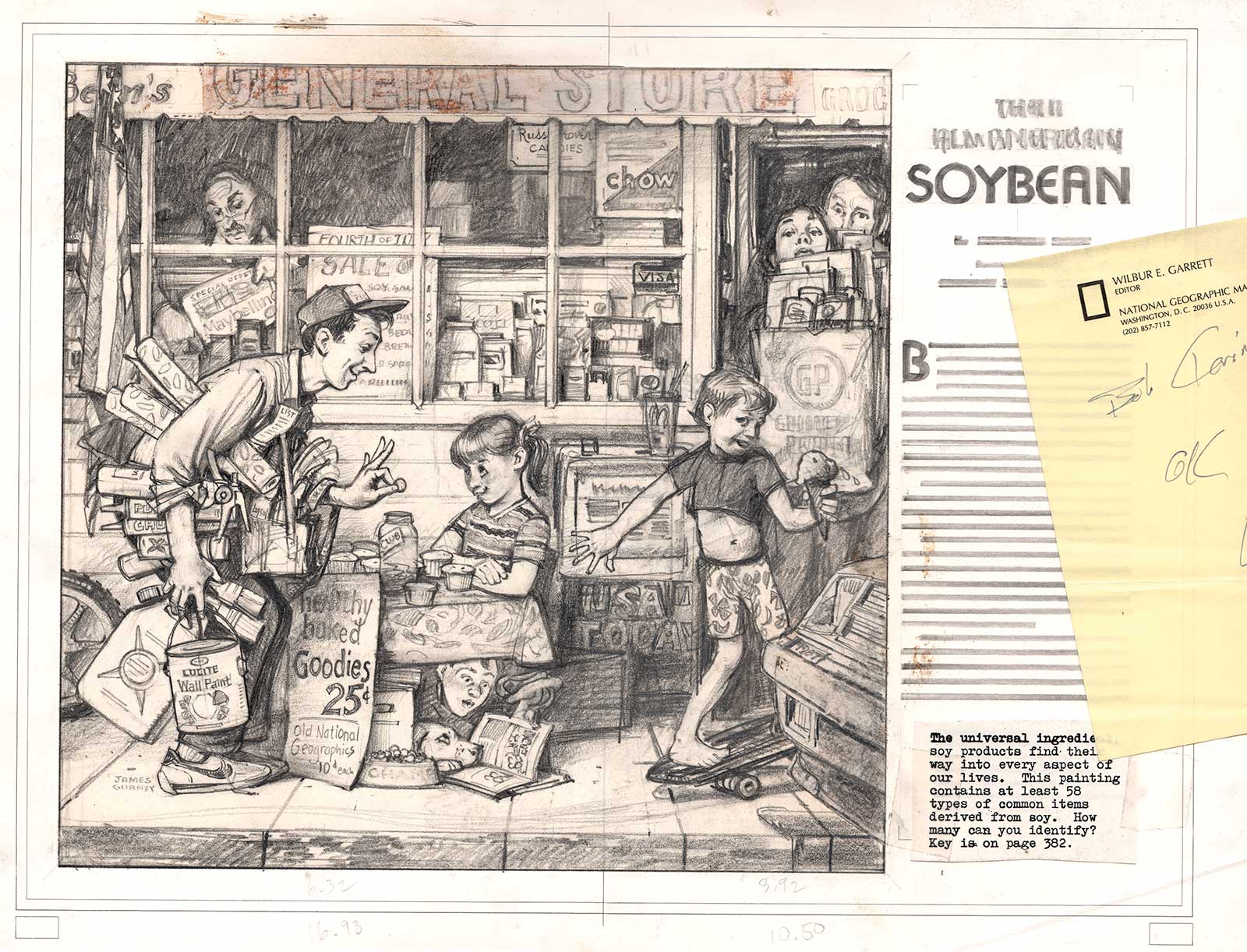
Layout concept from imagination, pencil on flimsy, spray-mounted to printed layout, 10½ x 13¾" (26 x 34 cm)
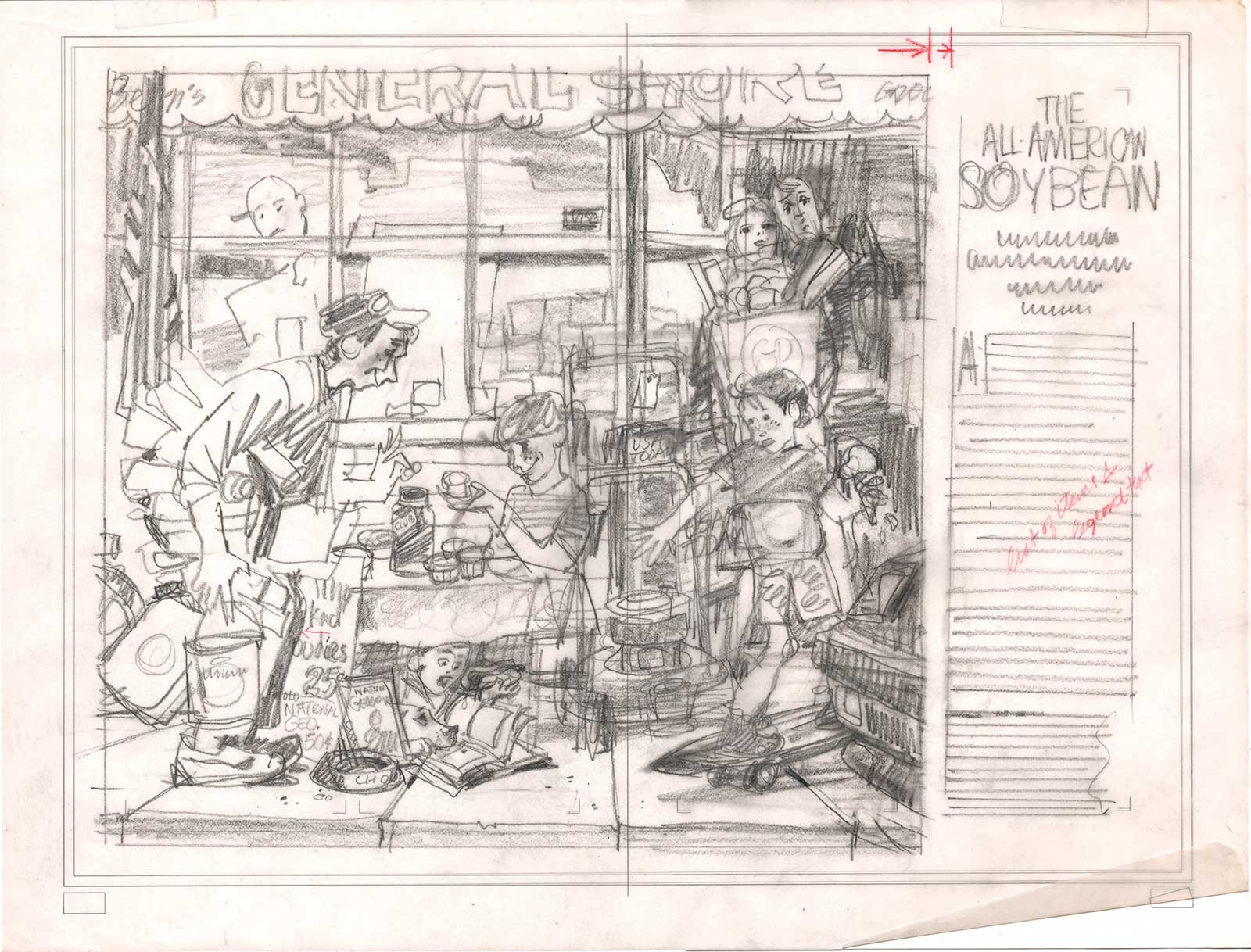
Draw-over by art director J. Robert Teringo, pencil on flimsy, 10½ x 13¾" (26 x 34 cm)
Locking the Concept
The idea for this illustration in National Geographic was to show a variety of products that use soybeans. The products appear in the context of a small town general store, with an overloaded handyman buying muffins from a bake sale. Every item had to be based on an actual product, and we had to get approvals from the companies before proceeding. But before hiring models and gathering props, I developed the concept as far as I could out of my imagination. My drawing is on flimsy, stuck down with spray adhesive. The art director made a tracing over that to suggest even more ideas. Falstaff beer company used soybeans in their brewing process, but they didn’t have an official design neon sign, so I designed one for them.
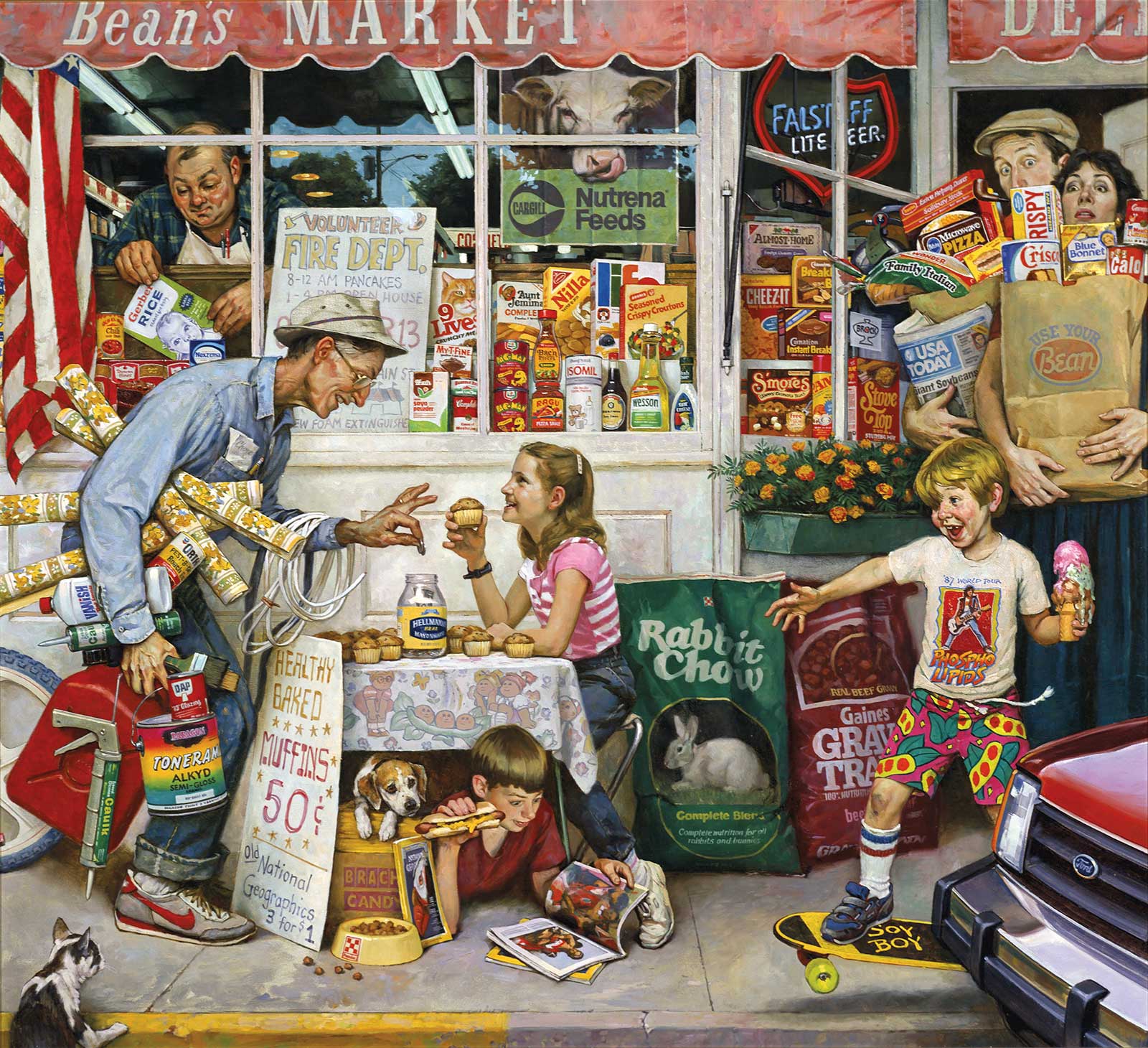
The Uses of Soybeans, oil, 24½ x 27" (62 x 68 cm)
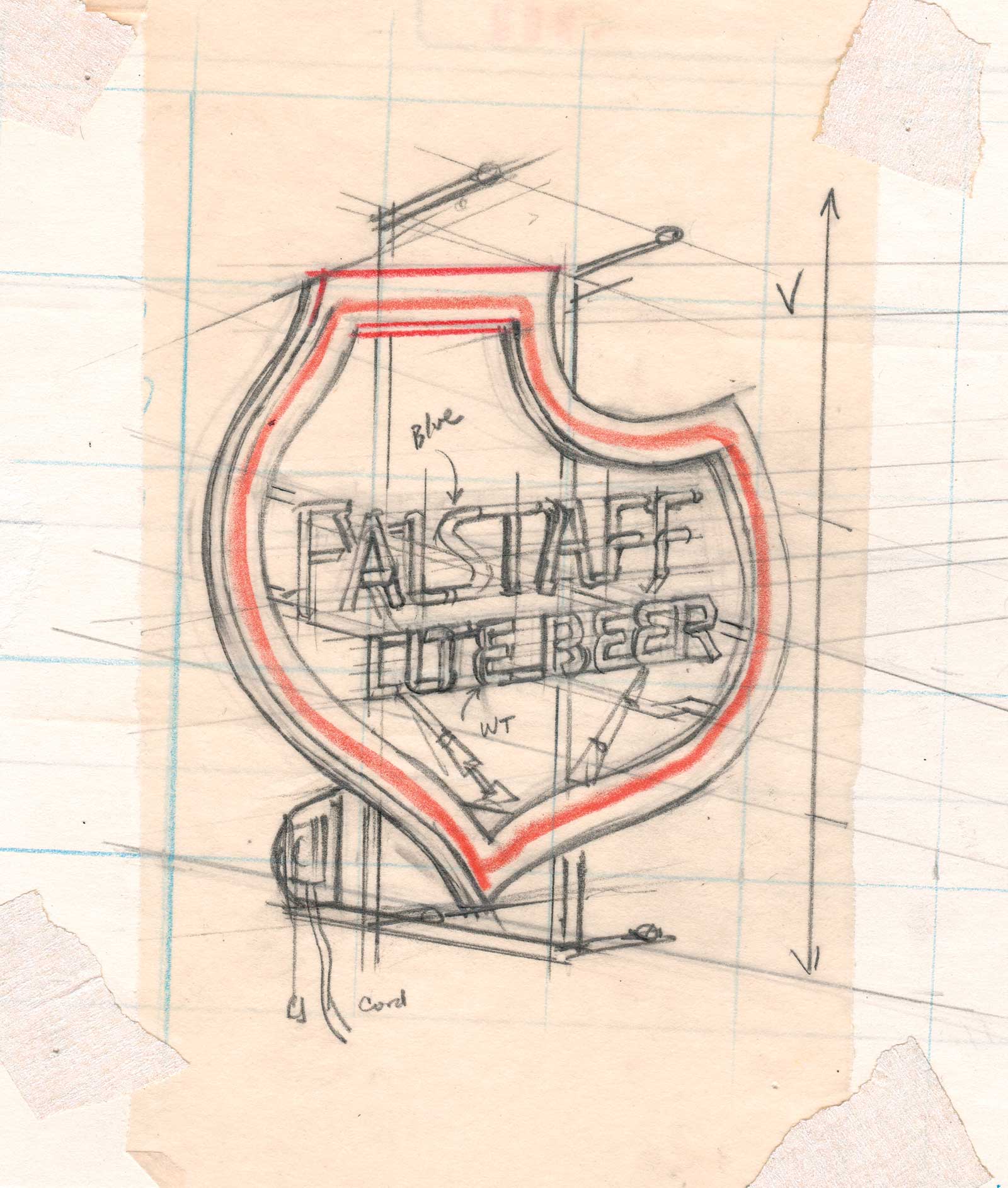
Far left: Falstaff neon sign, pencil on tracing paper, 5 x 4" (12 x 10 cm)
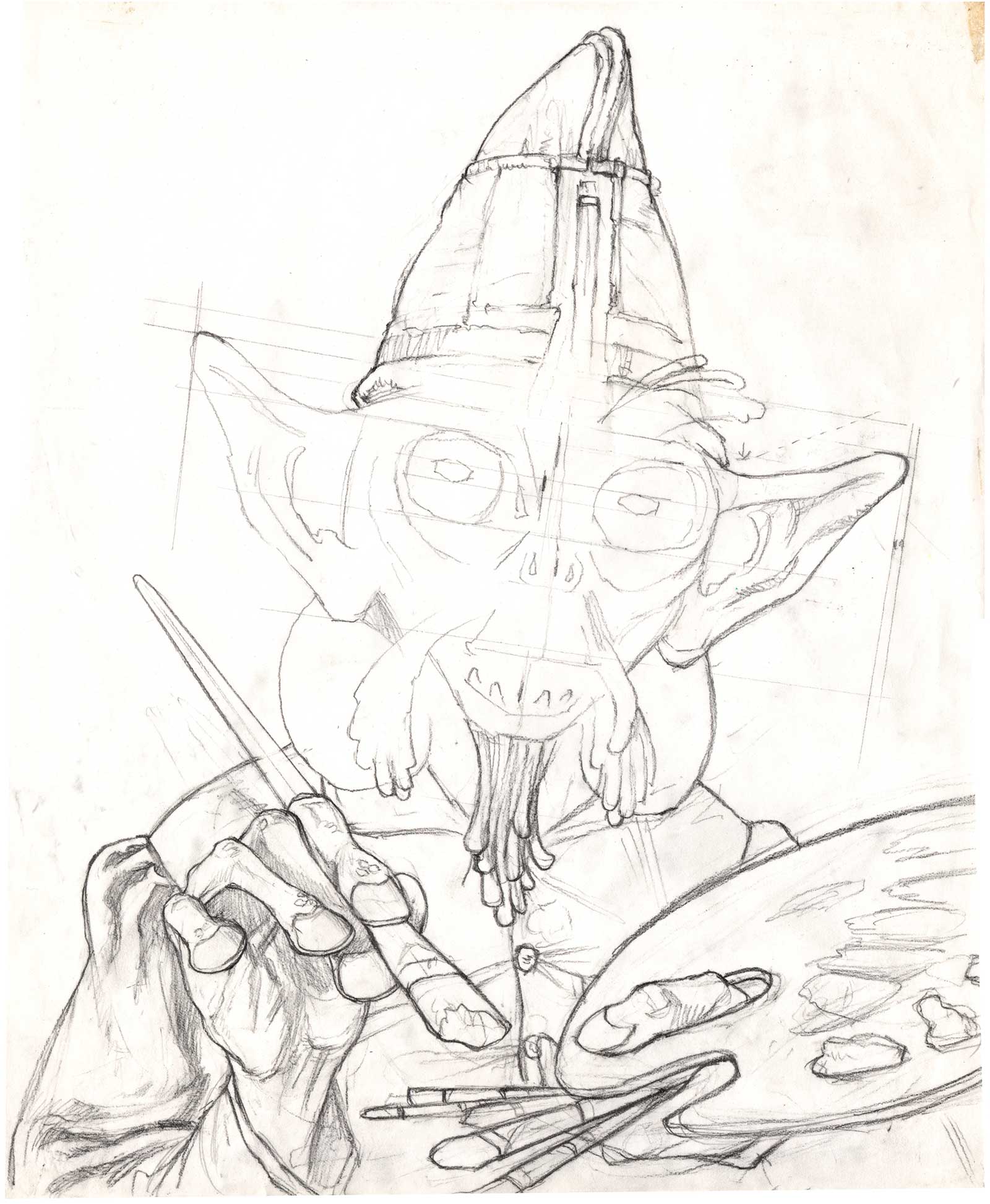
Elf tracing overlay, charcoal, 15 x 12" (38 x 30 cm)
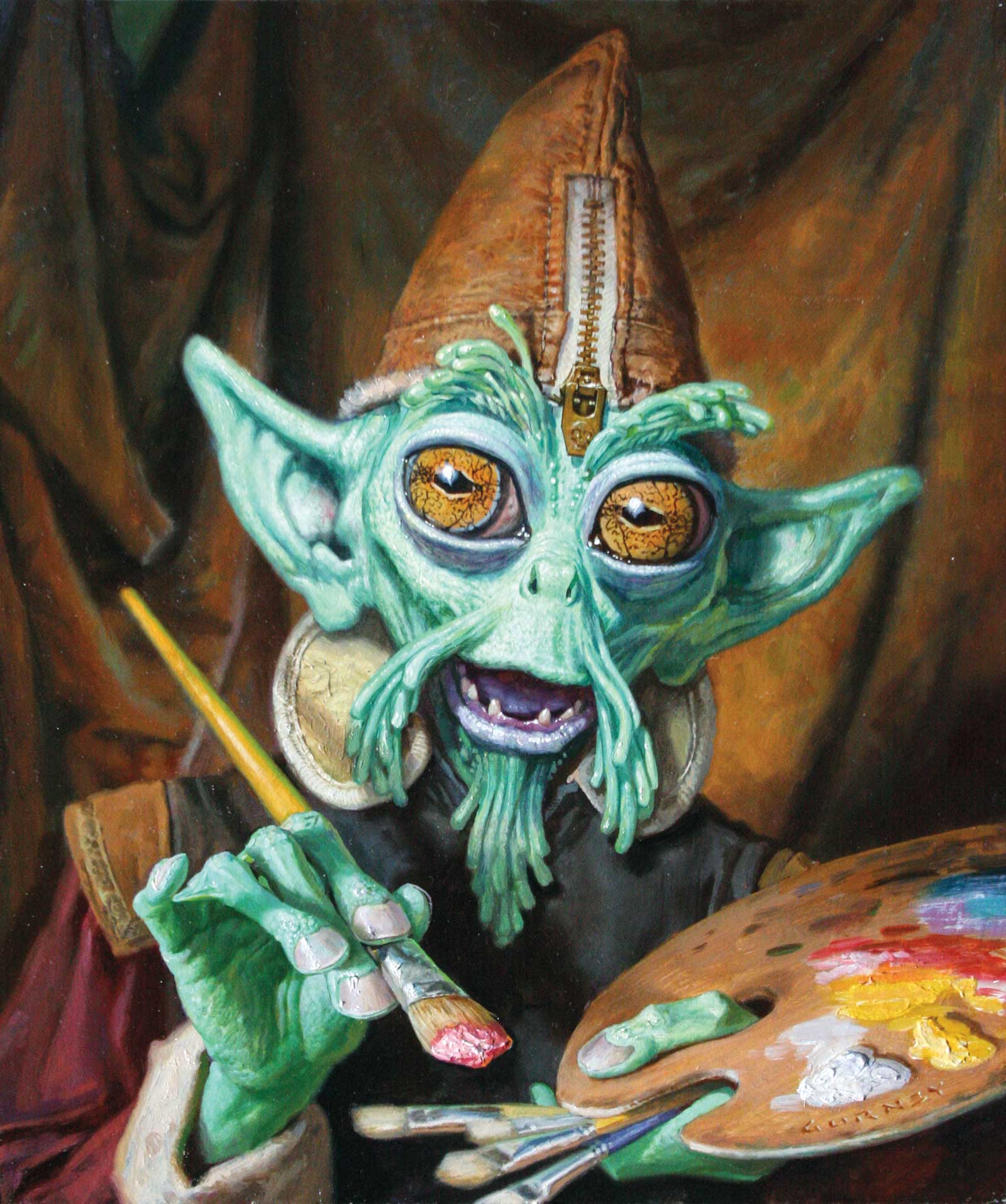
Outsider Artist, oil on panel, 15 x 12" (38 x 30 cm)
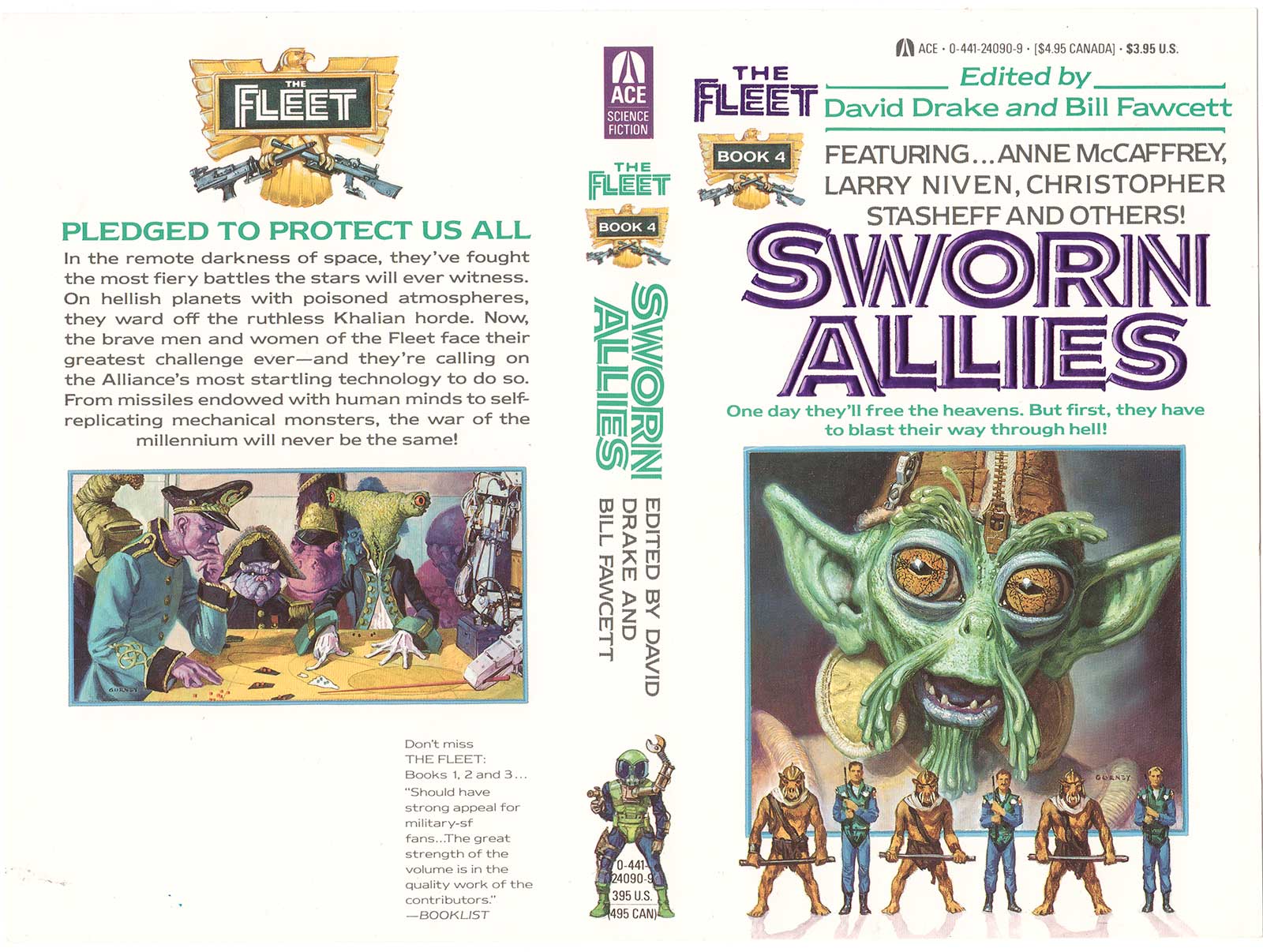
Sworn Allies, paperback cover.
Warrior Elf Becomes an Outsider Artist
An elf alien who made his debut on a military sci-fi paperback cover gets a new life as an “outsider artist.” The final image is a revision of a paperback cover illustration that involves a repaint of the oil original. Fortunately I had left some margin.The tracing overlay helps me figure out what I need to add. I extend his zipper cap, give him frog-like fingers to hold the brush in his right hand and a brush and a palette in his left. I transfer the drawing down to the board using homemade graphite transfer paper.
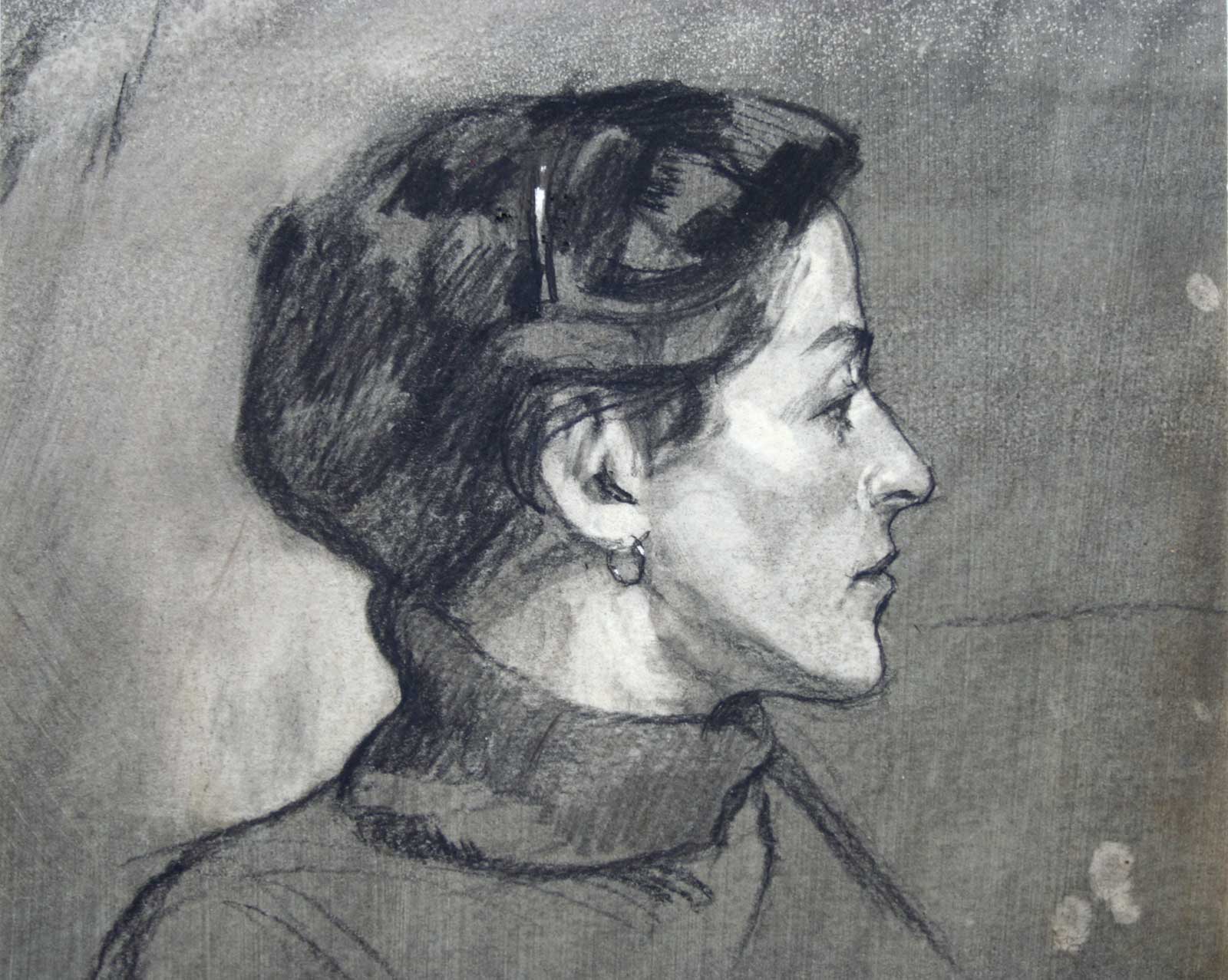
Jeanette, charcoal on tracing, 9 x 9" (22 x 22 cm)
Tracing as a Drawing Surface
Tracing paper has a smooth surface, so charcoal floats on the surface, allowing for a painterly technique. On a piece of tracing paper taped to a drawing board, I establish a tone with vine charcoal and brush it smooth with a soft rag. I draw the basic lines of the picture. I then lift the light tones out with a kneaded eraser. I try not to touch the surface with my hands, but there are a few stray touches of my fingertips on the lower right. Finally I add the last dark accents with a charcoal pencil. The surface is very fragile and easily disturbed, but it can be sealed with some workable fixatif. The fixatif overspray leaves white dots along the top.
Final Thoughts
Some artists and architects have replaced tracing paper with computer applications such as Photoshop. But many still use tracing paper in their regular practice, and I believe it’s worth a second look if you have never tried it or haven’t used it in a while. Are there still benefits to using tracing paper despite the convenience of digital methods? The answer depends on your personality and your process. For my own part, I enjoy using paper layers to develop complex images because it takes me down such a different path. The set of tools we use to make art influences the nature of the art we make, because each kind of tool calls for a different thought process. Or, to put it more simply, the toolset defines the mindset.
About the Artist
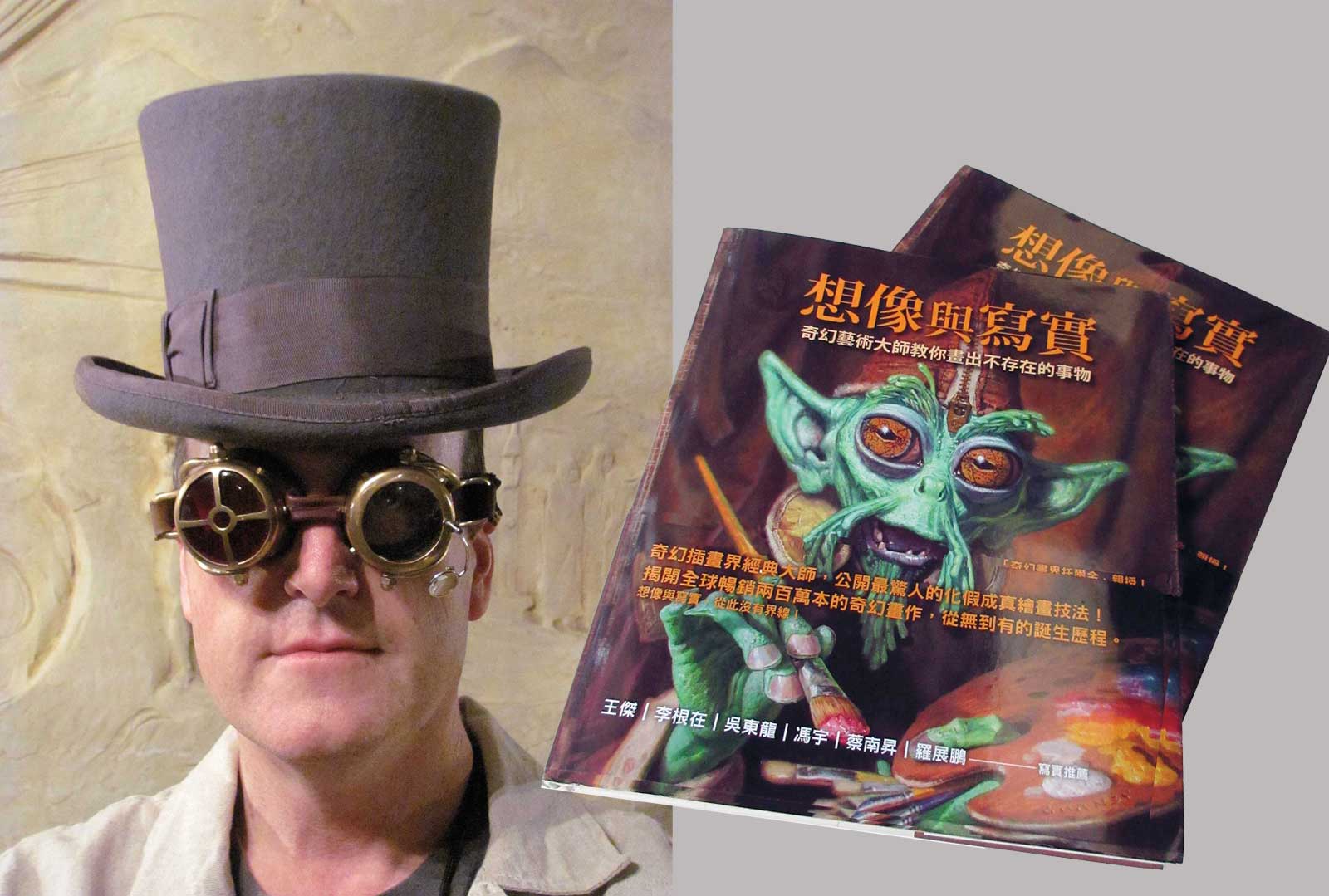 James Gurney
James Gurney reconstructed paleontology and archaeology for National Geographic. He has a dinosaur named after him: Torvosaurus gurneyi. His book called Imaginative Realism details the behind-the-scenes methods that he uses to paint realistic scenes of imaginary subjects. The book is available in Chinese, Korean, Japanese and Spanish, and is available signed to USA customers on his website: www.jamesgurney.com. Gurney is also the author of the Amazon #1 bestseller Color and Light: A Guide for the Realist Painter and Dinotopia: A Land Apart from Time.
Contact at
www.jamesgurney.com