After a lifetime of pursuing art, I have come to the realization that Edison was right, “creativity is 10 percent inspiration and 90 percent perspiration.” My style of scribbling is the result of years of drawing, teaching, experiencing life and developing my critical thinking skills. Every artist wants to know how they can be original and relevant in today’s art world. I taught art for 35 years and all my students wanted to be recognized and appreciated. My best advice to them was to work hard and draw every day. Don’t think about developing a style of drawing, just draw. After months of work, I could identify which drawings were Michele’s, which ones were Jeff’s, and so on.
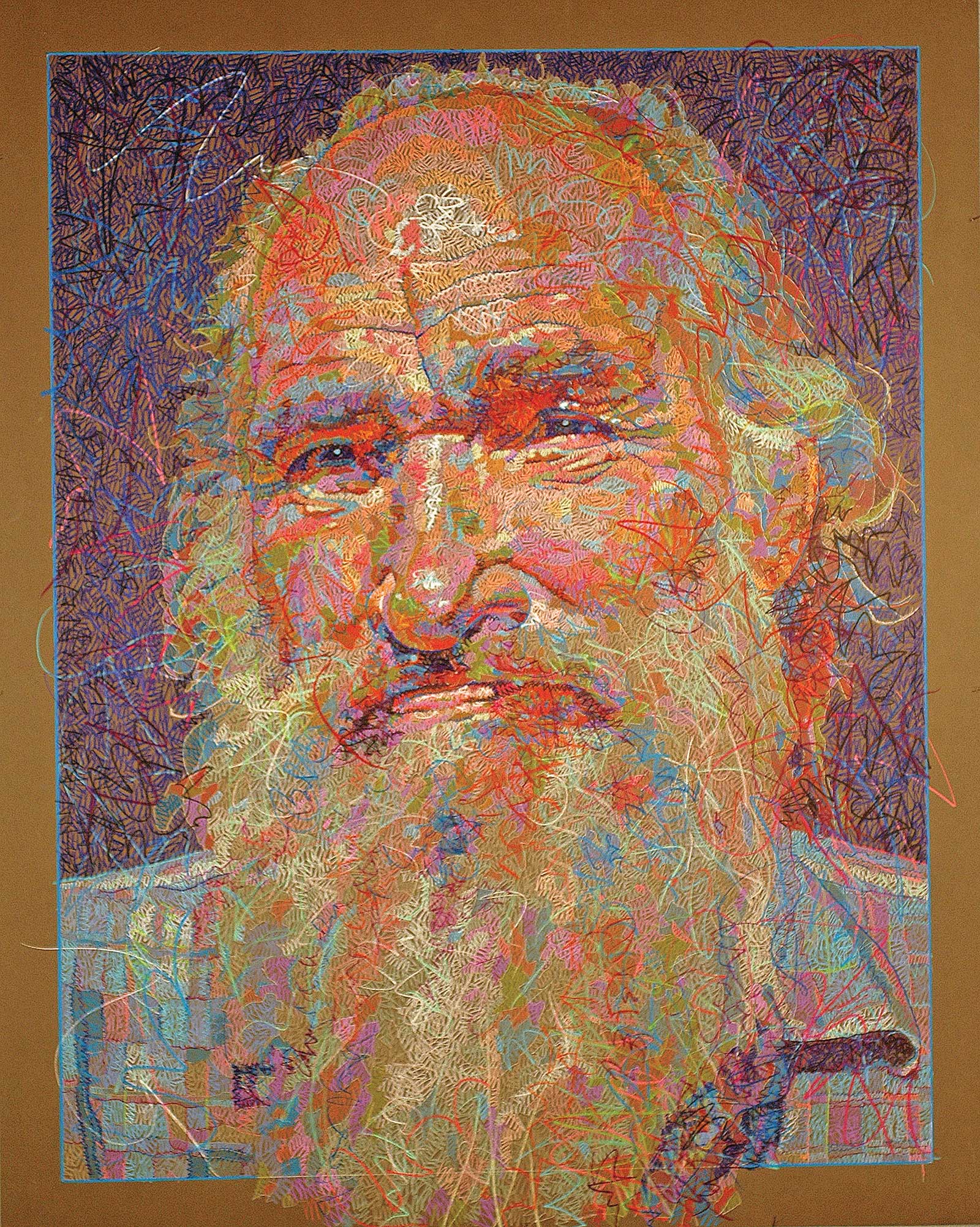
John, colored pencil, 40 x 32" (101 x 81 cm) I have completed several portraits of “John,” who would often visit his mom in my neighborhood. I met him on one of my walks in the development and we became friends as we got to know each other. He goes by “LJ,” little John, and I found him to be a unique model.
This was sound advice for students, but it didn’t address the final dilemma facing all artists. Who am I as an artist in my own time? To answer that question, you need to make a conscious decision about all aspects of your art. For me, that watershed moment came in a critique session with my colleagues where I introduced a new portrait created using colored pencils. I decided to change to a linear style of rendering with colored pencil that looked nothing like the highly polished renderings I had been doing up to that point. Everyone loved my new direction, but it was Tom Lehnert, the creator of our critique group, who gave me the advice that would change my work forever. He said, “John, you should think about scribbling. No two people scribble alike and an expressive line will add a dynamic quality to your art.” With that advice, I embarked on a new adventure that continues to grow to this day. I am always learning something new about line, color, shape, form, texture and pattern. I love what I’m doing now, and I totally enjoy my process and my product.
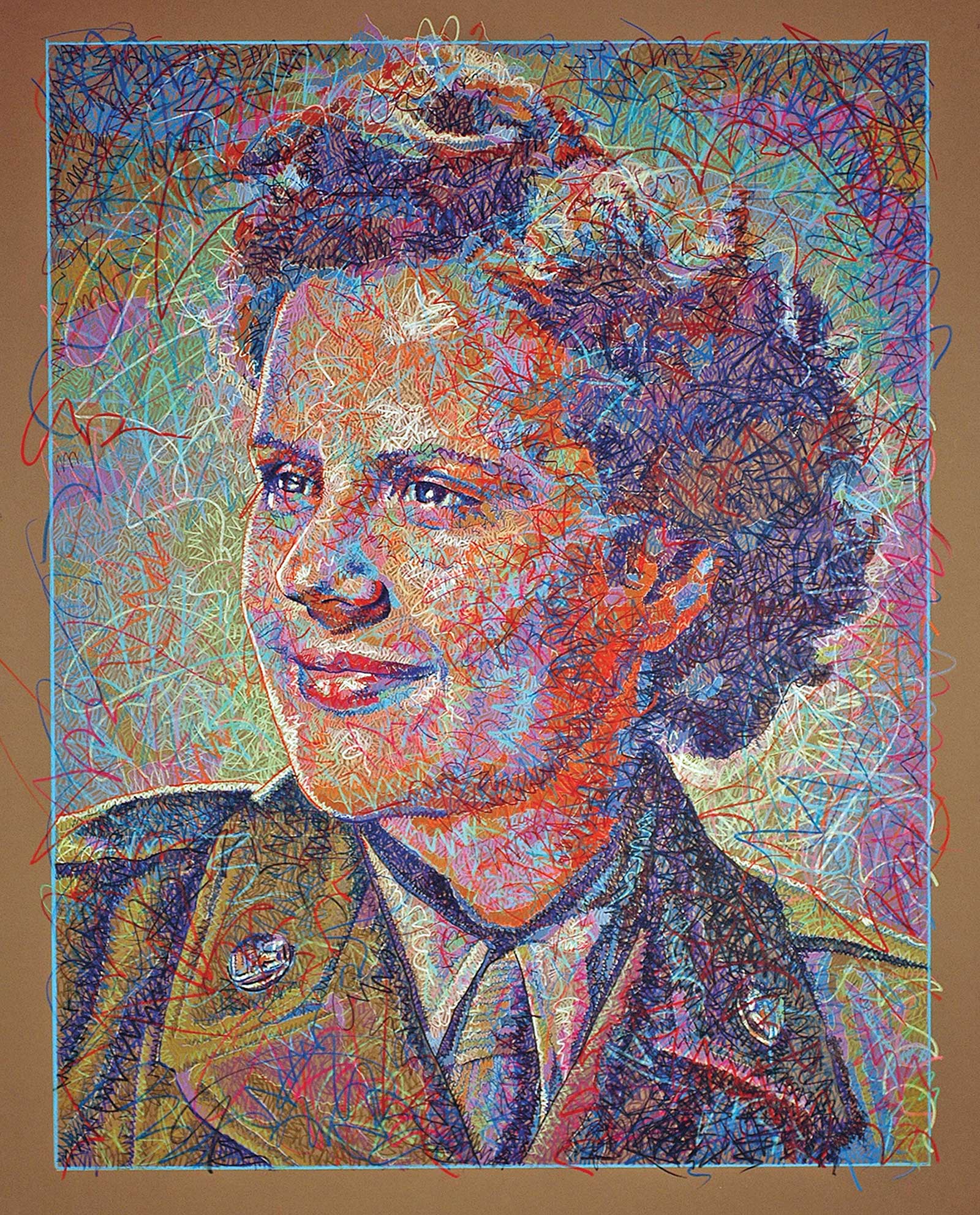
Aunt Sophie (A Band of Sisters), colored pencil, 40 x 32" (101 x 81 cm) This is a portrait of my Aunt Sophie when she was in the service during World War II. I had a small black-and-white photograph, as a reference, and I hope I captured the energy of this dynamic individual. She was a real hero.
I need to stress here that I was successful with highly polished rendering, but my work was comparable to other artists and needed a change. I created portraits, still-lifes and occasionally a landscape for subject matter. I continue to pursue my focus with scribbles and find the results to be much more expressive. The one thing that hasn’t changed is my initial line drawing of my subject matter. I would tell my students that they must create a successful line drawing as a foundation for whatever media they finally decided to pursue. Your painting is only as good as your line drawing. I painstakingly work on my line drawing, and once it is completed, everything else falls into place.
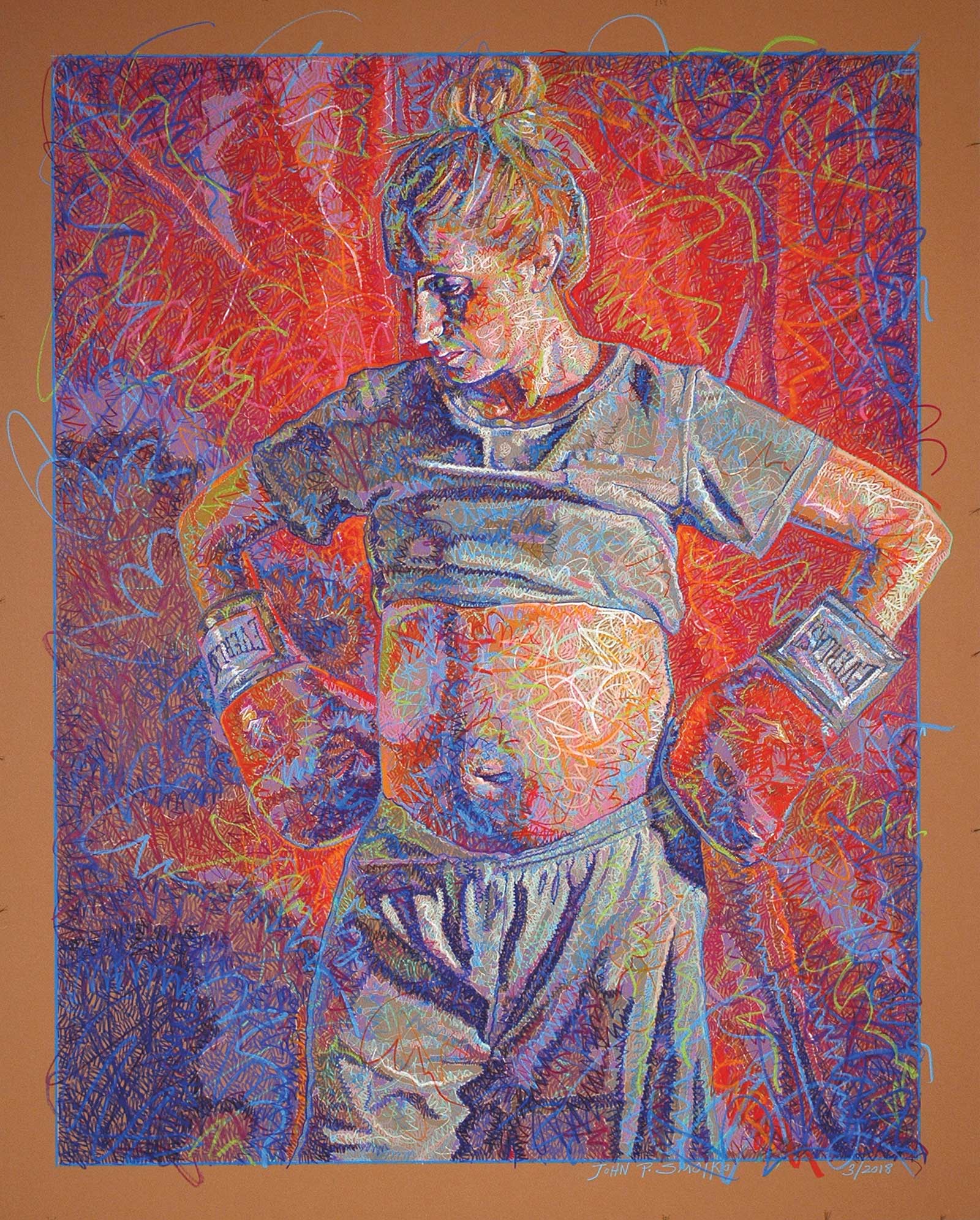
Round Two, colored pencil, 40 x 32" (101 x 81 cm) This piece is a portrait of my daughter-in-law, Katherine, when she was pregnant with my second granddaughter, Wren. Katherine is a dynamic individual and fun model to work with in my studio. I love my son, Matt, but my wife, Gigi, and I struck the mother lode with Katherine. We love her very much.
Everything about my scribble style derives from my art teaching. In “Art 1”, I taught my students how to crosshatch with pen and ink. It is that style that forms the foundation of my linear art. I call this layer my controlled scribbles, and I block in my entire composition with these groups of lines that fall in random directions. It is at this stage that I choose colors for the composition, and I strive to use the palette created throughout the work of art. A little of every color everywhere. Over this layer I will start to use a little more random mark making and strive to develop the forms in the composition. As the forms develop, I start to outline major shapes, in color, and accent major aspects of the work of art. It is this stage that took the longest to master—it was not easy to get comfortable with scribbling. My final stages have a variety of spontaneous lines that may run from one side of my composition to the other and even off the page. This is the part of the drawing I enjoy the most, where everything comes together. I love my job!
My Art in the Making My Left Hand Knows What My Right Hand Is Doing
 Stage 1
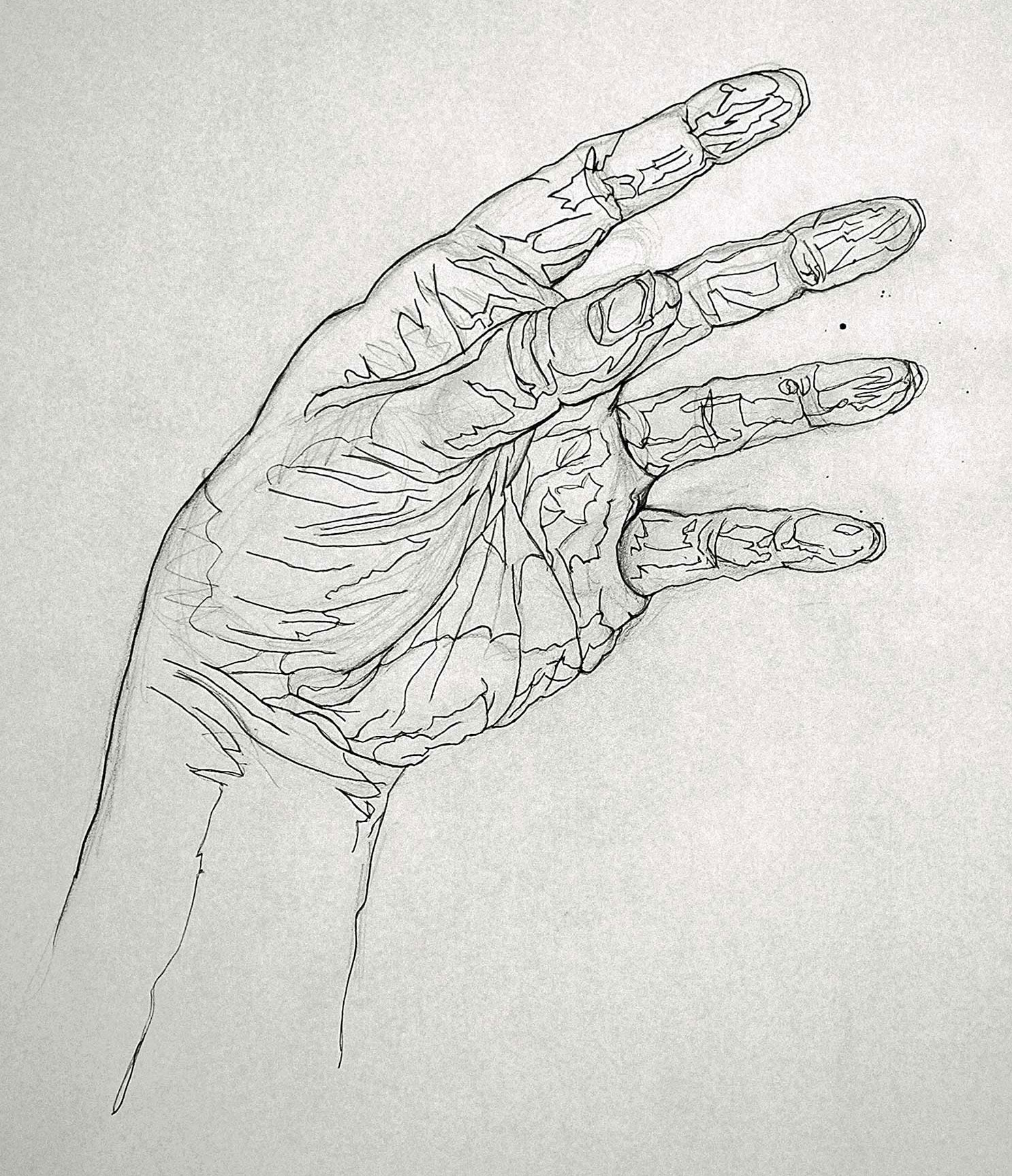
Stage 1 Initial Drawing
For this demonstration I decided to do a drawing of my left hand. I start with 80lb white drawing paper to develop my cartoon for my colored pencil work of art. With pencil I block in my guidelines and establish the placement and position of my hand. Over the guidelines I develop a detailed contour line drawing, and I find the shapes of all the visual characteristics of my hand. The shadows, middle tones and highlights, and every crease, fingernail and detail I see. The hand is now ready to transfer to the final surface. I decided to title this drawing, My Left Hand Knows What My Right Hand Is Doing.
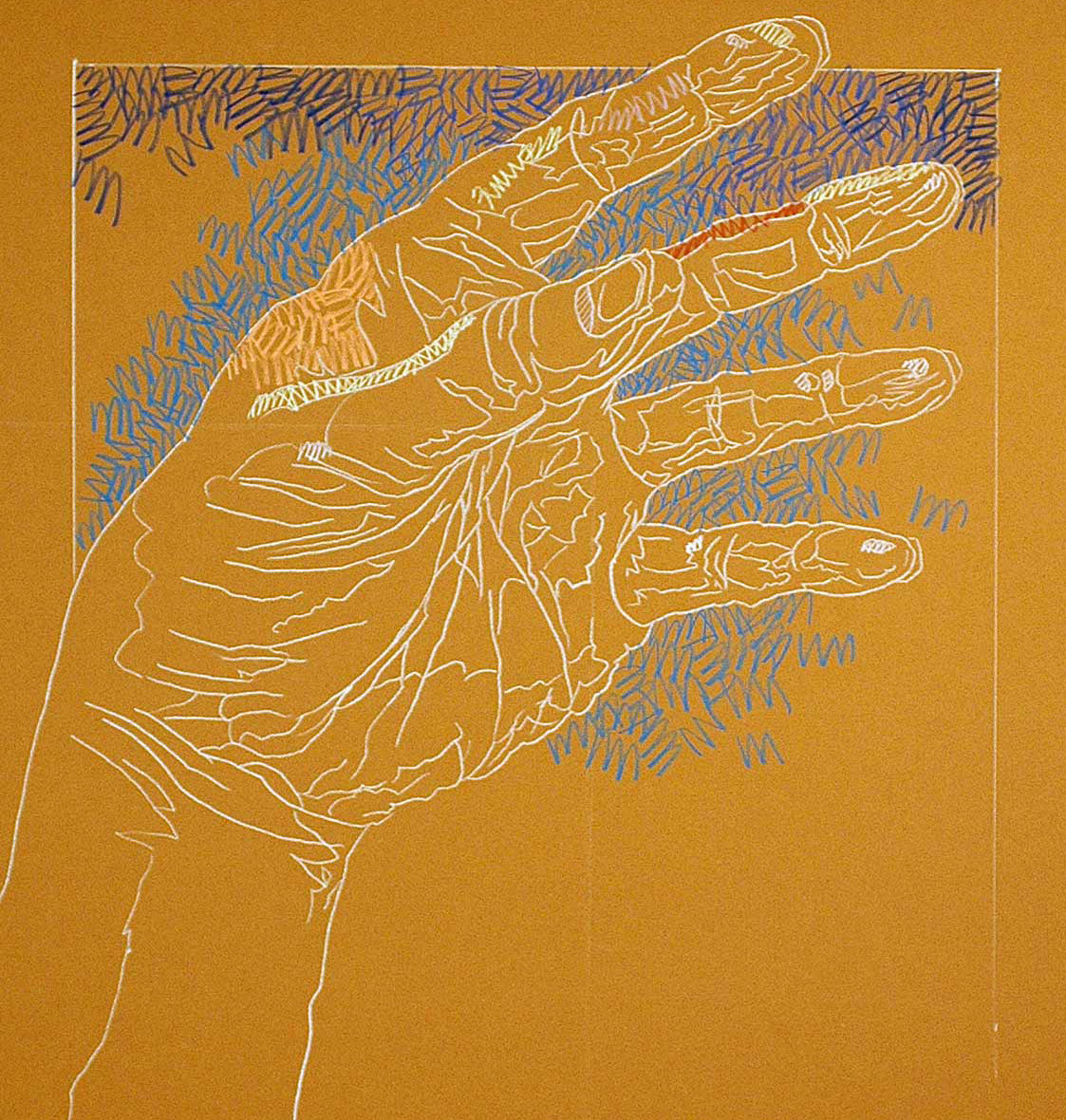 Stage 2
Stage 2 Transferring the Drawing
I transfer my drawing to a 24-by-20-inch sheet of oak brown Crescent RagMat. I use white transfer paper and position my hand exactly where I want it on the page. I also establish my border and start to block in my colors to determine my color palette. At this stage I am using small groups of what I call controlled scribbles, and I place them in random directions. As I developed my style of scribbling, I decided that every stage of my drawing needed to be linear for my art to hold together as a unit.
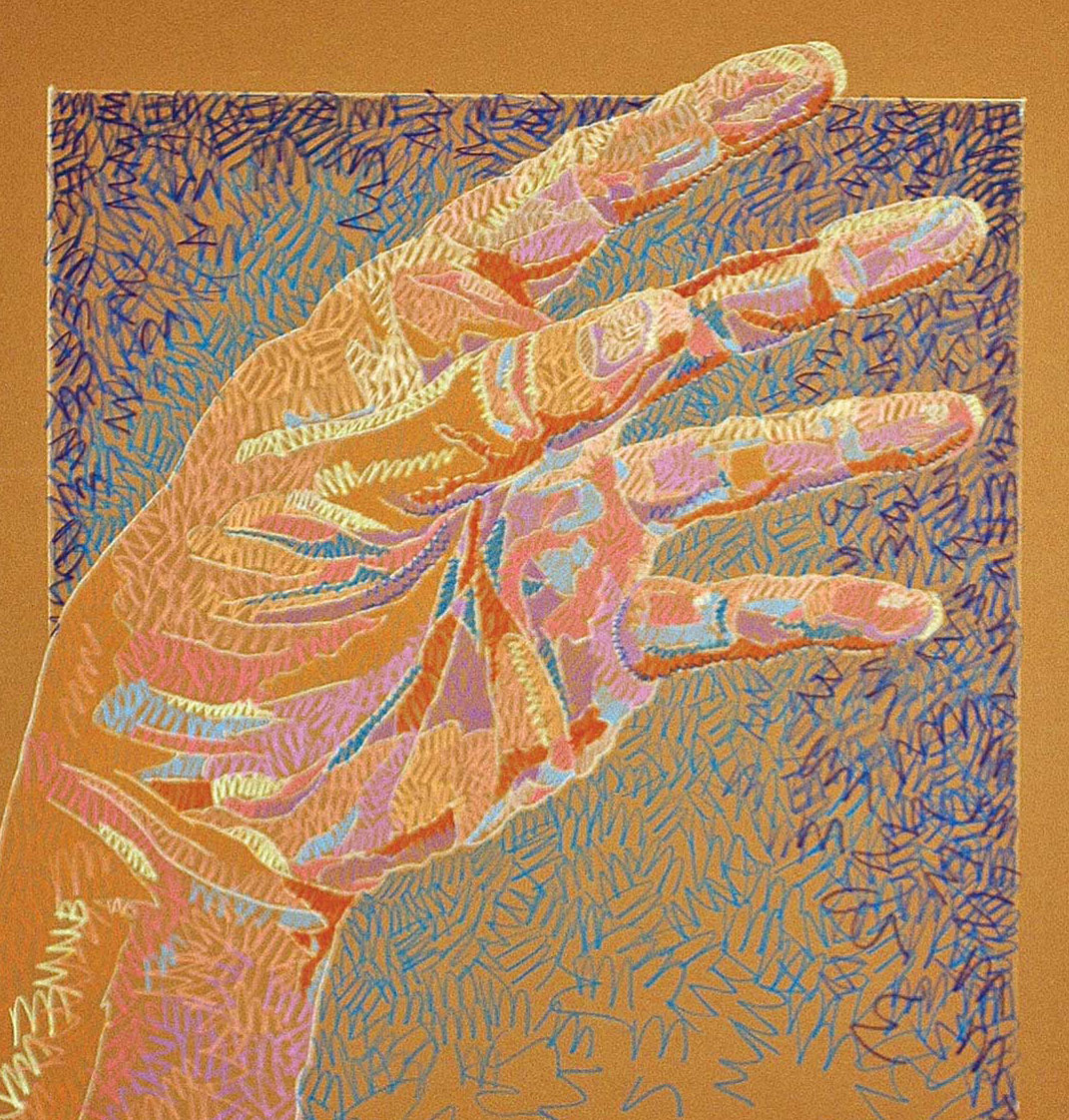 Stage 3
Stage 3 Establishing Color
I very rarely have an entire drawing blocked in as you see in this stage. Usually, a drawing will develop randomly with me focusing on centers of interest and developing some areas quicker than others. Here you see most of my colors established, and I’m starting to crosshatch darker controlled scribbles in the background. You also see a few lines getting longer and more spontaneous.
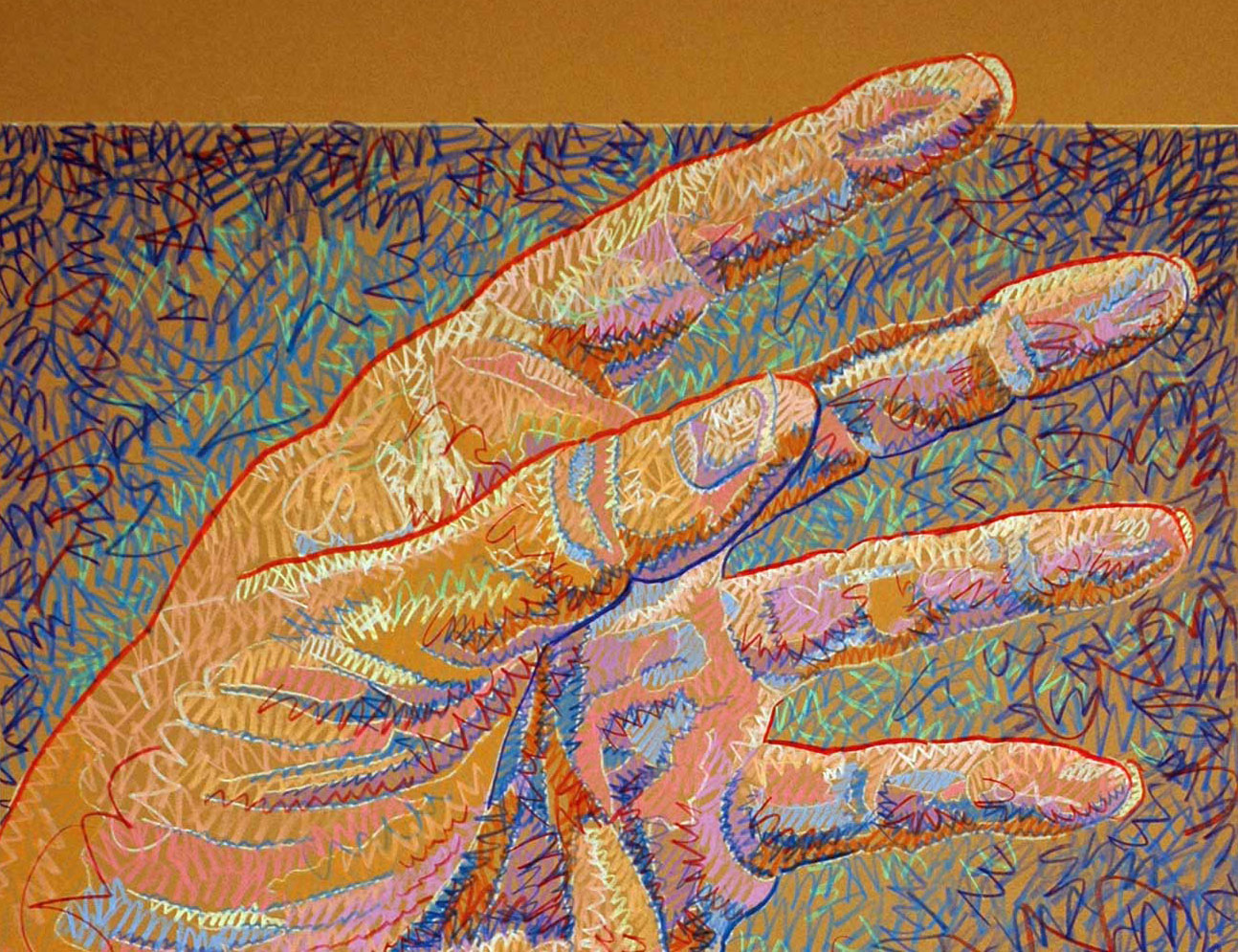 Stage 4
Stage 4 Building Form
Now I concentrate on developing forms and adding new colors to the palette. I am getting both lighter and darker as the drawing transforms and the lines get longer and freer. Shadows are established and outlined colors are used to enhance the contours. In this drawing I use red outlines for the light areas and blue outlines for the shadow areas. It’s worth noting that I am continually looking at my left hand in the proper light as I develop the composition. I do use digital references for most of my works of art, but always stressed to my students that drawing from life is preferred. And for goodness’ sake, if you use a reference, take the photograph yourself. (You can take the teacher out of the classroom, but you can’t take the classroom out of the teacher.)
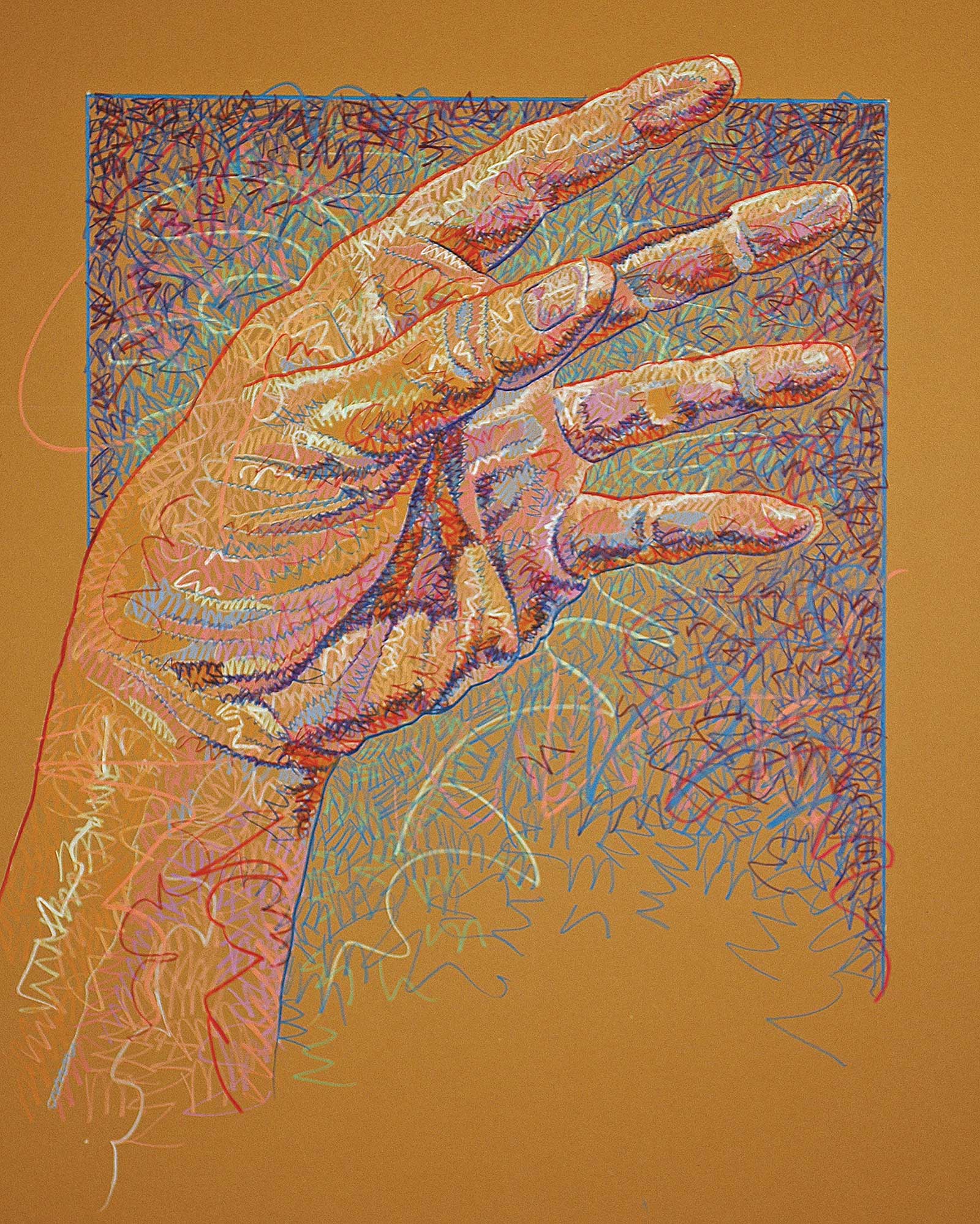 Stage 5
Stage 5 Thicker Lines, Enhanced Shadows
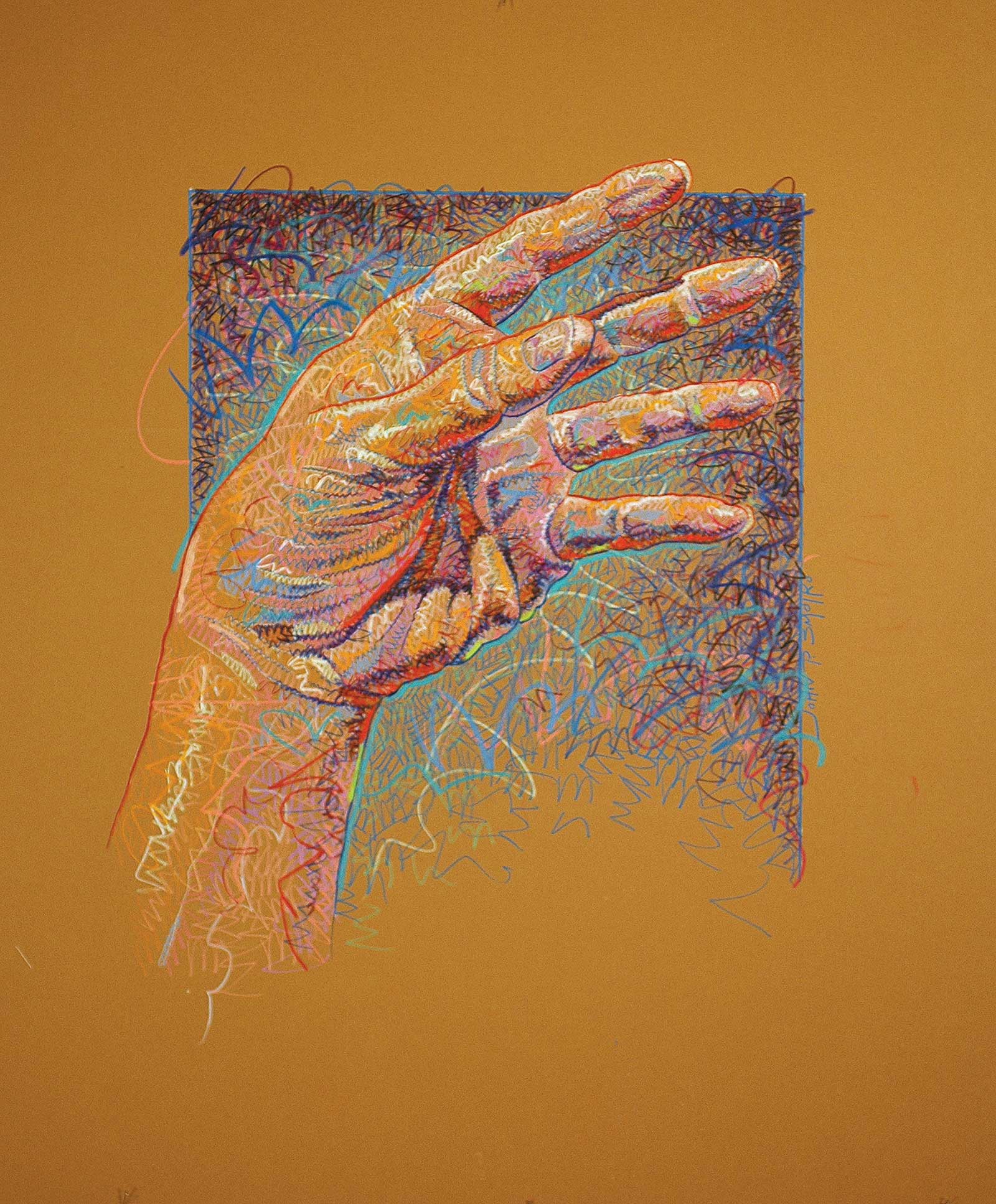
The appendage is further developed, and outlines are finalized on the hand and border. Lines get longer and thicker as shadows are enhanced. Longer lines take your eyes throughout the composition and even violate borders and outlines to add to the spontaneity. I strive to use a little of every color in my palette everywhere. I really have fun at this stage and enjoy the experience of mark making. I am one of those lucky artists who love their process and their product.
 Stage 6
Stage 6 Finished Artwork
My Left Hand Knows What My Right Hand Is Doing, colored pencil, 24 x 20" (60 x 50 cm)
In this final stage, colors are used to enhance the drawing and further develop the forms in the composition. In this phase of the drawing, I use Stabilo Woody 3 in 1 pencils for my thickest lines and most vibrant colors. There are only 18 of these wonderful colors, and I only use them for my monumental works of art. Stabilo pencils are acceptable for the Colored Pencil Society of America Explore This! competition, but not for the CPSA International Exhibition. Please “note” this for your personal works of art. I highly recommend these beautiful colors but limit their use to acceptable formats. My Left Hand Knows What My Right Hand Is Doing is complete and ready for framing. I urge all artists to learn how to comfortably draw hands, and please don’t leave the hands out of your figure drawings.
About the Artist
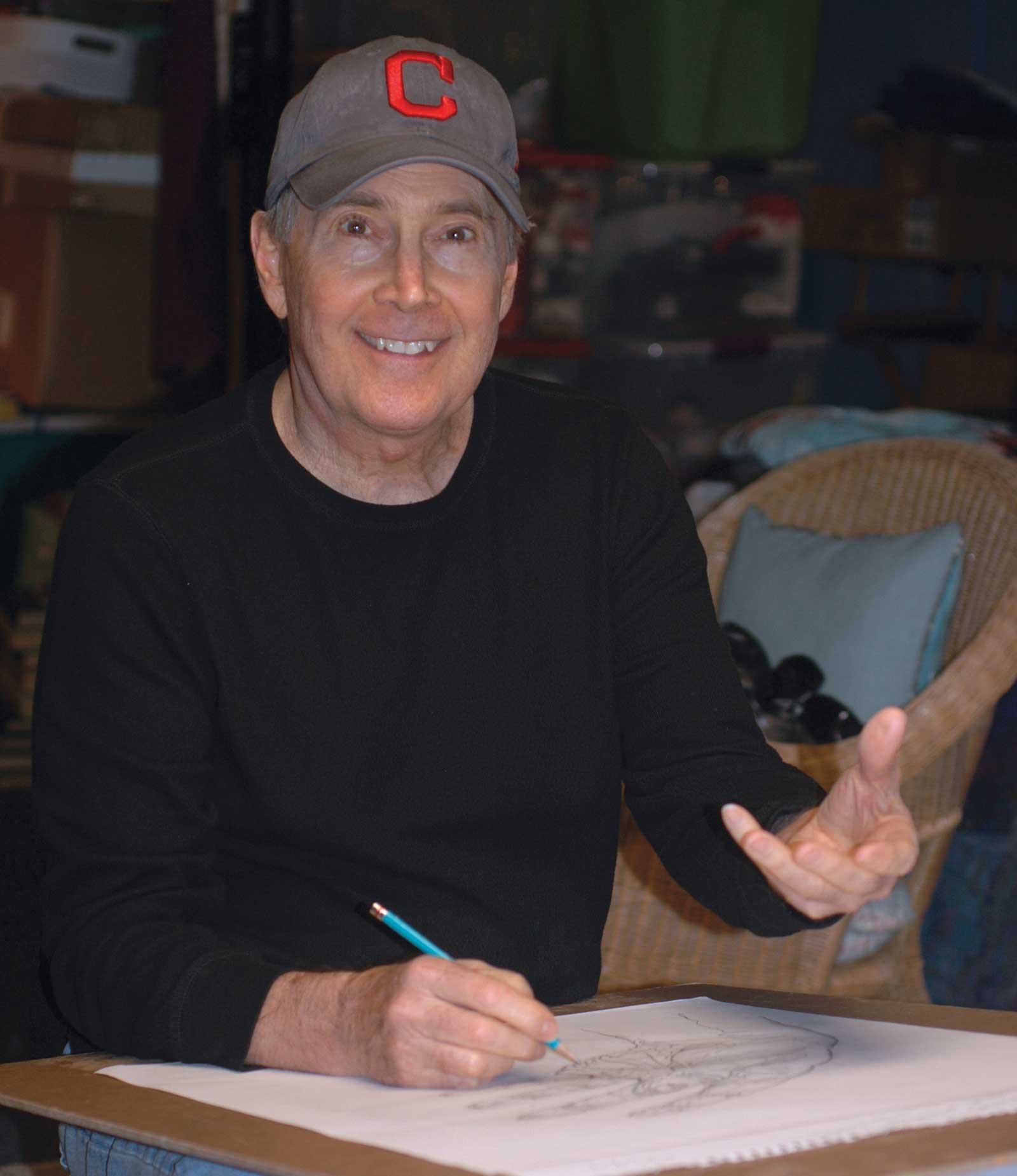 John P. Smolko
John P. Smolko spent 35 years teaching secondary school art education to talented young artists in Ohio. He retired in 2008 and presently enjoys working as a full-time artist exhibiting his art and providing workshops to those who want to experience the unlimited beauty of line. His art continues to be recognized in regional, national and international exhibitions. Smolko is associated with Group Ten Gallery in Kent, Ohio, and he exhibits with this group locally and statewide. He is also a signature member of the Colored Pencil Society of America where he participates in CPSA conferences and international exhibitions. Smolko is a member of several CPSA district chapters, and he enjoys sharing his knowledge with his colleagues. His colorful and spontaneous mark making has earned him numerous awards, and he has work in the permanent collection of the Butler Institute of American Art in Youngstown, Ohio, the Sargent-Laessig Museum of Fine Arts in Hinckley, Ohio, and the State Teachers Retirement System of Ohio in Columbus.