Egnoski: You received a degree in archeology and anthropology from Oxford University and then decided to pursue a career in painting. What led you to that decision?
Coreth: Drawing and painting was always something I enjoyed as a child. I graduated university quite young, finishing my final exams aged 20, so I thought I might take a year to explore my interest in painting before reverting back to archaeology to pursue a master’s degree. I had a particular interest in paleolithic cave art in Europe and San rock art in southern Africa. I went to study painting at The Florence Academy of Art, with short stints also at the Charles Cecil Studios and London Atelier of Representational Art. The introduction to traditional arts in Italy was enough to ignite a genuine love for drawing and painting. After three years of study, I felt clearly that I wanted to pursue a career in painting.
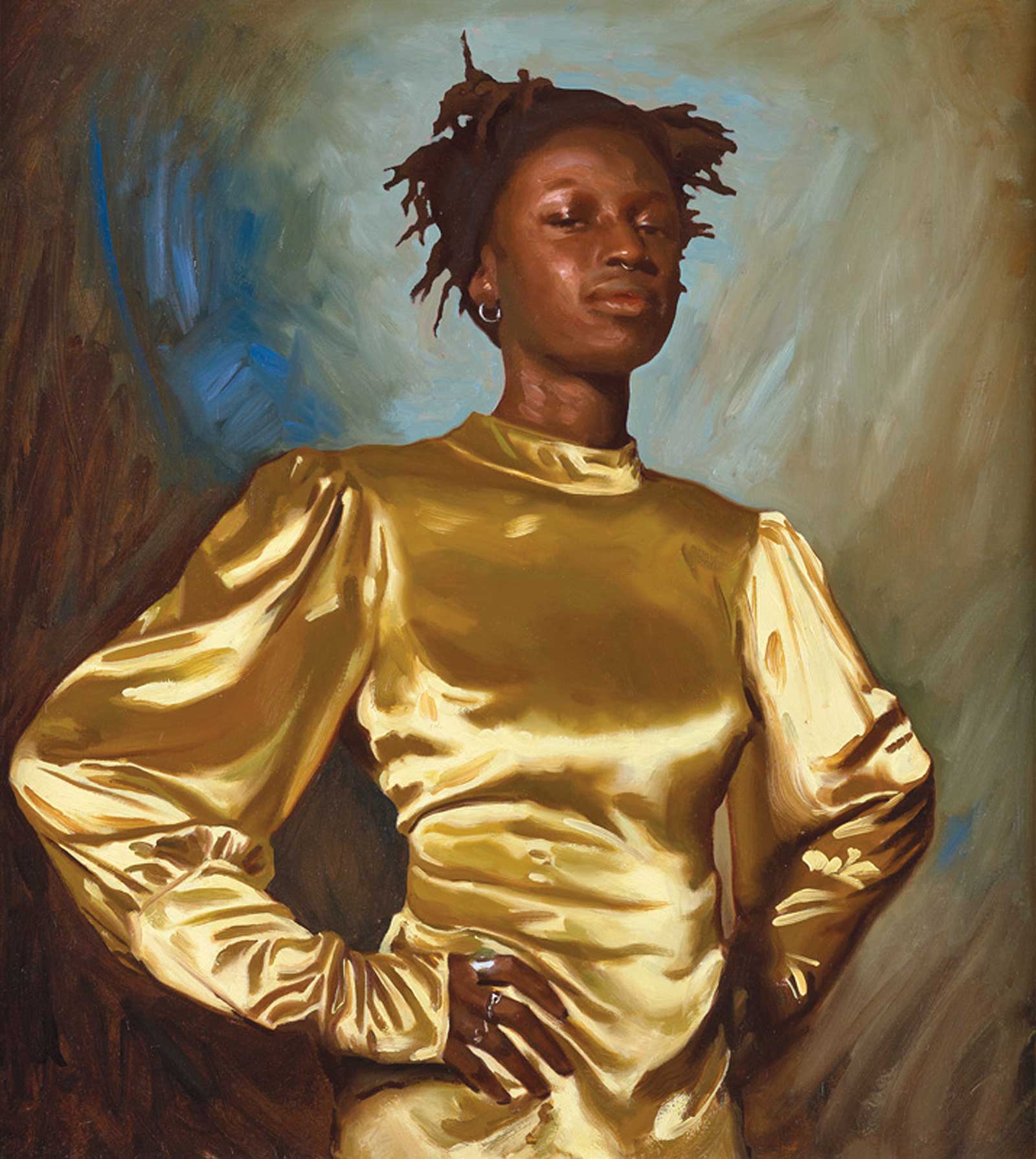
Jamie Coreth, Portrait of Fatima, oil, 28 x 25" (71.1 x 63½ cm)
Egnoski: Your paintings are a beautiful blend of traditional portraiture mixed with a modern vision. Was that an intentional decision on your part, or did it evolve over time?
Coreth: Thank you! I think it has evolved with time and the ingestion of interests in many different artists and concepts. I very much focused on improving my technical practice with close reference to certain 18th- and 19th-century artists. The traditional elements in my work have slowly improved over time. The paintings that I feel happiest about are ones where I had imagined something of the feel of the picture ahead of time and tried to paint it in line with that feeling. I suspect any vision I have for a painting has something of a modern feel about it, and I sometimes find that concepts are best expressed by stepping away from pure visual realism. I quite like to mix naturalism with some abstracted elements.
Egnoski: Your Portrait of Fatima was shortlisted for the BP Portrait Award and was selected for the catalog cover and marketing campaign of the National Portrait Gallery as well as received the Visitor’s Choice Award. What qualities in the painting do you think lent to the universal appeal?
Coreth: It’s a little hard for me to say. Every picture I paint takes a lot of effort, and it’s sometimes a little mysterious to me why some pictures are received better than others. I think in this case, the high value contrast of the golden velvet shirt, sharp outlining and balance of marks in the body, head and background help to give it some appeal.
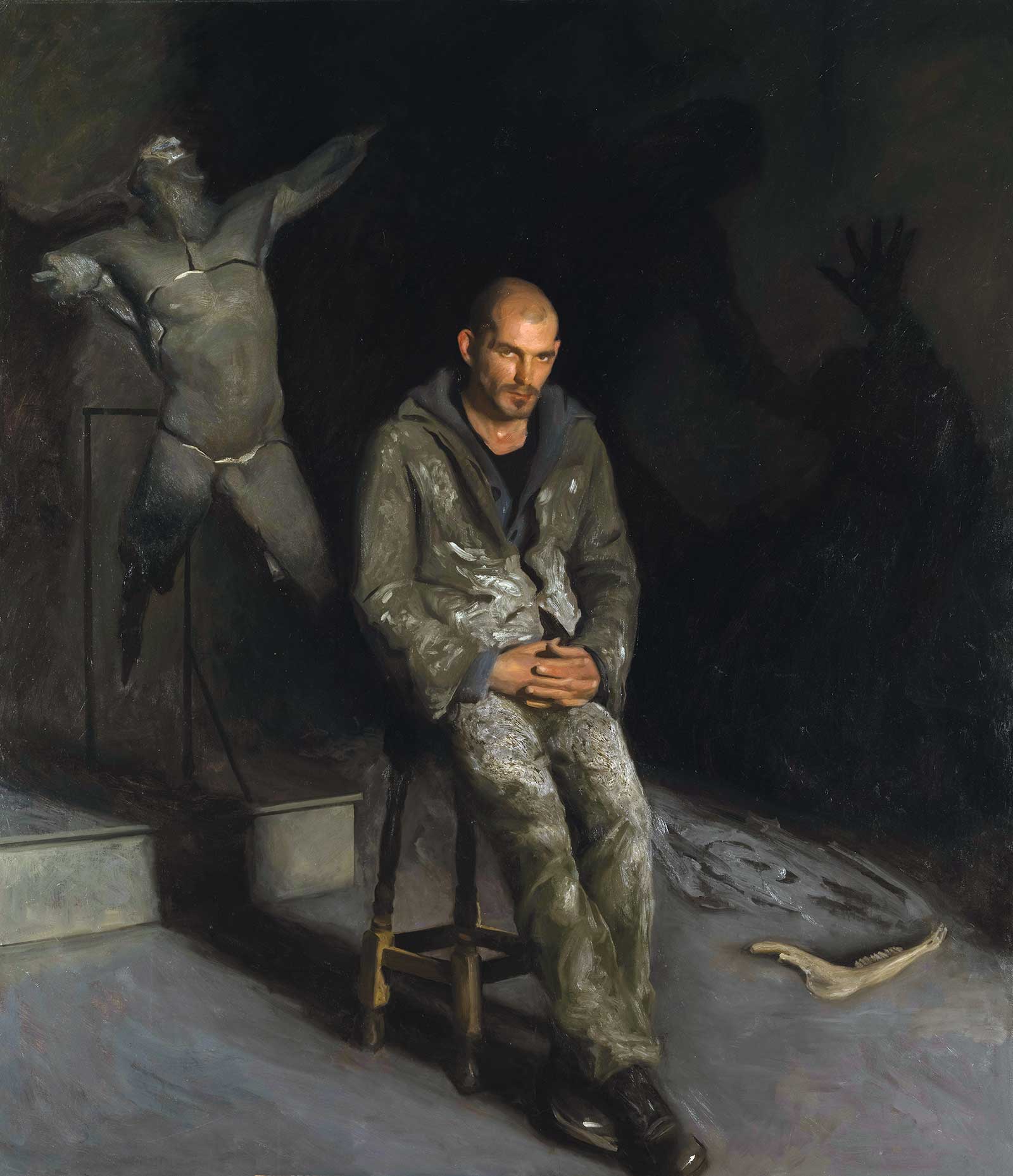
Jamie Coreth, Broken Bodies, oil, 87 x 75" (20½ x 190.7 cm)
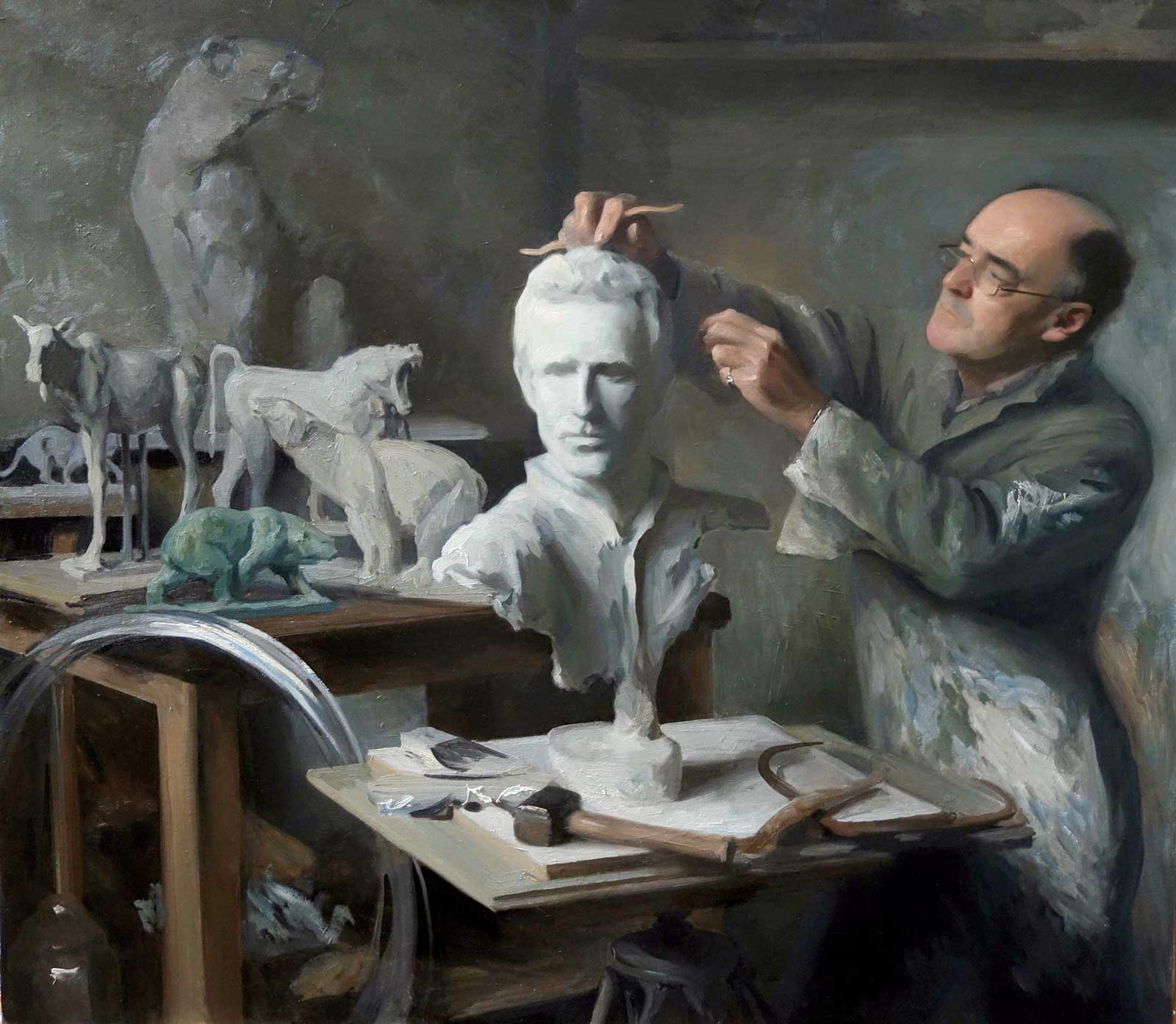
Jamie Coreth, Dad Sculpting Me, oil, 41 x 47" (104.1 x 119.4 cm)
Egnoski: Two years before entering the Portrait of Fatima, you were accepted into the BP Portrait Award with a painting titled Broken Bodies. Can you tell us about the inspiration behind this portrait?
Coreth: This is a portrait of a good friend of mine. I briefly lived with him in his studio barn in Wiltshire. He was formerly a soldier in the parachute regiment before becoming a sculptor. He was severely injured, particularly in his hips and legs, after his parachute failed to fully open, and his military career was consequently cut short. The picture shows him in his studio, with one of his sculptures behind him. It had already been cast and the clay had cracked across the hips and across the heart, so I felt it an apposite inclusion into the painting. In the looming shadow behind is an indication of a sculpture that he would one day like to make, of Cain and Abel, referring to the origin of conflict. I painted him over the course of a couple of months during winter, after dark. I remember it was absolutely freezing in the barn, making our sessions each day short, but it was one of the best times I’ve had painting any picture.
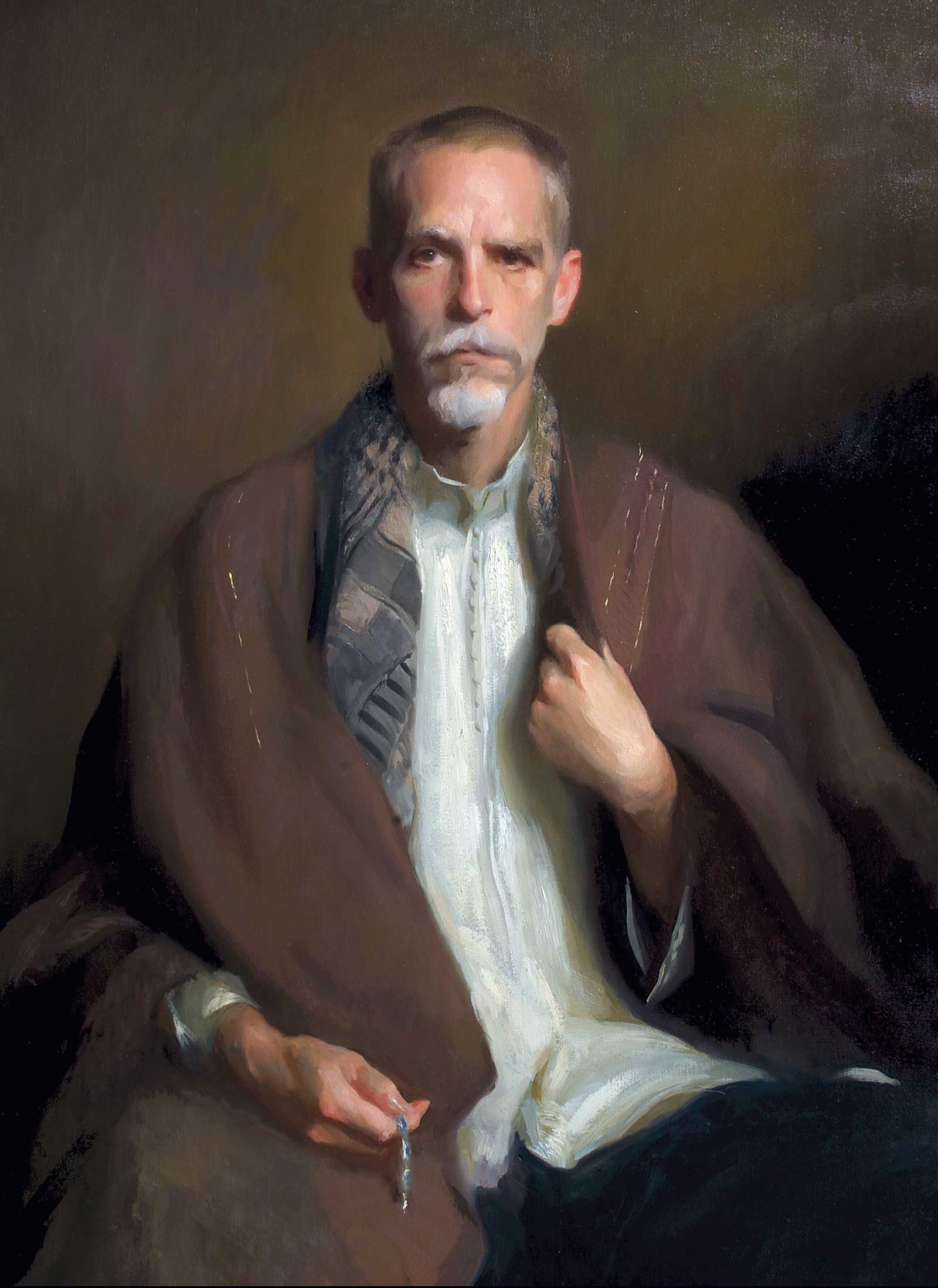
Jamie Coreth, Mark Abouzeid, oil, 45 x 38" (114.3 x 96½ cm)
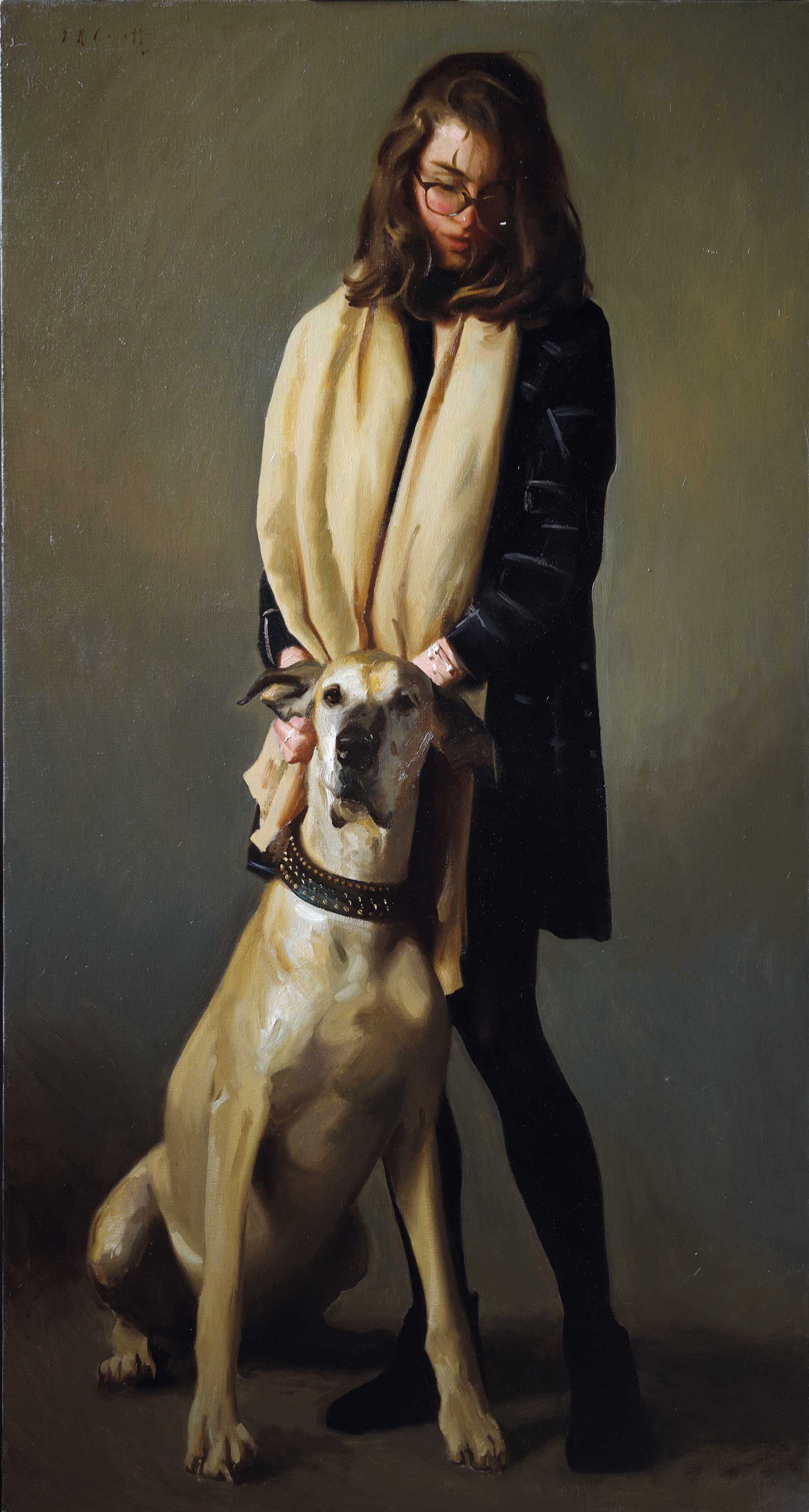
Jamie Coreth, Georgia McVeigh and Myrtle, oil, 601/8 x 321/8" (152½ x 81½ cm)
Egnoski: In 2016 your portrait Dad Sculpting Me was awarded the Young Artist Award. This painting portrays an endearing story of your father, who is a sculptor, sculpting a bust of you. I understand it was done from life. Do you always paint from life, and why do you think it’s so important to do so?
Coreth: When I started painting professionally, any progress I made on a picture was entirely reliant on someone sitting in front of me. The point of a painting is to capture a feeling of some kind. For me, I love capturing some sense of someone being there. If you close your eyes and think about the experience of being with someone, it’s not exactly highly photographic, but is in some way emotive. Color perception is subjective, and one can see colors in life that simply do not exist in a photograph. I have from time to time painted experimental self-portraits to push color and see what you can get away with without detracting from the naturalism of the portrait. For example, a strong teal green can exist along the contours of a face if the subject is in front of a strong red background.
Over the past few years, painting commissioned portraits has required me to find ways of incorporating photography into my practice to reduce the number of sittings I require and to relieve some of the pressures that come with painting on commission. A third of my paintings are an absolute breeze to make, however, the other two-thirds are very difficult indeed, and I often restart pictures or do battle with ones which are not quite right. To allow yourself to create a picture in a way that resonates requires feeling free for a picture to be a failure, and to cast it aside or start again. This is virtually impossible to do with a commissioned portrait, when there are time pressures, deposits paid and requirements to deliver your best. Therefore, photography can buy you time to work in private, and paint poorly, so that you can find the path to painting something well. The main problem of working from photography is that you end up wanting to make the painting look more and more like a photograph, which, as above, is not the goal. My approach now is still to have a number of sessions from life but in addition to painting the main picture, I paint miniature color studies focused on capturing the qualities which can only be painted when working from life. I also film footage of the sitter during those sessions which I replay on an iPad when they are not there. I find this is better than a photograph as you get all of the little head movements and expressions, which may contain the key to the success of the portrait.
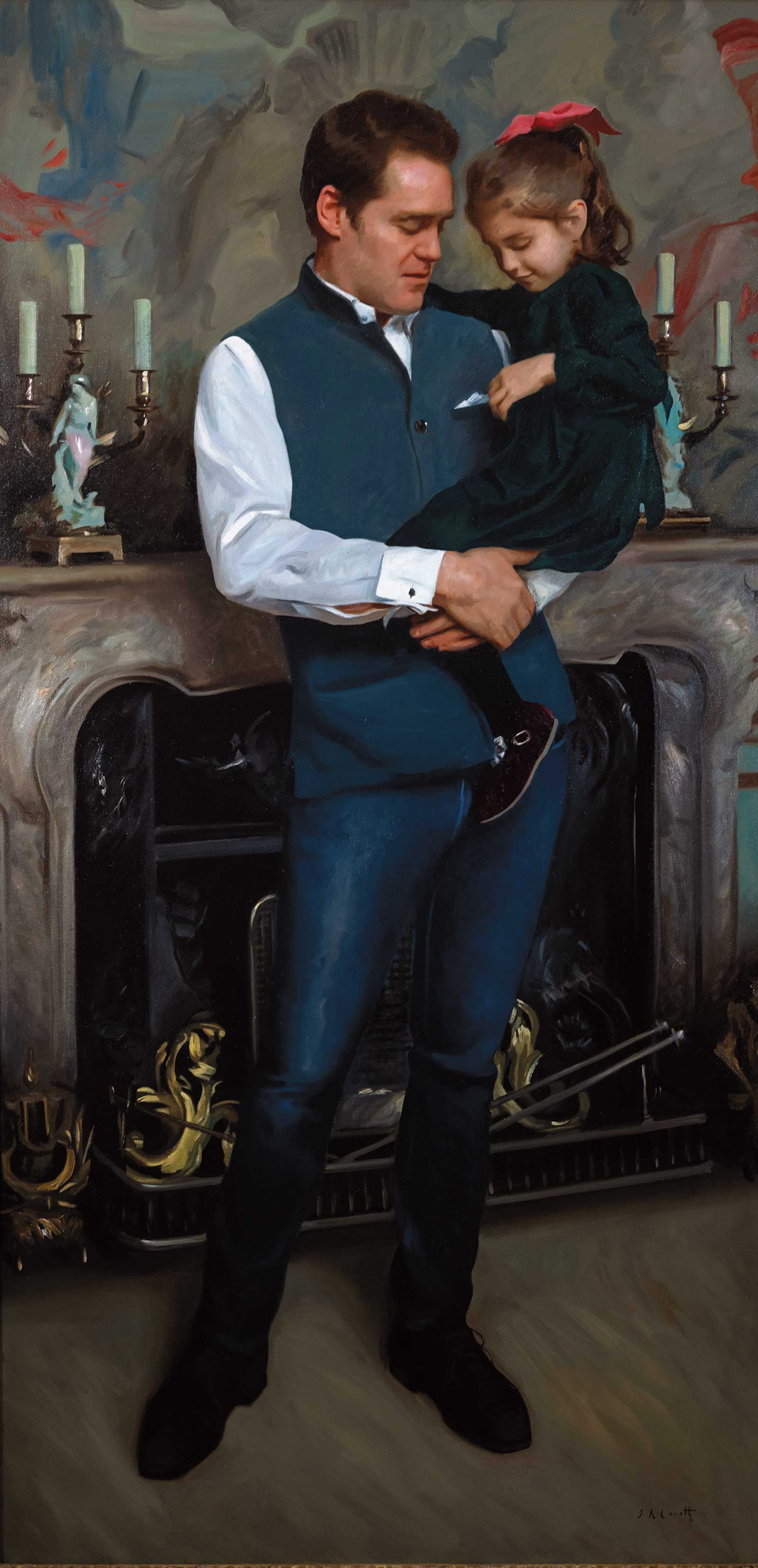
Jamie Coreth, Charles Innes-Ker, 11th Duke of Roxburghe with his daughter Gigi, oil, 865/8 x 433/8" (220 x 110.2 cm)
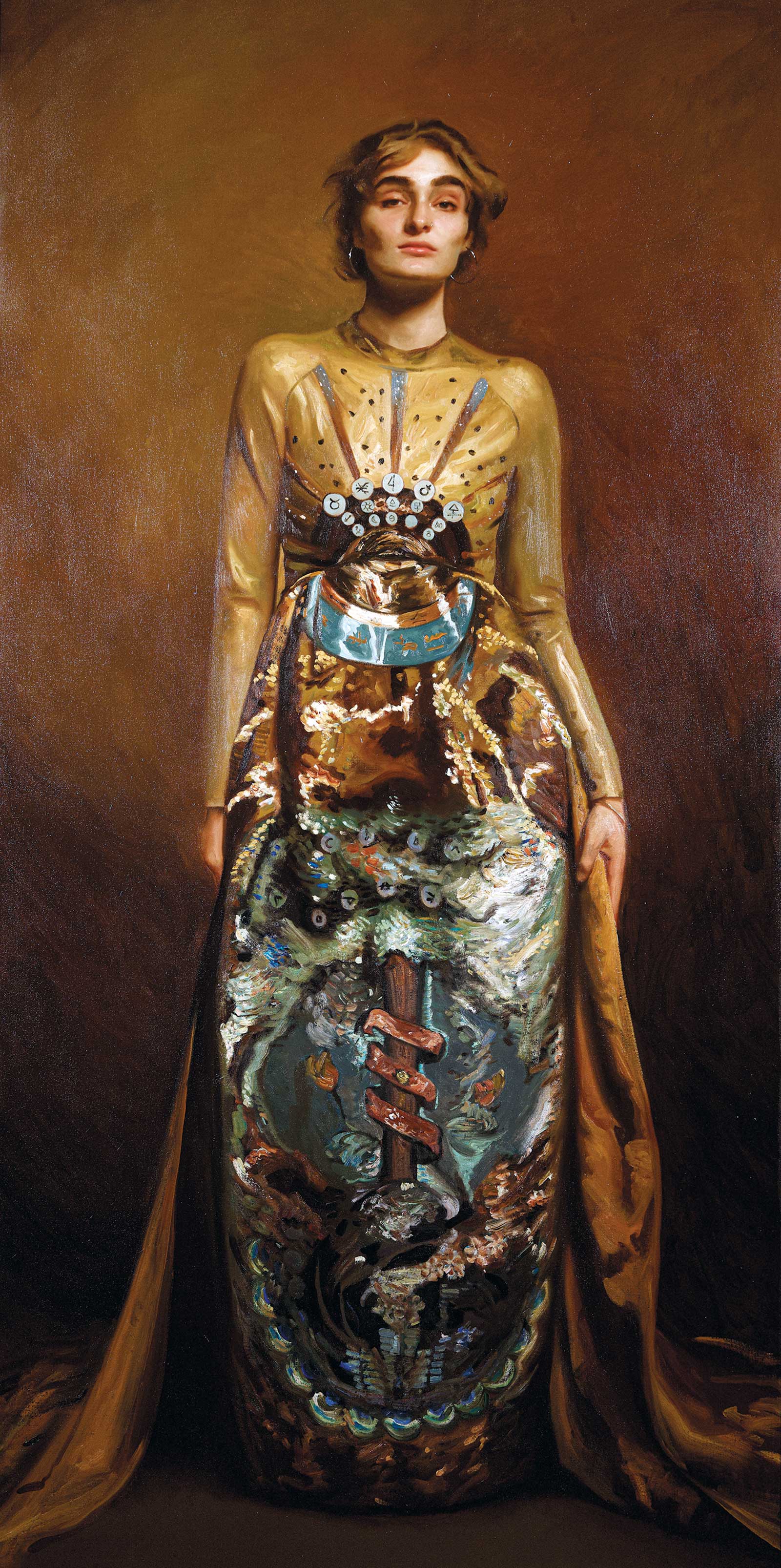
Jamie Coreth, Yasmina Zanasi in Mary Katrantzou’s ‘Alchemy’ dress, oil on linen, 865/8 x 43¼" (220 x 110 cm)
Egnoski: When viewing your portraits, you get a sense of the whole individual and not just a likeness in the face. How do you achieve this (by the pose, composition, etc.)?
Coreth: The key to this is certainly to get back from the picture whilst painting it—and get back as far as you can. If you can take in the whole of the subject and painting without having to move your eyes around too much, you will notice which bits of the picture are overly rendered or untrue to the look of the figure as a whole.
Egnoski: Do you have a message or piece of advice for a young person just embarking on a career in the arts?
Coreth: Be sober about the realities of the business of selling art and understand as best you can about what you need to turn over before breaking even. Costs for an artist, particularly in an expensive city, are not insignificant. Hard work is an absolute requisite, but the harder you work, the more you enjoy yourself and the more you sense progress. It’s a rare thing for me to enter the studio and feel fully ready to paint, but so long as you start work, the motivation will eventually kick in.
Social media is a really poor distraction and carries the danger of convincing you to paint pictures to catch on Instagram rather than pictures which are meaningful to experience in reality. If you want to paint pictures with any sense of authenticity, try to draw your creative inspiration from places other than what you see online. —
Christine Egnoski has been the executive director of the Portrait Society of America for 24 years. She recently interviewed artist Jamie Coreth in his studio in London.