



Whenever I get a chance to work with a live model, I ask their permission to take photographs even when they are not posing. Many of my favorite works have been from those references I took during a model’s break time, showing their natural postures and expressions. This drawing is from one such reference. Before I begin, I generate an ideal image of the subject in my head, which diverges in various ways from what is captured in the reference. I work on a thumbnail sketch to ensure that what I imagined will work in the actual drawing. During this process, I also choose the right material for the work based on the image.
 Stage 1
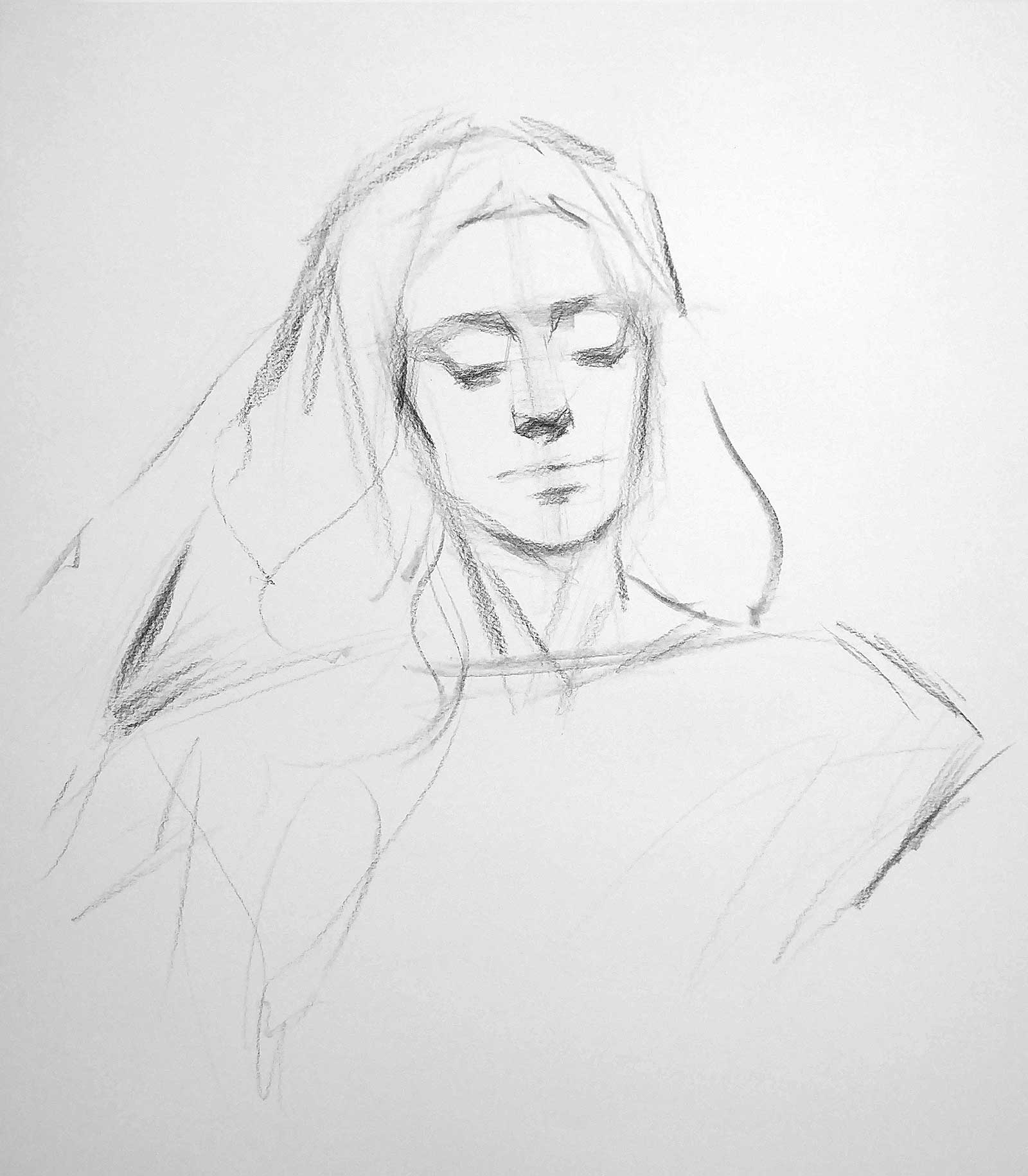
Stage 1: I start drawing the outline of the overall shape with a light touch. I try to represent main shapes as simply as possible and focus on the angles and the size relationships between shapes and features. At this point, I mostly use long, straight lines to get the right angles and use a vine charcoal to make it easy to erase any redundant lines as needed. I gradually move from larger shapes to smaller areas.
 Stage 2
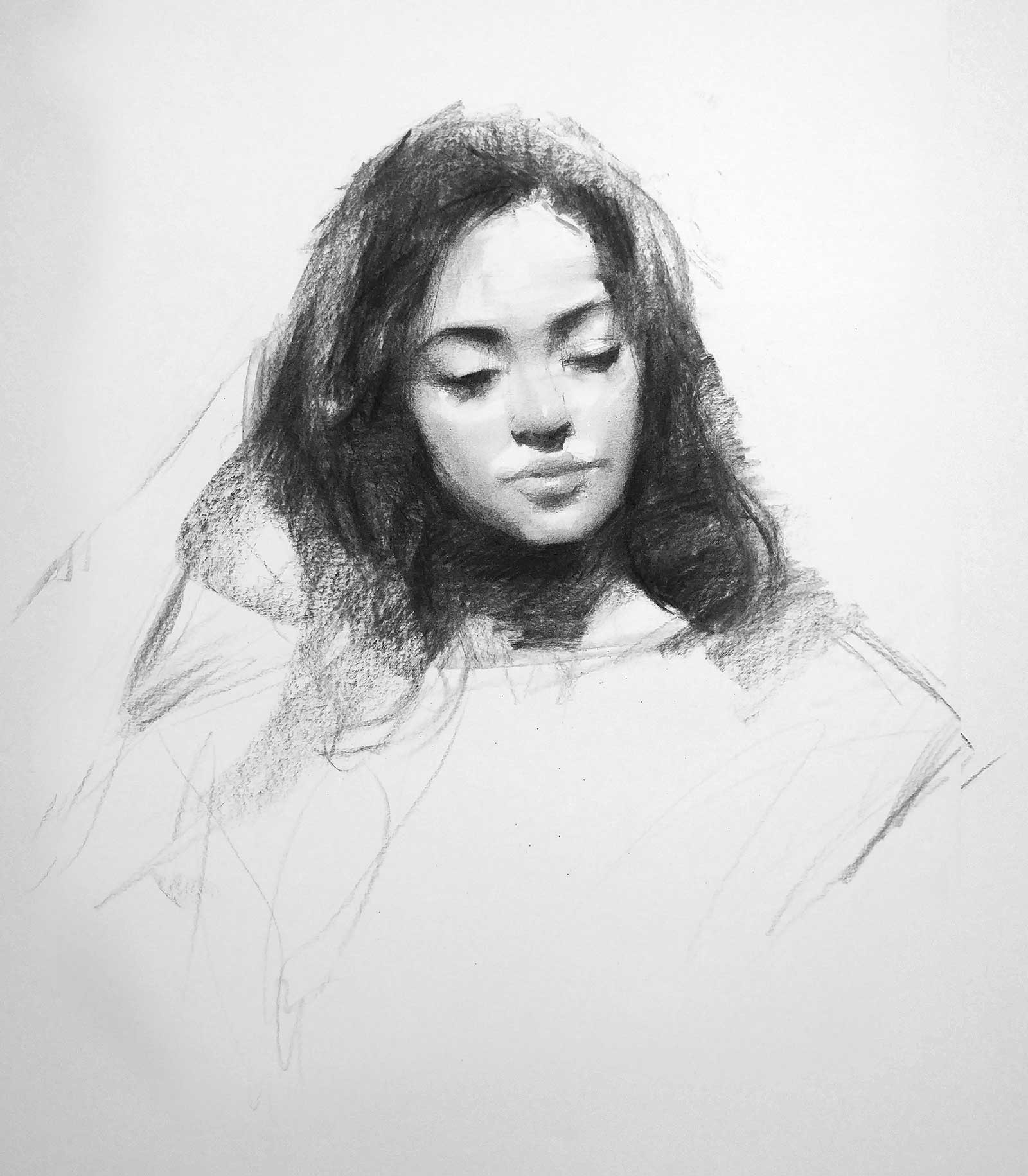
Stage 2: I start to block in with light and dark shapes. I squint my eyes to simplify the value pattern and see the right shapes of light and dark. Then I fill in the dark tone with a thick vine charcoal, get some contrast, and keep the sharp edges around the shadows to make light and shadow in the value pattern clearer and more distinct. After that, I use a tissue or a finger to add mid-tone areas and soften the transitions between the light and dark parts. At this stage, I focus on getting the structure of the head with simple planes as frames.
 Stage 3
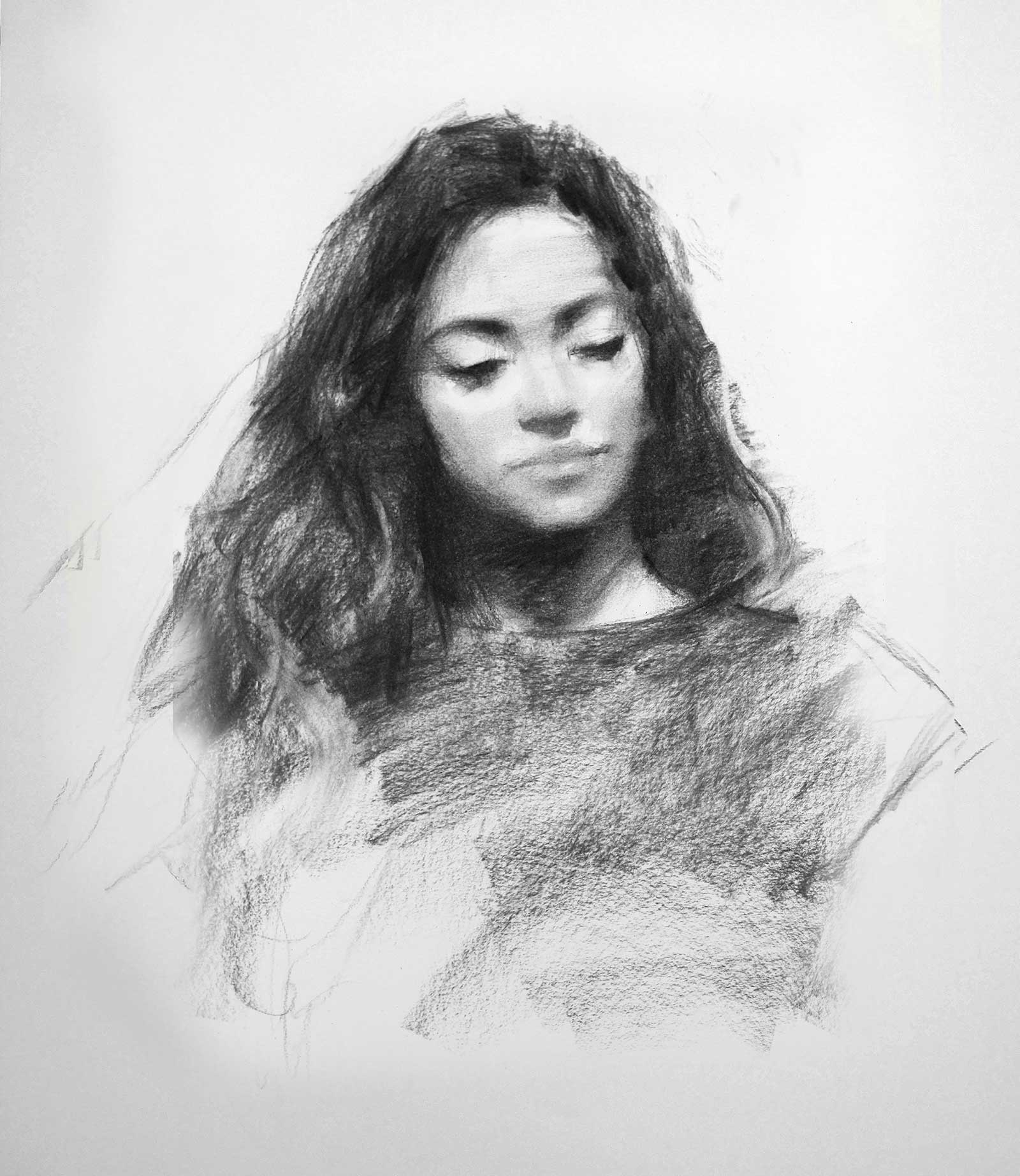
Stage 3: I refine the features more carefully, being mindful of the ratio between them, the angle of each and the overall head shape. I also locate and indicate turning edges. I maintain the basic value pattern and contrasts from the structure I built earlier, while I work on mid-tone areas. Then I draw other areas like the hair shape, as well as the neck and shoulder lines. I continue to adjust and build up outline shapes. I sometimes make adjustments to the neck width, the cloth shape, the shoulder line and so forth, if they are necessary to get a better overall pose or to put more emphasis on the character.
 Stage 4
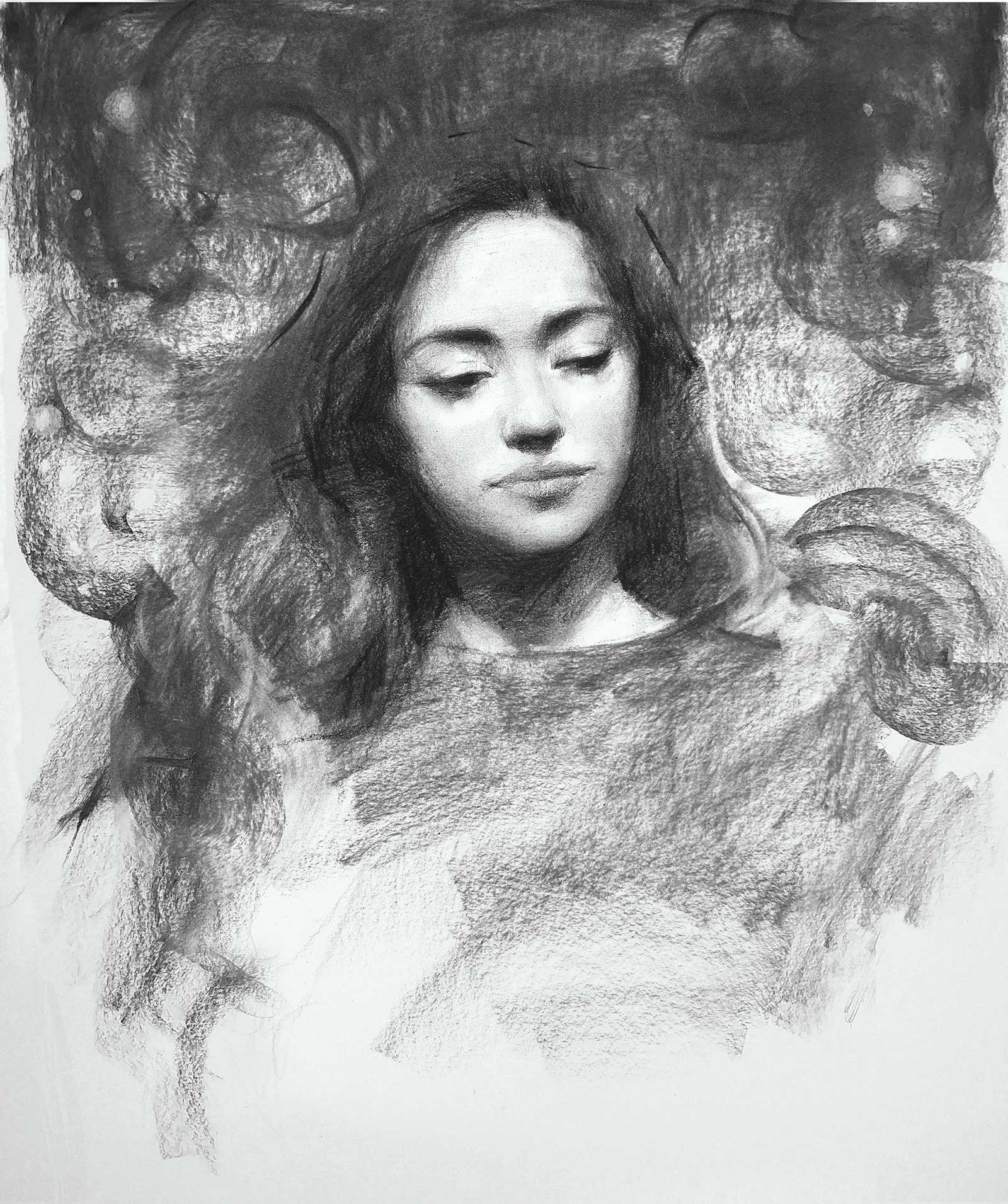
Stage 4: In order to make the face pop out as a focal point, I put dark tones around the hair shape and reduce the contrast between the outline of the hair and the background. Instead of a plain dark tone, however, I draw circular shapes with thick vine charcoal to give an abstract, airy feeling in the background. In addition, I refine the darkest dark using a compressed charcoal, resulting in a wider value range and further strengthening of the focal point.
 Stage 5
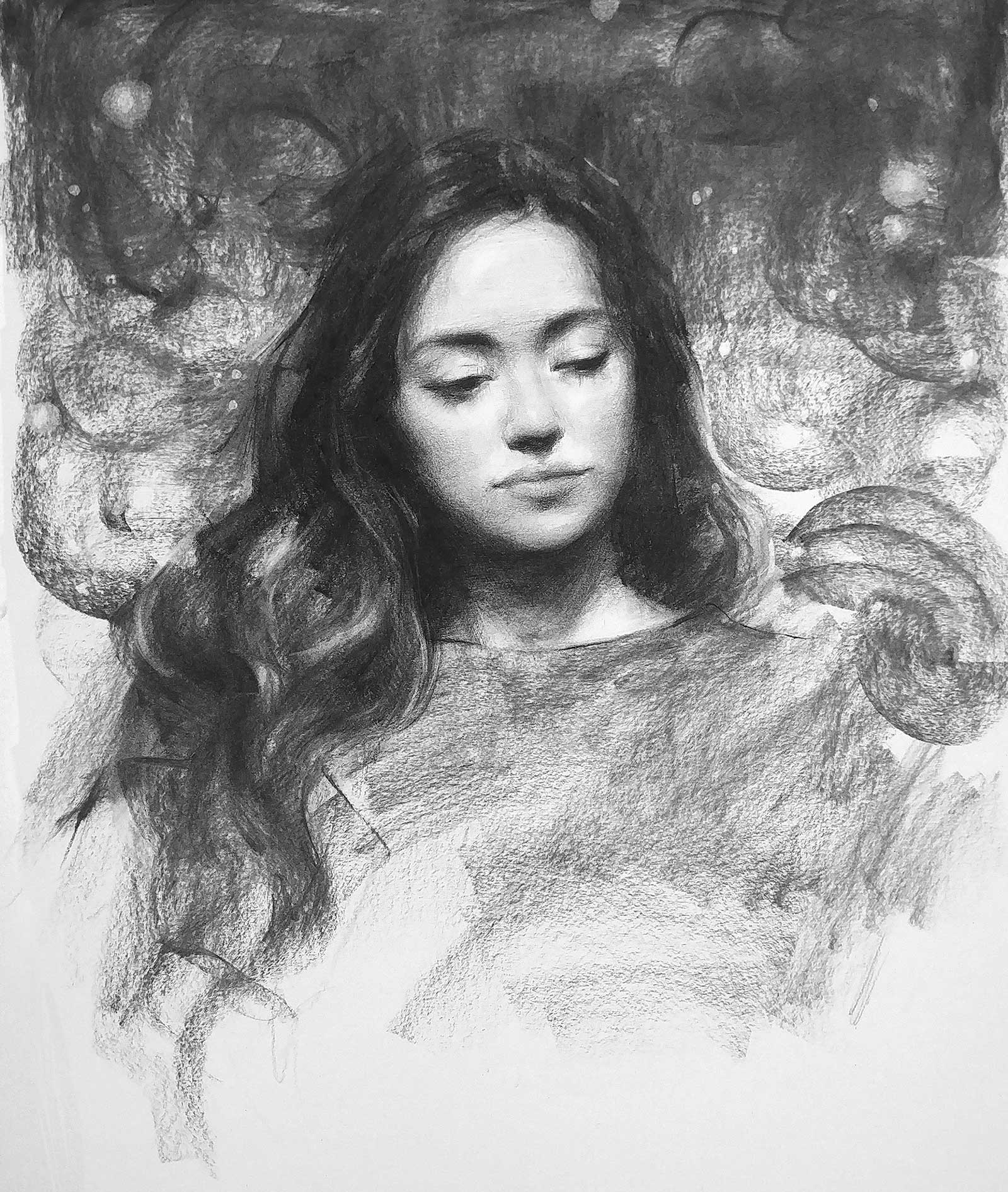
Stage 5: I go into the details of the model’s facial expression and various other shapes in this stage. I refine the features with a sharpened HB charcoal pencil. I go back and forth between different areas of the drawing while adjusting values, clarifying edges and refining shapes. I spend hours defining many fine-curved planes and refining them with delicate pencil strokes, placing the right values at the right locations. In addition, I try to find essential points where tiny changes can have a dramatic impact on the overall image.
 Stage 6
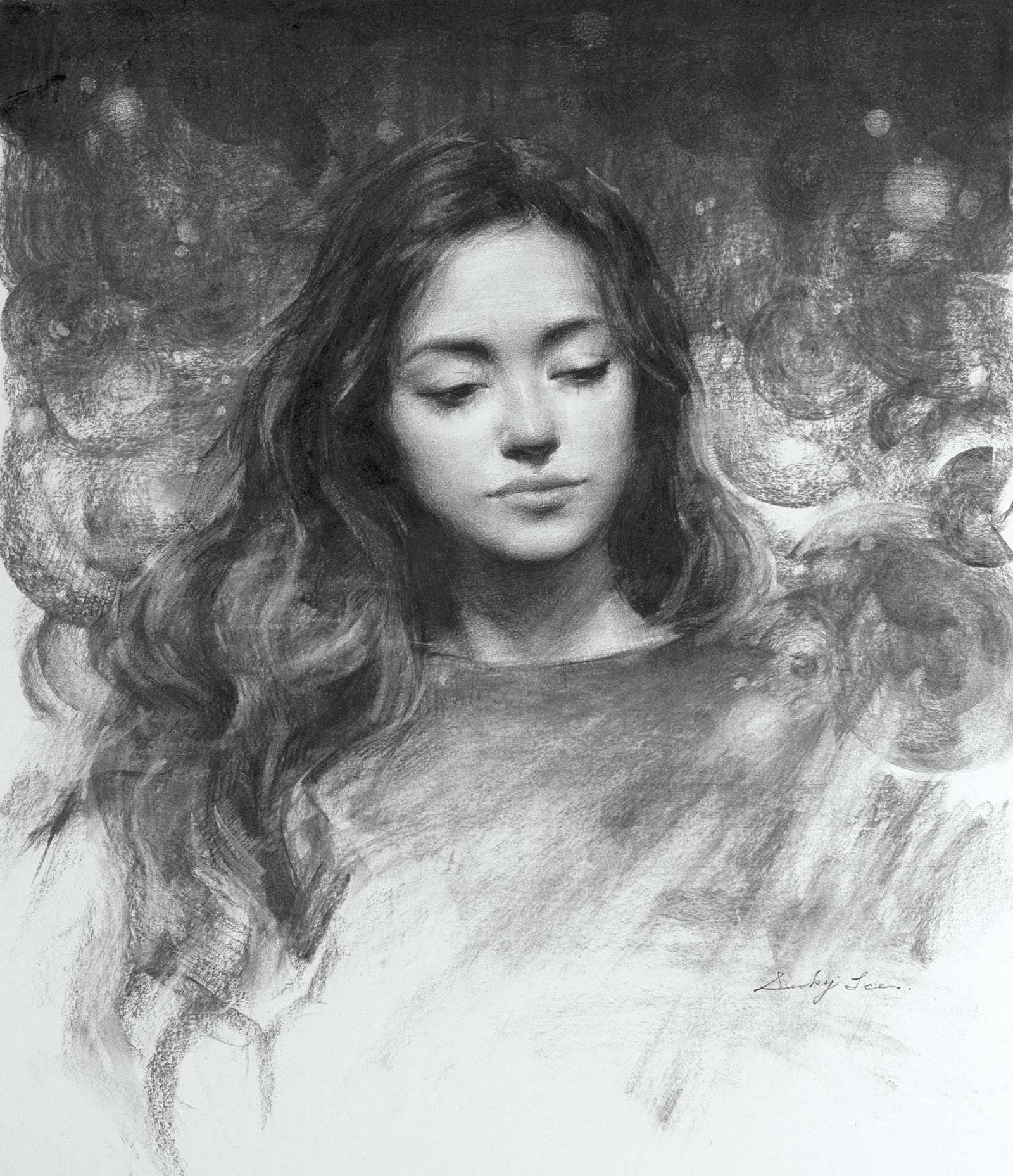
Stage 6: After completing the focal point region, I work on the overall atmosphere. I add some soft and light touches showing the volume of hair, and I add small decorative touches in the background. I try to step back from the easel as often as I can. Sometimes, I even stay away for a week or more before coming back to the drawing to check the proportion, values and their balance. I continue to make small adjustments until the moment it’s “finished.”
Materials
General’s vine charcoal and charcoal pencil, Daler-Rowney drawing paper
Sookyi Lee is a contemporary realism artist born in Seoul, Korea. She earned a BFA from Hong-Ik University in Korea and her MFA from Academy of Art University in San Francisco, California. She received many awards including First Place in Drawing awards at Portrait Society of America’s 2017 and 2019 international competitions and Haynes Gallery Award at the Art Renewal Center’s Salon International competition in 2019. Lee actively teaches in the United States and Singapore while working as a full-time artist.