In all of history, there has never been two moments exactly alike. Just know to some extent, you’re being original. And even if you copy something, you can’t help but have yourself enter the work. Trust yourself more and more each day and with each artwork.
During the middle of your creation, let your inner mind get involved. Your inner mind has much to visually say and can know where to take you with your work. Your outer mind knows this and will work with the inner. We use our inner mind with all the things we do; and so it is with our art.
Which Leads To…
Keeping that natural elevation we get when doing something with our talents. Much like reciting, “To be or not to be…” as if the actor had just come up with those words fresh from his mind. Even then, each time given, there will always be just the slightest difference in tone, pauses, speed of delivery; all depending on what might have happened up to that moment on stage. Life can never perfectly duplicate itself. That’s a gift to us.
Every face is different as is its ever-changing environment. I observe and prepare for the preliminary strokes as if I’m new at this “game” but also bringing the confidence of my eager skills. This gives joy to the moment of creation, which includes my mood and how this model inspires me. I’ll tell you here and now, that every model has inspired me. I speak on behalf of many artists.
CHIEF POWDERFACE
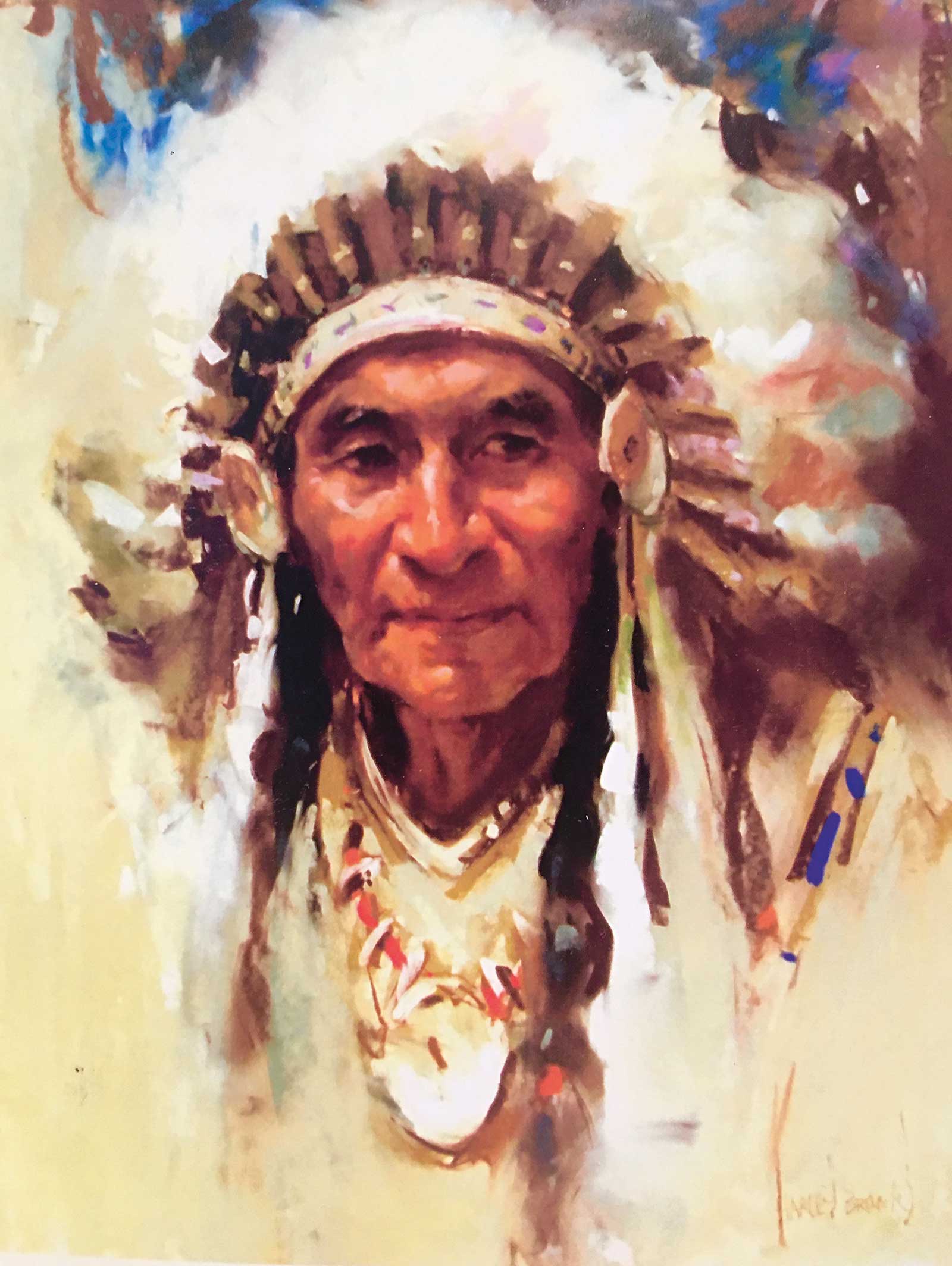 Chief PowderfaceWe see the portrayal of First Nation Chief Powderface. A strong leader at a Powwow; often with friends and family close to him. His thoughts, memorable. Here his expression is contemplative, decisive. Light and shadow values with facial features done accurately. Adding strength with overall design are the warbonnet and braids.
I’ll take this further: The brain is so infinitely complex in dealing with all the facets of existence. Hour after hour, day after day, there’s never been a boring moment in all my years. I don’t know boredom. Exasperation yes, anxiety a double yes. Perhaps my mind doesn’t allow itself to be bored, so it sets up little inner games and cross circuitry to keep itself mobile.
Moment by Moment
While developing my art, I begin to understand in degrees who to listen to and what to observe. Other things weren’t noticed as much, like “background music.” Then there came a time when less advice actually meant more as I flowed into my own way of thinking and doing. You’ll know when it happens. Oh yes, you’ll know.
Moment by moment, no matter what we are are doing, our minds grab everything, including incidentals. All this brings us individuality even when we don’t realize it—when we begin to trust our senses and what we’re doing. And much later on, we start to understand we’re not immortal. Ah, but are our art is! That’s some consolation. Our emotions, talents, creativeness, joy of life and making art, giving us an energy that carries on—all felt and seen in our works.
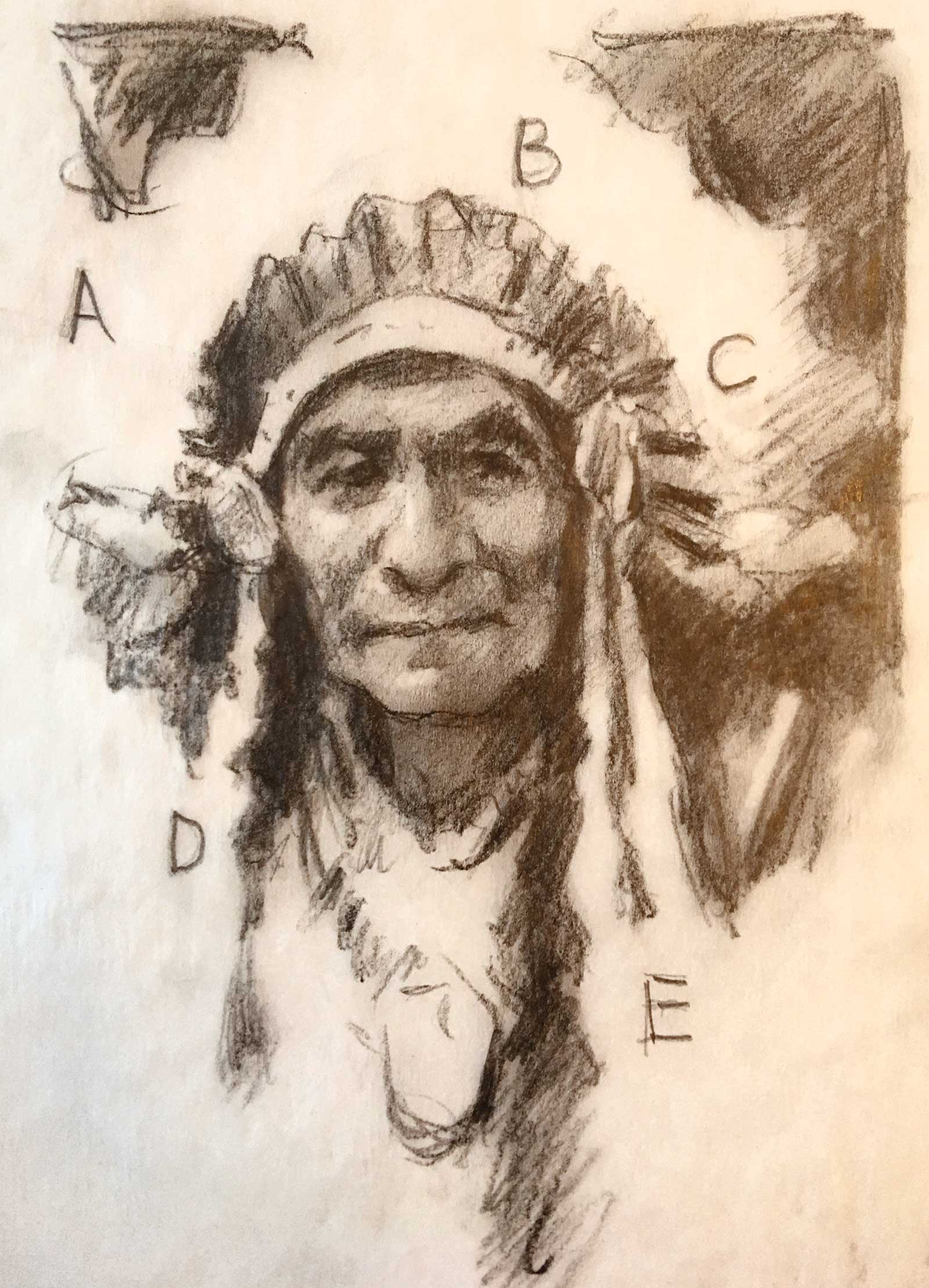
A. Lost edge with war bonnet; much of the light and dark in that area are loosely indicated and help overall composition.
B. Feathers not detailed, top edge importantly laid out; beadwork holding feathers done freely but accurately.
C. Soft edges going into background; many “lost and found” edges.
D. Braids done loose; these small areas of design are important.
E. Near the bottom area, the shapes fade and disappear, inviting our eyes to go back up to the importance of his presence.
True to Myself
Comparing myself with others has never happened; I can only be me. What occurs at the easel is of my own doing at that moment. There are days I might not be as good as I was the previous week. There are other times I’ll finish a piece that makes me absolutely ecstatic and continually glad I decided there’s no other life than art.
I am the sum of my arts but also all the love and the spirit from those who have been in my life throughout. They’ll always stay with me.
Will today’s famous contemporary artists’ works be admired passionately in 200 years? In the way Lautrec, Degas and Rembrandt are admired today? It’s a question with complex answers but worth a try. With that in mind, what will art be like 35 years from now? No one on this planet can give a reasonable description. How about 100 years? A thousand years? Perhaps then, art will not exist. At least art as we understand it today in the visual context.
For the Record
I do my art mostly in my studio. Over the years, it wasn’t quite as convenient. When I started out, my studio was the living room and the coffee table was the easel. Later, the bathroom mirror was where I taped my paper for drawing and pastels; the sink below collected the “droppings.” For a number of years, I did portraits in saloons, restaurants and fairgrounds. And with a peddler’s license, I sold my art door to door, as well as portraits done in the buyers’ living rooms. Putting it another way, I was was determined not to “work for a living.”
Over all that time, the first dozen strokes on an art piece erased any negatives I may have had that day, both mentally and physically. I’m released into the world I dreamt of from childhood on. No matter the circumstances, it has never failed. Being an artist…it’s a blessing.
Basic Self
I do not take myself seriously. I know my faults like being forgetful, not understanding complex things. My intelligence is average and my flaws don’t bother me in the slightest… I never think about them. Yes, but a pencil and a piece of paper make up for everything. From the beginning I understood art as guided by my mentors mixed with my own hit and miss methods of learning. Lights, shadows, colors, design and with a mind owning the subject. So no need to worry about us imperfect humans.
Another Consideration
Let us consider this modern world we inhabit. There’s hardly anything we can’t see or do in a relative moment. I’m sitting here in Vancouver. If I want to create a painting from life in northern Alberta, I can be there in one day. If I need art supplies, they’re minutes away. If I want a gallery in London to see my latest work, they’ll get the image in seconds.
As we artists sit at our computers, we can look at the Sistine Chapel ceiling, specific works by Sargent, get an art lesson, all with the flick of a button. What might Rembrandt or Van Gogh think of this? If those two masters were magically transported to our world today, how would they approach their art and their ever flowing spirit?
Let’s bend our minds around what I just wrote and consider:
Yes, we see some art where the artist is trying to “say something.” I’d rather look at works of art where the skilled artists are totally immersed in the joy of painting particular subjects. When the “visual messages” come through, I can connect. That’s the depth where I want to go.
Know the difference with the lighting: cool to warm; out in the daylight and in a studio. I’ve done many of my works outdoors, and then when put into a room with artificial lighting, there’s a difference.
Don’t forget, when you’re on a flat plain with the level horizon straight ahead and you’re looking at your friend, who is your same height and standing in the distance, that friend’s eyes are level with the horizon. That’s a big deal for artists.
The Learning Life
When I did workshops, I taught all day and well into the evenings. During class, I might talk for a few minutes about things other than art. Once in a while there might be a student who complains he didn’t come to the class to hear about my playing in a band or my trip to Russia. No mention about nine hours a day crammed with art. This has happened with other teachers.
Back in my early learning days, I went to an artist’s workshop and wasn’t getting much from him. Well, one morning, he started talking about how to work details in the light and shadow areas of the face. His explanation went on for a few minutes; it was ultra major for me. At the end of the class, I sincerely thanked him for what I learned. Those minutes made the week.
In school and college, once in a while, we’d hear the teachers talk about things other than history and math. It’s called being part of life; we all came away a whole lot smarter and filled with joy in our surrounding world.
What About Those Lights and Shadows?
When painting or drawing a face, put a bit less texture and fine details into the shadow areas than would be in the light areas. But also, if the face is more in shadow, that’s where the detail goes and slightly less in those small areas of light. In most cases, it’s the light areas that get the attention, bringing out details. Also, in shadows, colors are somewhat muted.
The Shadow Knows
Lighting on your subject is so important. It can be simple, hitting the face from the front, slightly up and to the side so that there are cast and form shadows on the sides of nose, cheek and eye areas. Typically, that’s often what we see in a Renaissance portrayal. Often, I’ll allow a slight reflected light touch the shadow side. It is how the shapes of those lights and shadows combine into art. This is a major part of portraiture; personally, aesthetically interpreting those lights and shadows.
One of my books has 400 of my art world thoughts. Here are five quickies:
1. I don’t much contemplate about my future; doing so limits my options.
2. If each day doesn’t bring you something that lifts you or adds to your musings, then you’re not paying attention.
3. Don’t isolate a color on your work. At least insinuate it elsewhere.
4. Another way of working a good composition is “MAP”: Mastering the Arrangement of Patterns.
5. Every stage of a painting can be a work of art. —
BALINOFSKI: NON-OBJECTIVE REAL
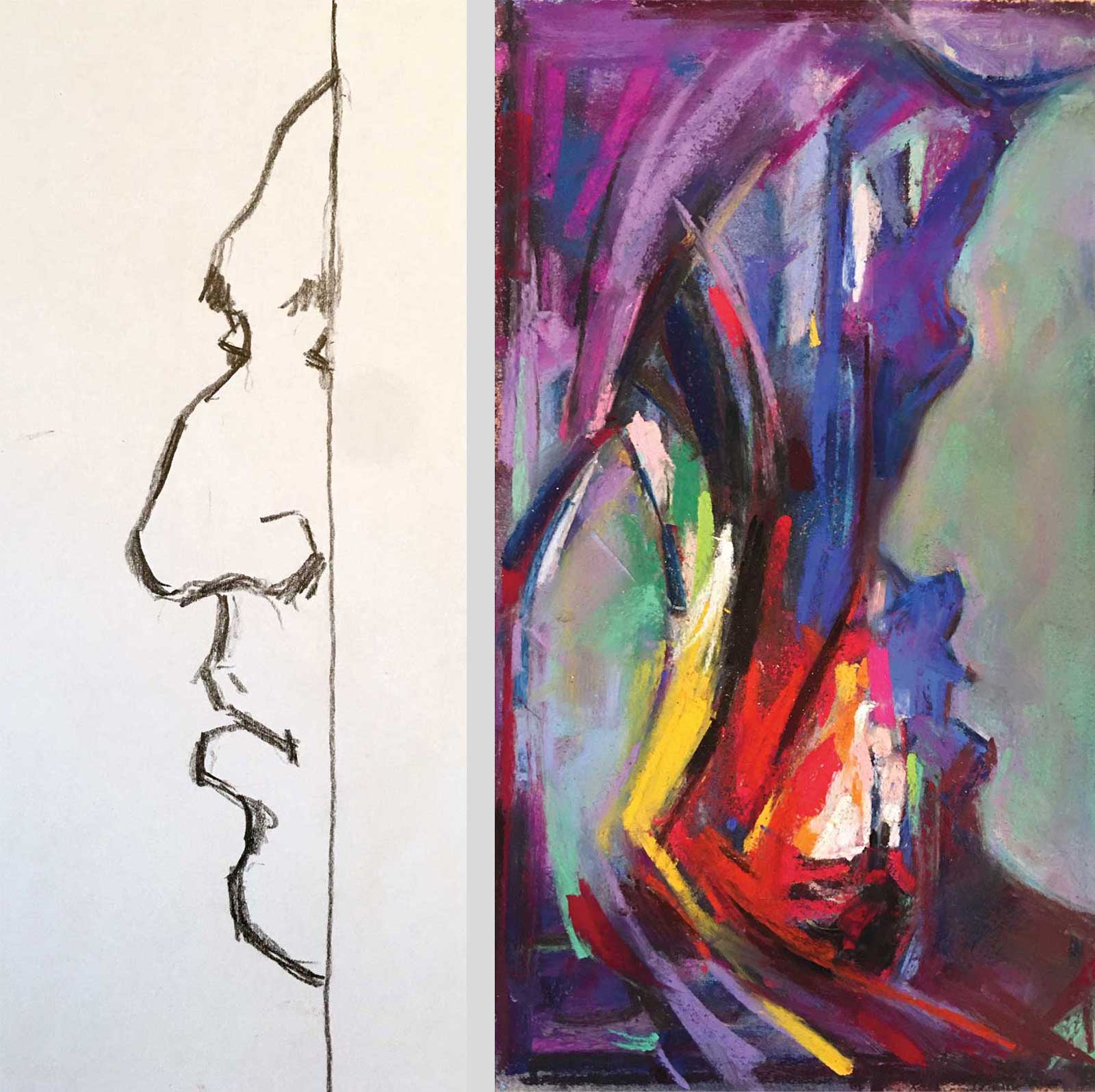
I’ve often thought that abstract art is a reflection of what the artist has observed in a lifetime. Shapes and colors, day after day from billions of visuals over the years. Trees, mountains, people, literally everything going into the inner mind. That grand mixing of shapes and colors artistically flow out the same way we talk without having to think of every word. This is how my mind works when I do an abstract.
Here, I worked the colors and shapes with the purpose of showing specific real life translating into non-objective. Look at the right side of this abstract and you will see Uncle Ivan‘s profile. It’s both abstract and real life.
Now a thought for you dear reader. Try the same approach with the profile of a friend. Real life into an abstract work. It will bloom in your mind and push your understanding of colors and shapes going next to colors and shapes. It could very well inspire into your next representational.