



Since I was a kid, I liked to draw and paint. I always knew that I would become an artist when I grew up. Therefore, in 2005, I attended the Florence Academy of Art in Italy to study the methods of the classical masters’ technique. I had an intensive training in several drawings and painting technique such as pencils, charcoal and oil. I always paint from observation—either directly or by means of photographs, which I take by myself. My gaze is directed at my immediate reality, capturing various interiors or exteriors.
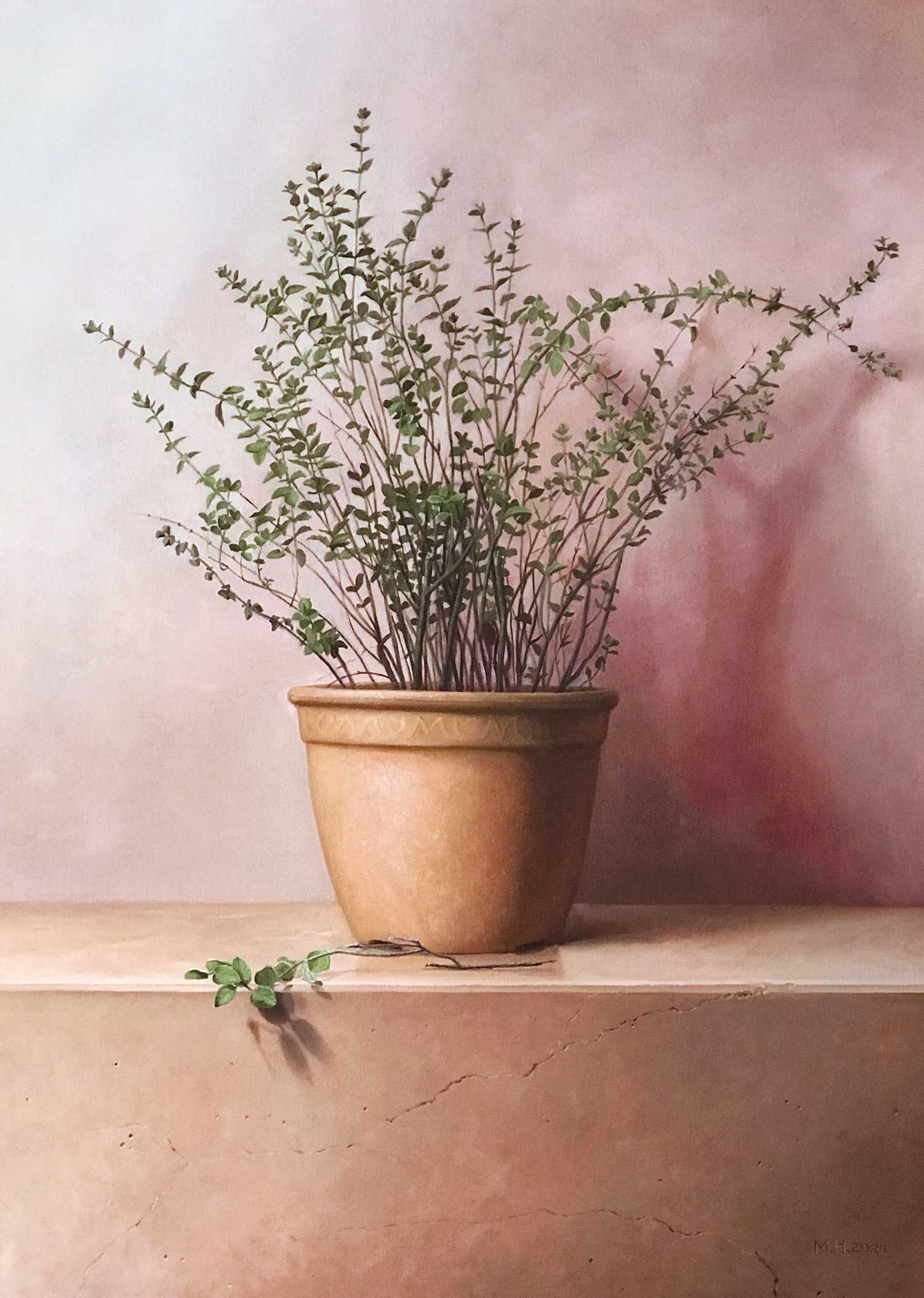
Thyme, oil on canvas, 31½ x 23½" (80 x 60 cm) Remembering when we were young, when we were accompanying my mother on the wilderness around the estate, she picked thyme. We’d return home and all the family and neighbors gathered to separate the thyme leaves from it stems. I remembered its distinctive fragrant smell fill our house. Thyme reminded me of the village, family, traditions and homeland. Thyme is considered in the Palestinian culture to be a symbol of origin and freedom. As soon as it was confined to a flowerpot, it lost its freedom and pulled up from its original soil to become a marginal decoration.
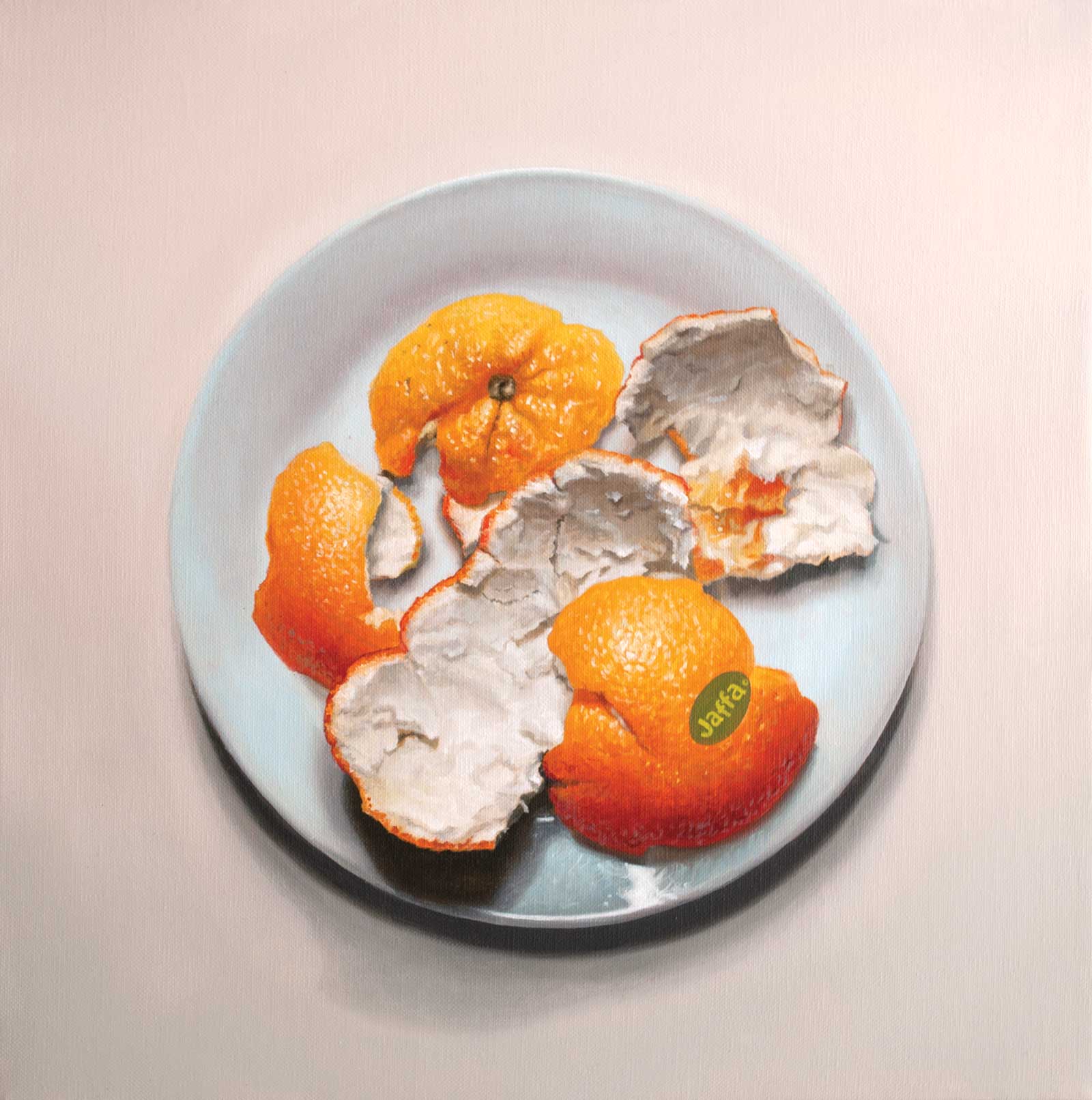
Jaffa, oil on canvas, 16 x 16" (40 x 40 cm) This painting, which describes the remains of orange peels in a ceramic dish, appears as a regular and naive scene, but it has the story of a city, a people and a homeland. As you can see, the orange crust has an adhesive with the name “Jaffa.” It is known that the Palestinian city of Jaffa was one of the most important exporters of oranges to Europe during the time of the Turks and the British Mandate after that. After the establishment of the State of Israel and the displacement of the city from its people, Israeli families seized orange groves and seized the brand of Jaffa oranges to be re-marketed as an Israeli product in the local and international market.
The subject matter of my artwork is classical, such as portraits, still life and landscape. The illusion of reality represented on canvas is indeed seductively beautiful and perfect, yet it is simultaneously revealed to carry a disturbing charge, which is related to disruption and disintegration.
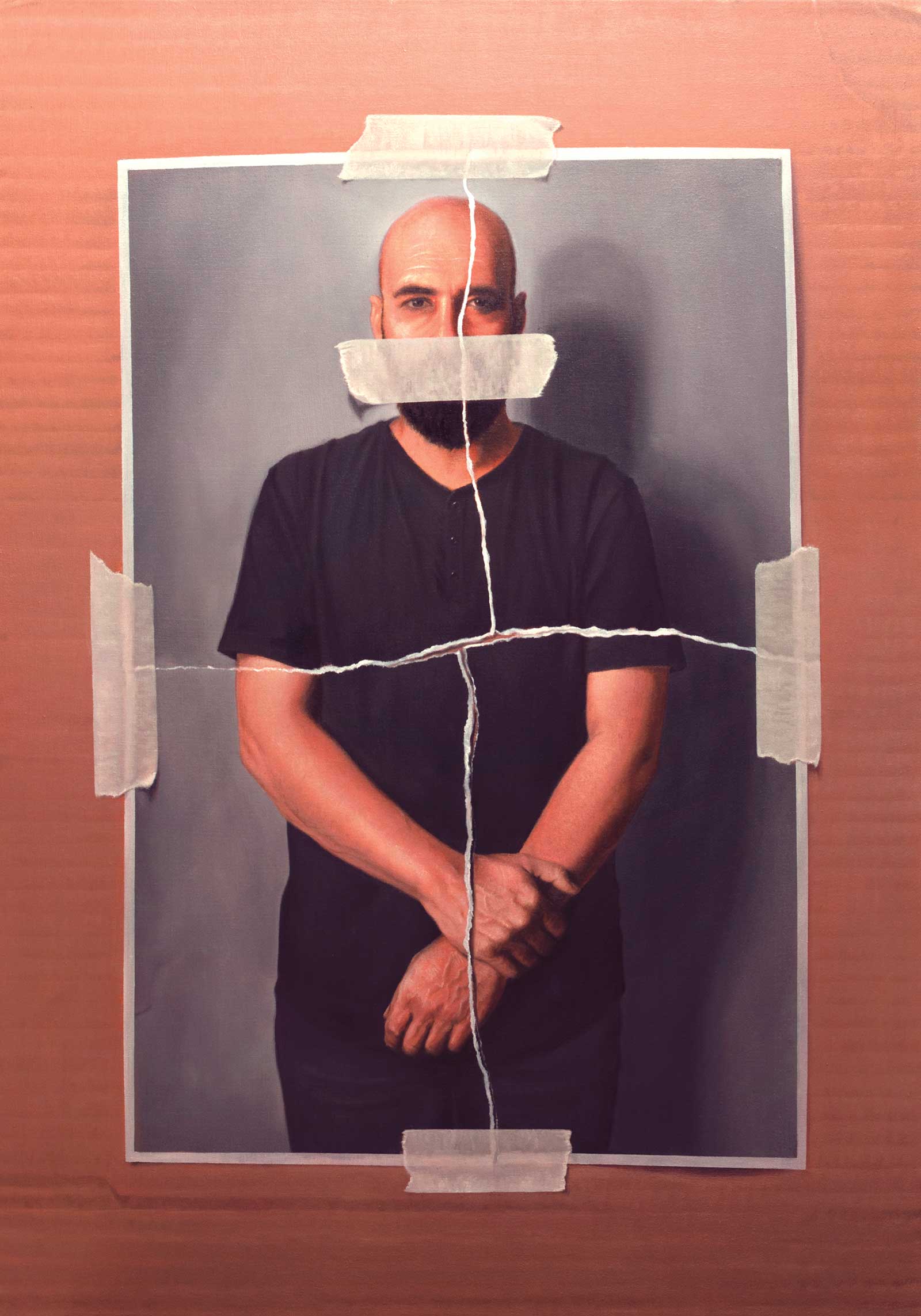
Covid-19, oil on canvas, 27½ x 20" (70 x 50 cm) In this painting, I used the Trompe l’Oeil style to create an illusion. It was painted during the lockdown because of the COVID-19 crisis. It is presented as a torn self-portrait of the artist plastered with tape attached to cardboard. This oil painting includes two contradictory processes of shredding and gluing so that the viewer interprets its content in several points of view: personally, socially and politically. The inspiration of this work was based on the feeling of helplessness caused by the COVID-19 virus. This unexpected feeling, in which your whole life is facing disintegration and collapse, is reflected in the act of tearing up the self-image. On the other hand, the act of documenting reflects attempts to find solutions to keep yourself safe and also have faith and hope to survive the crisis.
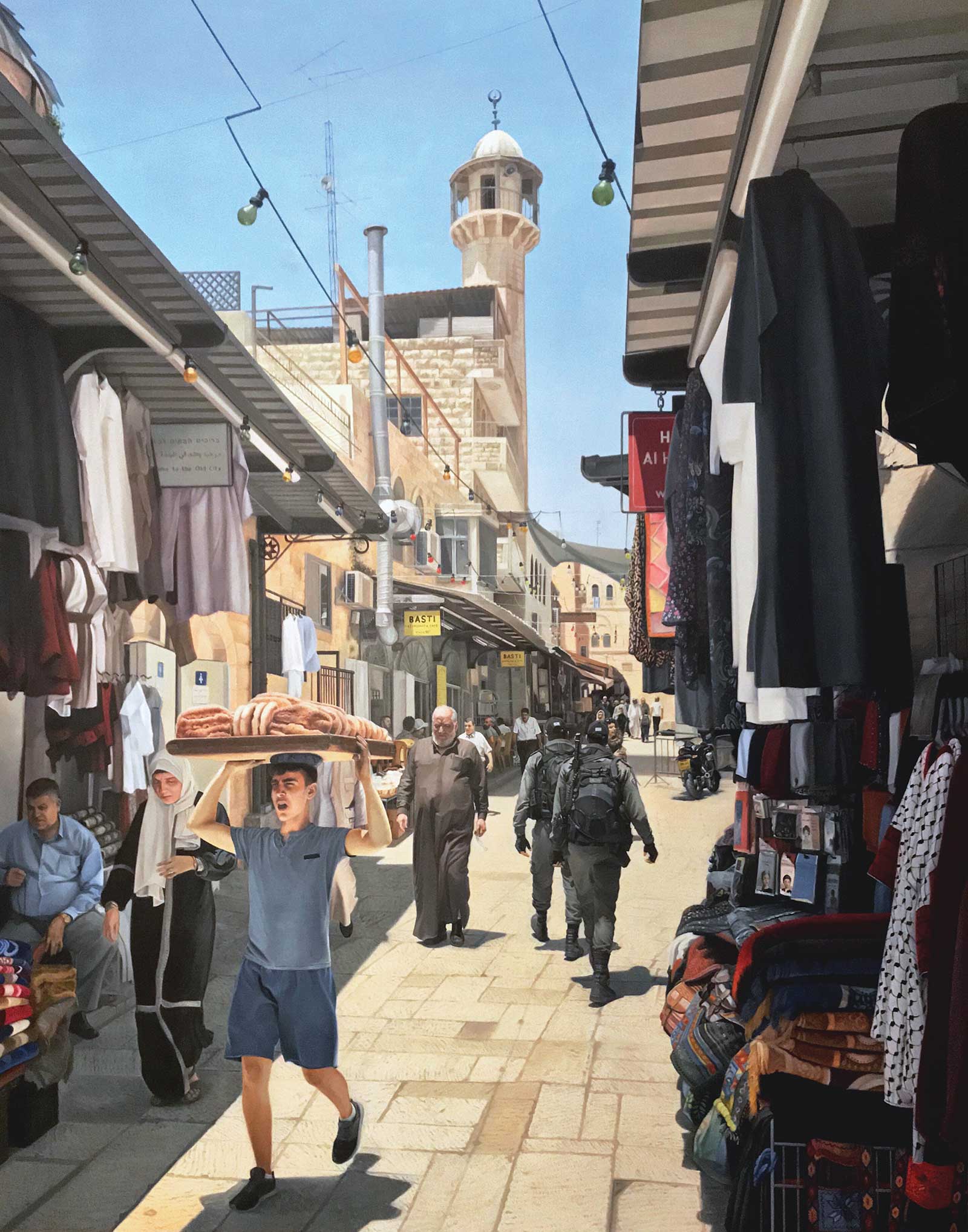
The Bread Seller, oil on canvas, 75 x 59" (190 x 149 cm) It was important for me to visit Jerusalem and document what is happening on the streets of the Old City, to document daily life in a realistic and simple way without judgment or nostalgia. The painting reflects daily life under occupation and the Palestinian man’s struggle for survival. The bread seller is a figure who metaphorically reflects the willpower and choice of life against the difficulties of life. It is a kind of optimistic scene though. In the context of the integration of self-portraiture into painting, this is a well-known classical move in the world of painting, and many artists such as Sandro Botticelli used it as an act of presence and commemoration in other cases. However, what motivated me to incorporate my portrait into the painting is, in fact, a double act in which I am a witness to what is happening, as well as belonging and identification with my people. The scene is built in a way that it invites the viewer to dive into the painting and allows them to assimilate into it by feeling that they are present in the place and feel what I feel.
My artworks follow Western traditions in terms of structure and technique style but differs in content as it merges the Western and Eastern worlds, which distinguishes it from traditional realistic painting. In fact, I am combining two styles of realistic drawing/painting and conceptual art. This combination provides the ability to read the works in many directions and urges the viewer to think and delve deeper into the content presented. The advantage of hybridization is important and challenging, but it gives the painting both global and local “characters.” —
About the Artist
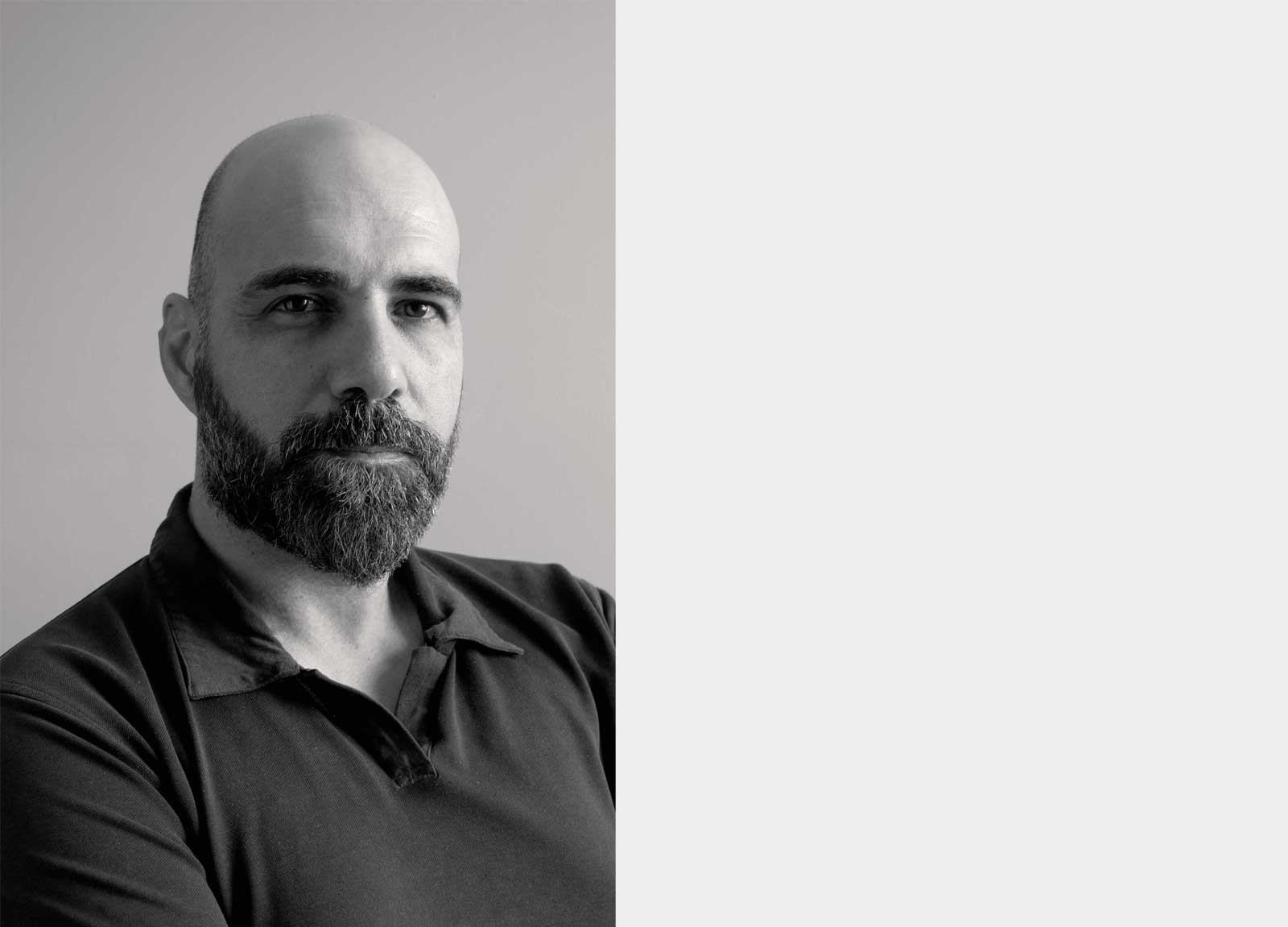 Michael Halak
Michael Halak was born in 1975 in Fassuta village (upper Galilee) Israel. He currently lives in Haifa and work as a lecturer in the Art Department at Haifa University. After studying Fine Arts at Haifa University, Halak won a residence scholarship in 2005 to attend the Florence Academy of Art, Italy. There, he would perfect his academic realistic style. He graduated with a MFA at Haifa University in 2009.
Halak’s works moves along the frontier between realism and conceptualism. The illusion of reality represented on canvas may be seductively beautiful and perfect, but equally conveys feelings of disruption and disintegration. The perfectly constructed and executed works depicting landscapes, toys, and people are almost always slightly off: beautiful, almost real and yet they convey an awkward feeling, often impermanence, hybridity, entrapment or categorization. Halak has exhibited in many museums and galleries in the Middle East, Europe and the US. He has won several awards including the Ministry of Culture and Sports for contemporary artists and the Rappaport prize for a young painter and many more. His work can be found in several public and privet collections in Israel and aboard. He is represented by Tabari Artspace.