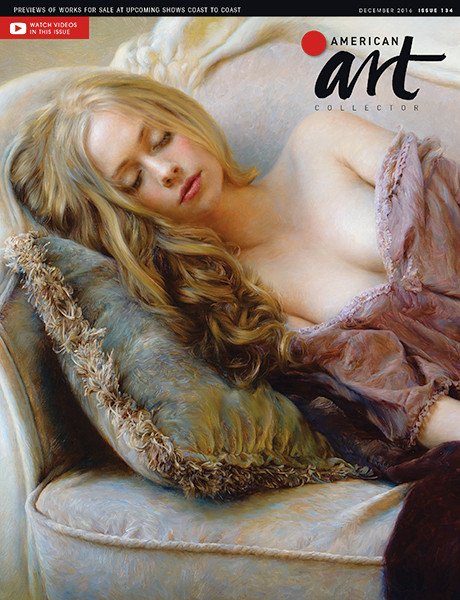
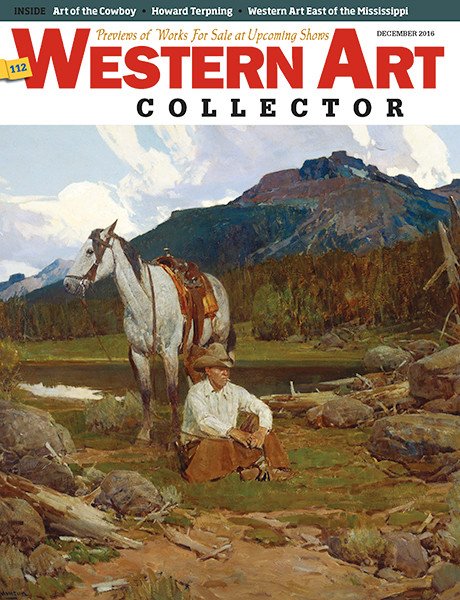
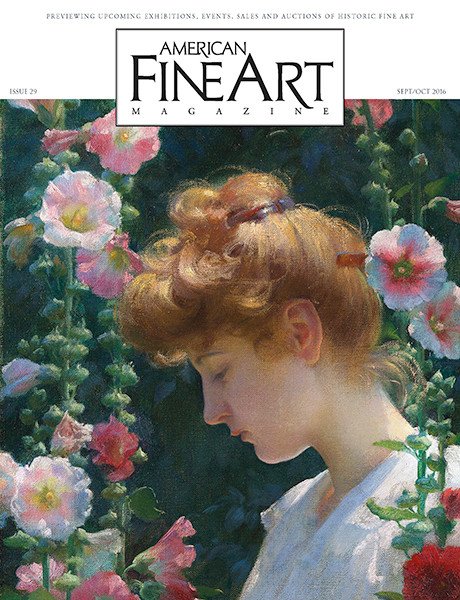
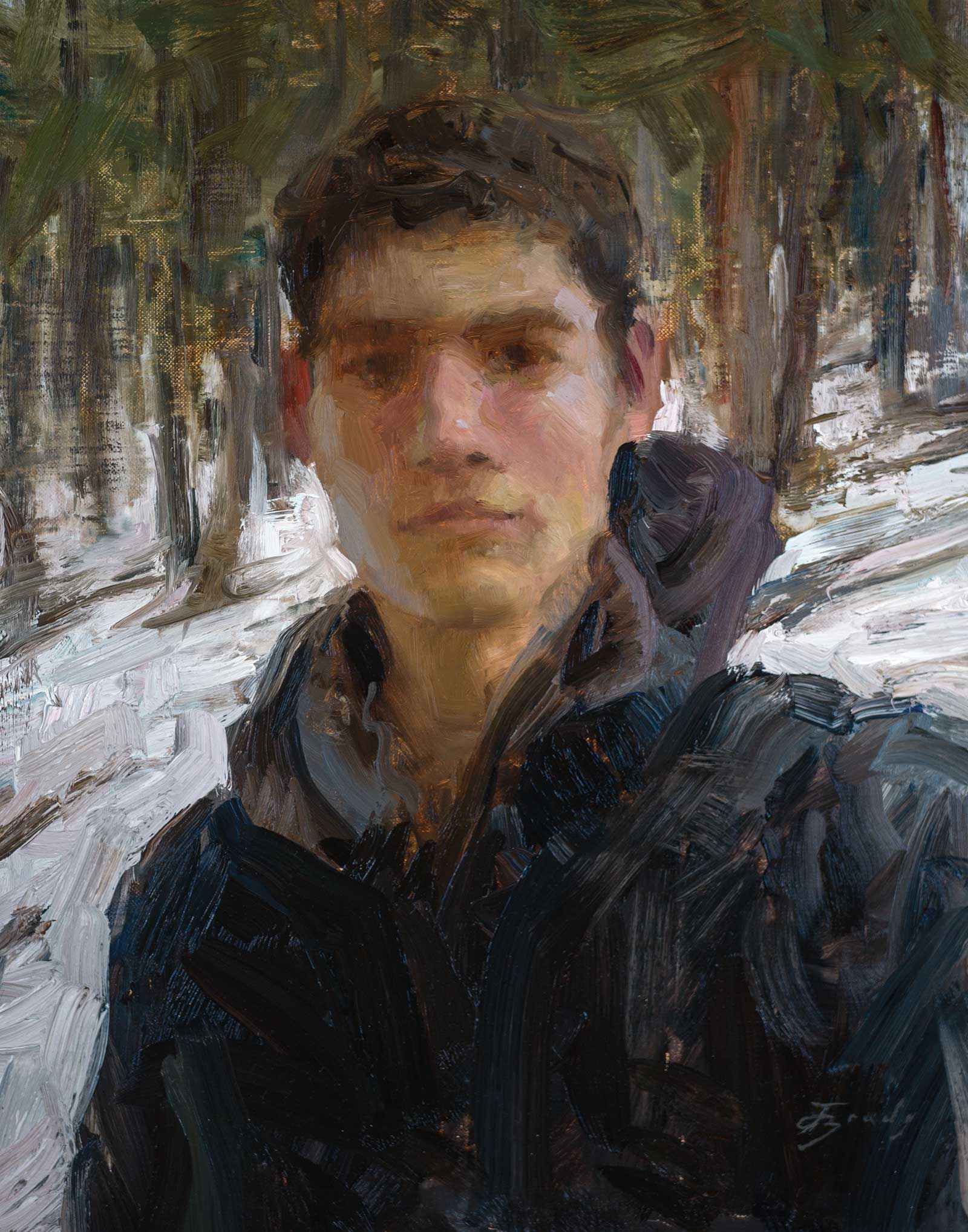
 Winter Self-Portrait, oil, 14 x 11" (35 x 27 cm)
Jared Brady
Inspiration
I completed this piece during a 30-day painting challenge. In order to grow as an artist, I’m always trying to think of ways to challenge myself, and what better way than to paint an outdoor self-portrait. I carried my studio mirror outside and leaned it up against a tree. Thankfully, the conditions were ideal for the painting—overcast but not too cold. It was a perfect winter day to paint outside with my pups by my side.
Process
To start this piece, I first applied a wash of oil paint thinned with some Gamsol to get rid of the white of the linen. Next, I established a few general drawing lines to get basic proportions and placement correct. After that, I blocked in the average values and colors while making sure to squint and compare to help simplify the value structure. As I got closer to the end, I worked on refining the form of the face. For the final touches, I went in with some bold and thick brushwork in different areas. Self-portraits are a great way to experiment and try new ideas without the pressure of having someone else sit for you.
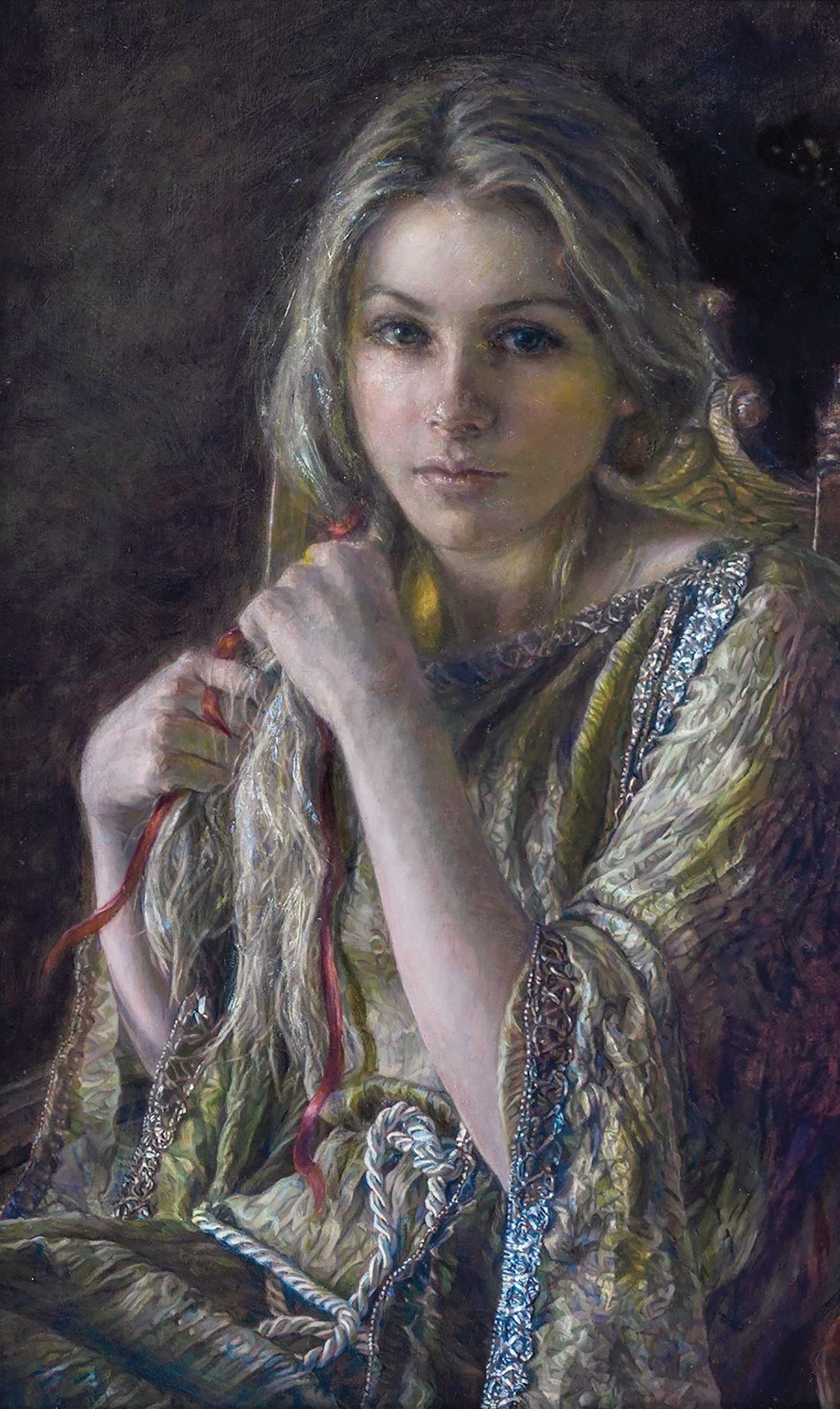 Alexandra, oil on canvas, 30 x 16" (76 x 40 cm)
Sandra Kuck
Inspiration
The inspiration for this painting is my fascination with the Pre-Raphaelite movement—attention to detail, period costumes and the overall romantic realism. To me, capturing a time and place that only exists in the imagination is far more interesting than recreating the world around us that we see every day. I have three granddaughters that have been my models for almost 25 years. Alexandra is the oldest and the subject of this painting. They are so wonderful to paint and can sit for hours without direction or a complaint. In fact, they ask me if I’m tired. “Do you need to take a break grandma?”
Process
I start out with a general idea (thumbnail sketch), design costumes and have costumes made. I then do many sketches before and during sittings over three to four days. Back in the studio, I begin the process of transferring sketches to canvas. I work about 10 hours a day using very small brushes and thin oil paint. Once my first pass is made, I oil out and begin over and introduce glazing (not always). This process is repeated for as long as it takes. The last step is varnishing—not my favorite part of painting.
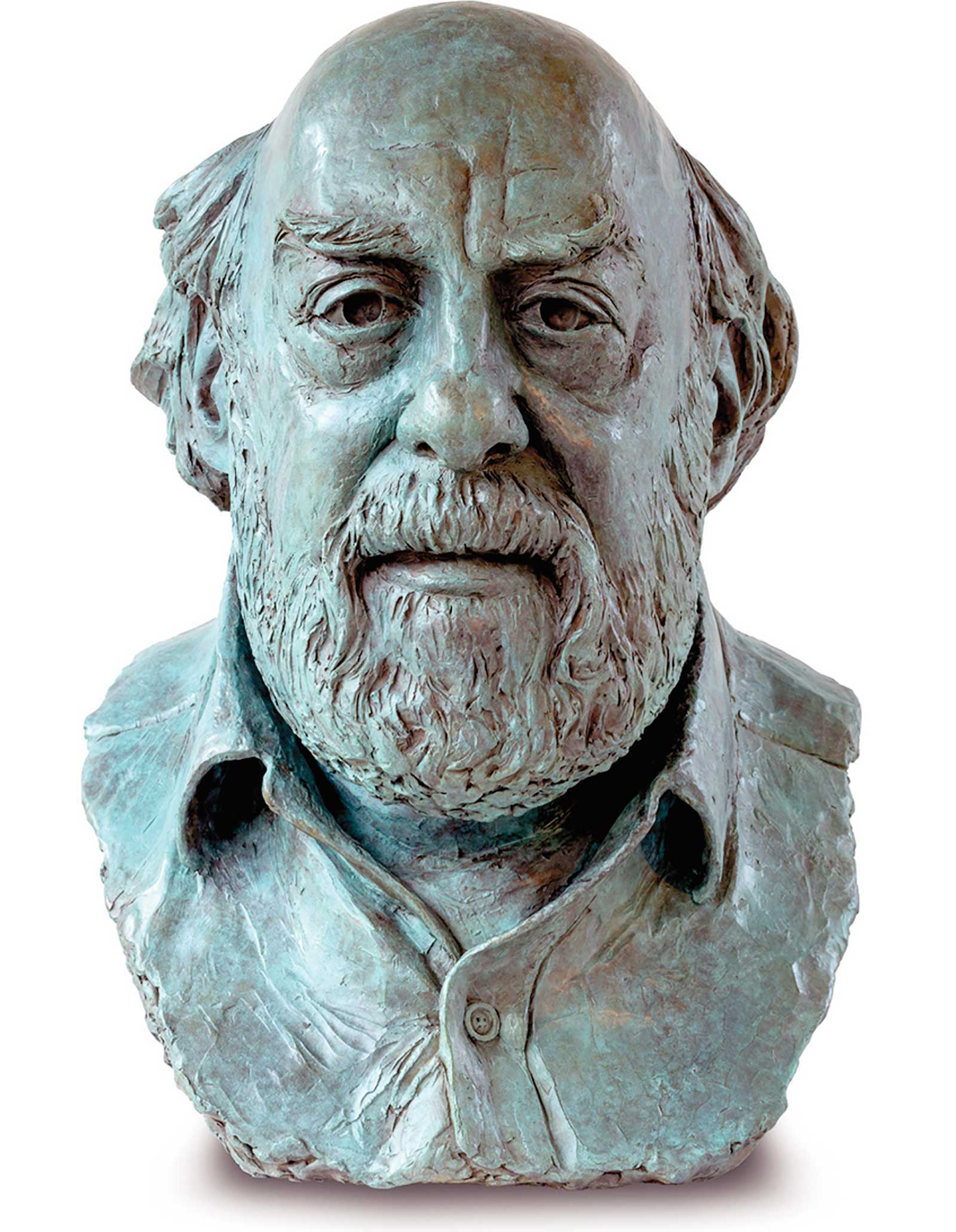 Daniel, bronze, 15 x 11 x 12" (38 x 27 x 30 cm)
Wende Caporale
Inspiration
The inspiration for Daniel was my husband and partner of 39 years, Daniel E. Greene. Producing a sculpture seemed to me to be the ultimate way to commemorate the man who was influential to so many artists through his brilliant work as a renowned painter and legendary teacher. Dan was a brilliant figurative, still life, urban landscape and portrait painter whose work was pivotal in reviving the renaissance of realist painting in the early 1960s. His earliest influence was Robert Brackman with whom he studied at the Art Students League in New York. Brackman’s artistic lineage includes the great American painters Robert Henri, George Bellows and Thomas Eakins. As a mentor, Dan was my most significant supporter, and I could not think of a better way to honor him and perpetuate his memory.
Process
The process for creating Daniel involved making a life-size model of Dan’s head using plasteline clay. Dan was seated a few feet from me while I blocked in the general shape of the head. A variety of metal and wire tools were employed to shape the planes of the head while observing Dan’s features. Calipers also proved helpful in checking proportions. Using a spotlight to better illustrate the form, I worked in a 360-degree circle around Dan while also observing him from above and below. Once the sculpture was continually refined and eventually completed, a rubber mold was made in preparation for a wax mold. At the foundry, I examined and refined the wax mold which was then used to make a ceramic shell. Heated bronze was poured into the cavity of the shell to produce the final bronze sculpture. Dan and I returned to the foundry to see the final result and observed the application of various acids which yielded our chosen patina.
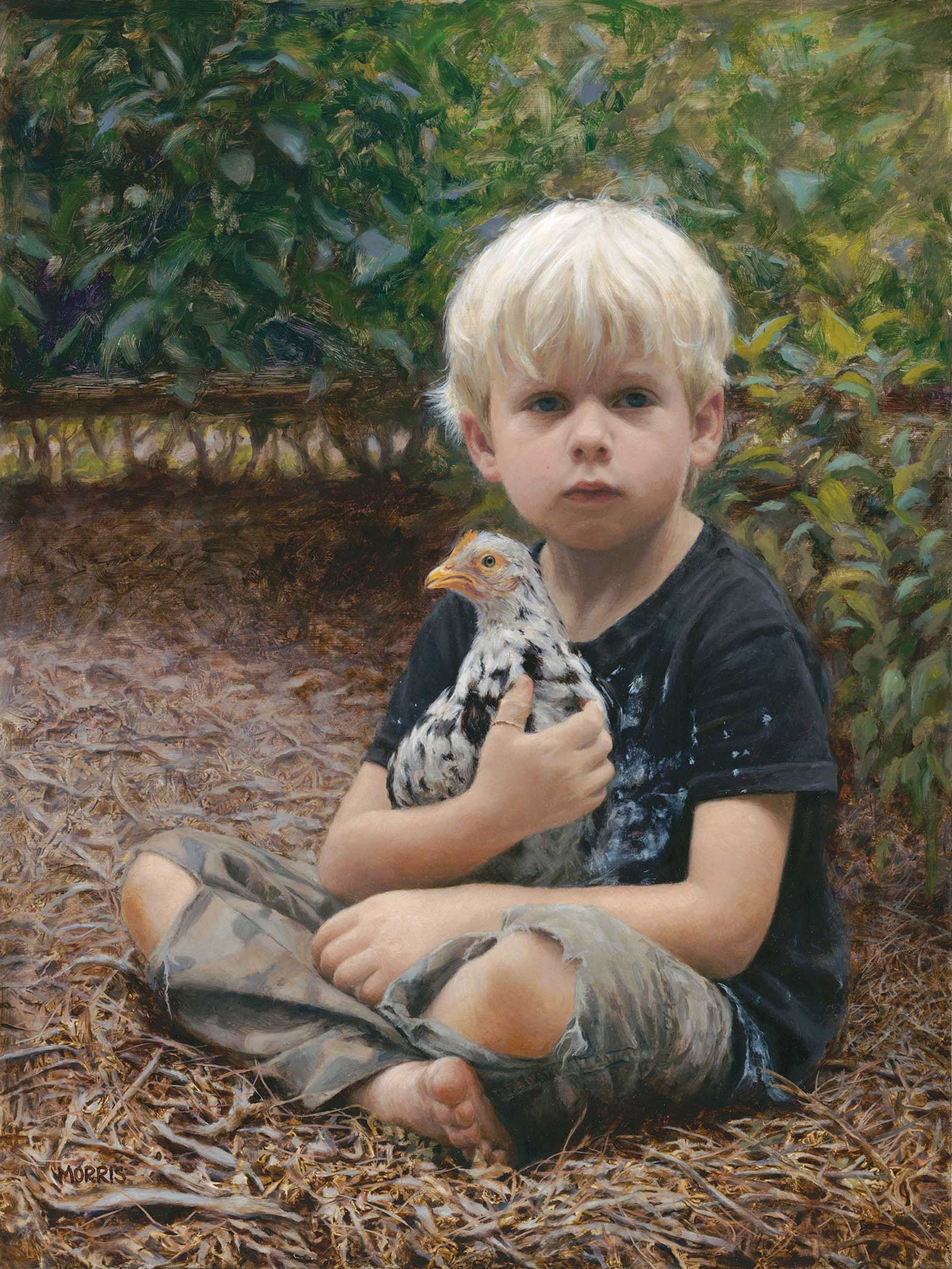 Camouflage, oil, 24 x 18" (60 x 45 cm)
Kathy Morris
Inspiration
The extraordinary resides in everyday life events. Painting our son’s large chicken coop became a family affair as my son, husband, two young grandsons and I all chipped in to help. We dodged periodic rain as we painted, so when the sun finally came out, I seized the opportunity to take photo references for a future painting of six-year-old Ezra and his favorite chicken. Ezra insisted on wearing his black “paint shirt” flecked with white paint because it became camouflaged with Gingerbread Joyce’s white with black spotted feathers. Beauty and wonder are ever-present, waiting for us to stop and notice. Sometimes it’s only the child’s eyes that see it.
Process
I began by painting a small 4-by-6-inch color study to solidify the composition and color palette for the painting. I toned a homemade ACM panel with a thin raw umber-ish mixture, which was the average value of the light side of his face. After drawing my subject on paper, I transferred it to the toned panel. Beginning with the shadows of the face and skin, I painted a preliminary color layer of oil paint thinned with solvent over the rest of the painting and background. After allowing that to dry, I applied paint from the shadows into the light, following the form with my brushstrokes to build up the value and color in layers.—