
A composer creating a memorable melody, not just music razzle-dazzle. A writer developing a dynamic plot, not just a parade of characters. An artist painting an inspiringly designed work, not just well-drawn.
A work of art can go “flat” without a good design, no matter how well painted. It doesn’t have to be a flamboyant composition. Take the simplicity of Girl with a Pearl Earring, or more complex like The Lady of Shalott. I discovered this basic principle by studying works of art over the centuries, from my mentors and from my own years of developing. This is the importance of design.
The Moment
When painting or drawing, I’ve never thought of the image created on canvas or paper as a “freeze frame.” To me, it is a moment of time when the subject is about to do something. In fact, as we look at the portrayal, we can imagine what might happen within the next moment. The person in that painting is alive and this is how the artist feels while developing the work. There’s life before and during and after that portrayal. I’ll add that it could be a leaping horse with a cowboy on top. We imagine that cowboy holding tight with the horse and about to land. Or a portrait of someone looking over at me and then turning back to continue reading her book.
Simple, Basic
In a drawing or painting, if something is off, it gets attention. Like a perfect rendition of a song except hitting a bad note in the middle. Not that we want the painting to be perfect for other people. We’re painting for ourselves throughout the work; and we want the completed piece to inspire us from top to bottom. I often put my work away for a few days and then come back to give it a fresh look. I might see a color too strong, a shadow too dark, a hand that seems unnatural.
REFLECTED LIGHT
Something else I so often discuss is the artist overdoing or not understanding “reflected light.” Reflected light is a joy to do, and it has artistic values. But when overdone, it can harm the work to the extreme. Once in a while, I enjoy placing a dim light near my model that will cause a reflected light. Sometimes a simple white sheet of paper will cast it perfectly. A major part of artistically interpreting that light is getting it right with how it appears on the subject. I’ll add that in certain cases, I will purposely slightly alter some of these lights, but only with very careful consideration. When I’m looking at a painting, I don’t want the reflected light to be the first thing I see. Like when the whites of the eyes are too light, or the nostrils too dark. Best to hang close to what nature hands us. Certainly, we can play with certain shapes and push colors. In other words, it’s a merry dance with Mother Nature leading. Most importantly, we must totally understand what we’re seeing.
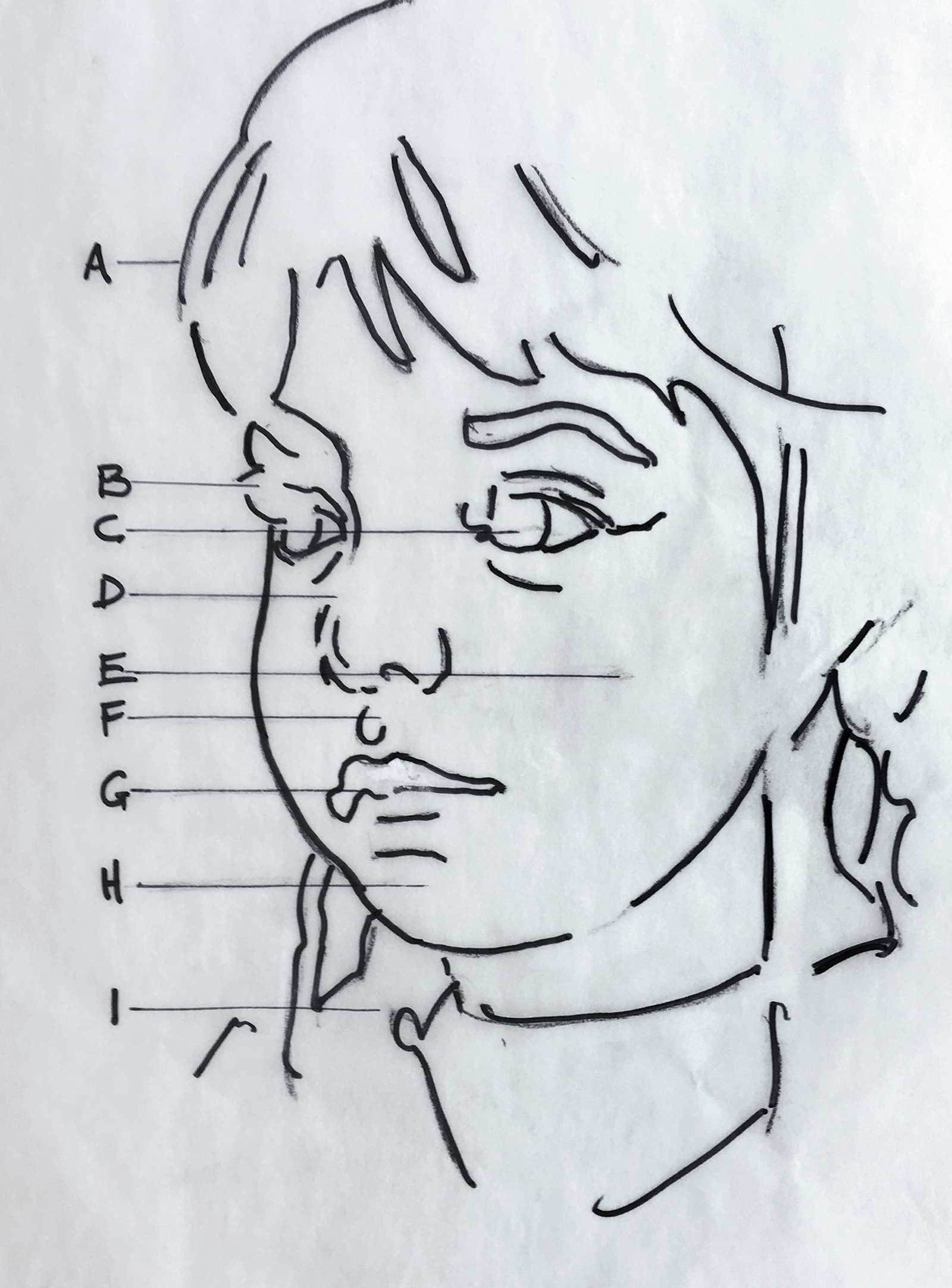
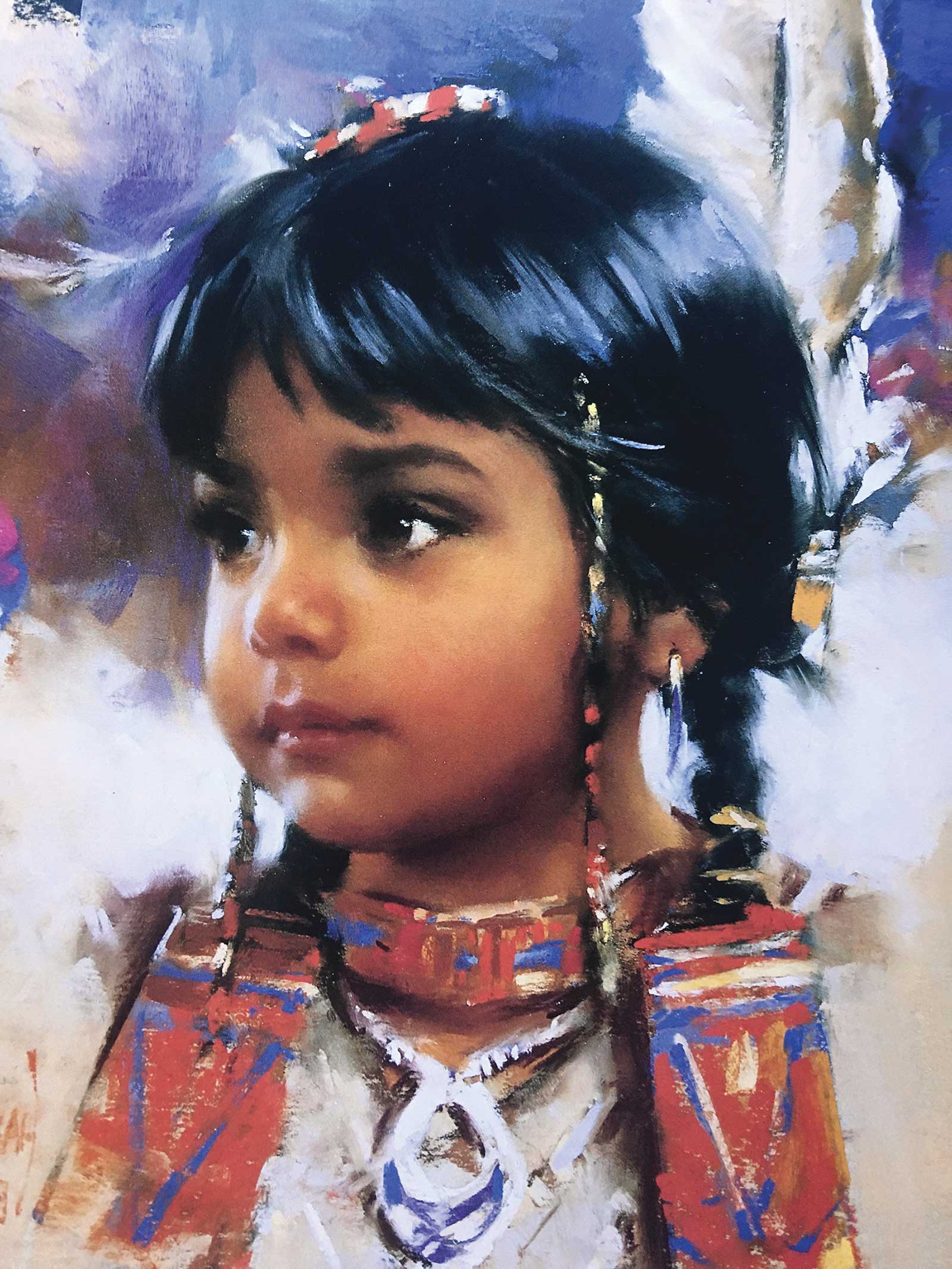
I’ll explain my reflected lights with Young Dancer, a pastel I did of this young girl who was very involved with ceremonies in a grand First Nation gathering. Her face needed extreme observations because any flaw would stand out. At the same time, it would be my personal pastel interpretation. I’ll explain certain areas:
A. This reflection of light gives life and reality to edge of her hair.
B. Dark areas of eye and eyebrow connect together.
C. The eye on the left sparkles on the edge. The other eye has sparkle within the edge.
D. The nose tip and upper cheek reflect slightly stronger with light coming from the upper left.
E. The area of this cheek contrasts with reflected light on the other side.
F. See subtle lighter parts on the area between the upper lip and nose.
G. I did not use lip anatomy, but followed what was observed.
H. Lost and found edges on the chin. Slightly softer on cheek edge.
I. Beads, braids, etc. are done looser, contrasting with delicate accuracy of face.
A Few Thoughts on the Camera
A camera is like a very good assistant and does what it is told. We use a photograph for many reasons. For example, a complex scene that will be there for only an instant. Certainly, we can set up a scene with good lighting, composition and facial expression. That’s great in getting a work going in a major way. We also have to bring ourselves into the piece; picking and choosing parts we keep, parts we use less of or not at all. Colors we might enrich, maybe near the center of interest. Or colors we can tone down.
I will sometimes replace the face if needed, maybe redo folds in sleeves, etc. All options are open; our studio is like a film, with changes of characters, backgrounds, mood and design. Of course, I’ve had photographs that have it all, even things I wasn’t expecting.
What I’m saying is that a photograph records what a particular scene will give us. We artists have total freedom to do what we need with that photo image, including areas we should pay attention to while accurately interpreting facial features, or a deer running or a cabin at sunset. My cameras have given me several lifetimes of photographs that have been taken all over the world under bizarre conditions. These cameras have handed me so many great subjects and say to me, “We gave you plenty of images Harley, now do what you will with them! You!”
I wonder how Rembrandt would work with a camera if he was transported to our present time. An epic drama, starting with him in his Amsterdam studio…then magically brought to 2022 and into a grand West Coast studio overlooking the Pacific Ocean. After getting accustomed to his new world along with a first-class digital camera, how would Rembrandt’s paintings begin and end as they appear before our eyes, dear reader? Created from both life and use of photographs. Think about that. Puts my mind into a whirl…got to take a break.
SHADOW SHAPES
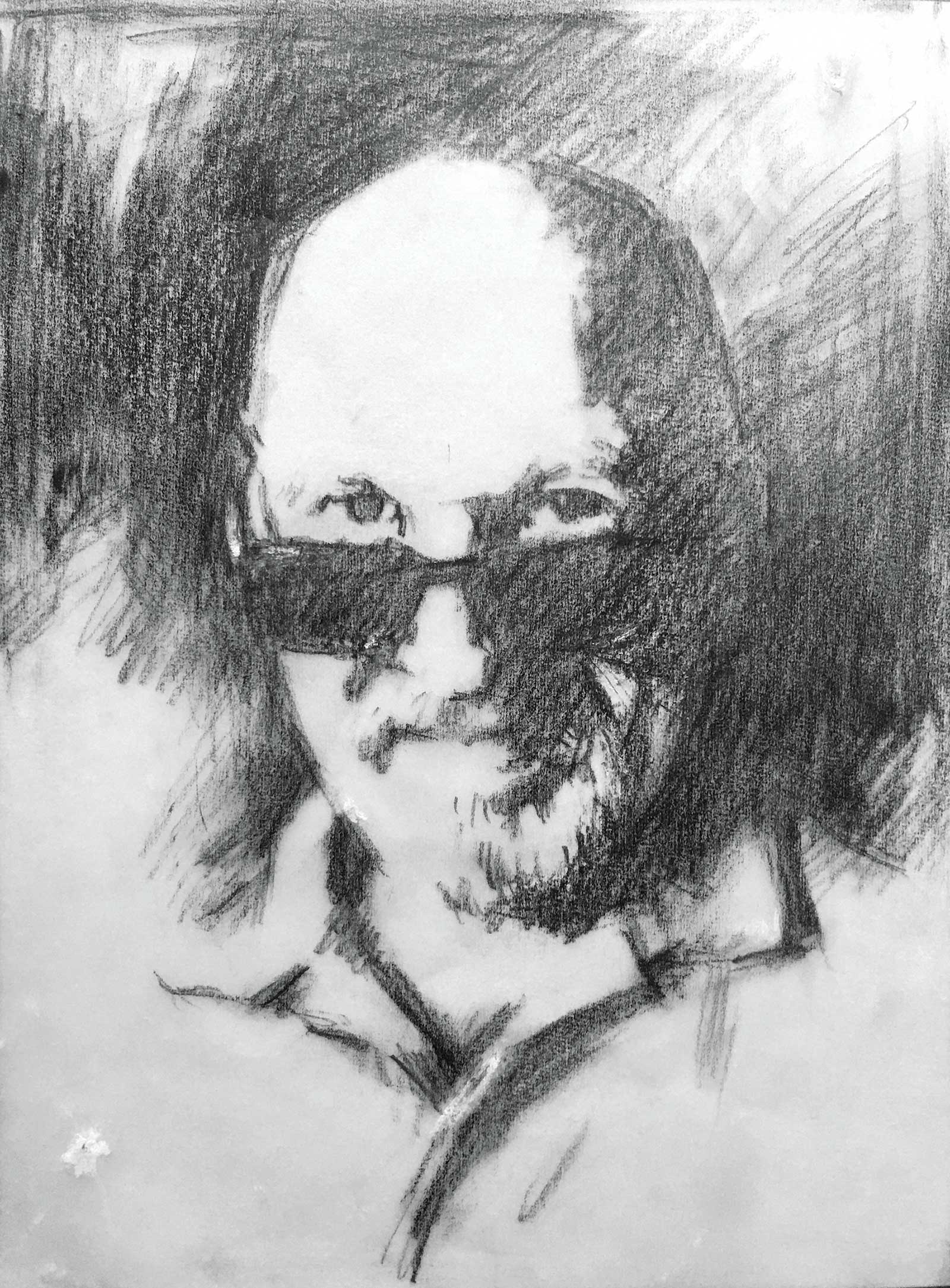
Spend a few days drawing shadows as shapes. Many years ago, I learned from mentors, showing me that shadows are part of an artwork’s design and not just showing bone structure or folds in fabric. I have here a quick sketch of a black-and-white photograph. The lights and shadows help shape the artwork’s design, as well as the background. Give it a try, implanting it into your mind.
Rejuvenation
I love to create images on paper with a pencil. One of the main things that kept me bursting with pure joy for all my years in art was drawing from life. Yes, now I often draw from photos, but I still work from life, drawing whatever I see around me. Tonight, the cat is resting on the bed. The resilient mental strength this gives me cannot be explained. I’ll give you a break; you can certainly do those sketches from photographs. And while you’re laying down the strokes, your brain cells are bringing you an inspiring ecstasy within your art life. No exaggeration. You, dear reader, know I speak the truth here.
Reality
In art we take nothing for granted. Every feature of a face, the trees along that horizon, folds in the clothing. Clouds above. Personally, I don’t trust using my memory with getting something right. I always go to the source, the real thing. Through our years, we visually understand what reality gives us. We meet reality halfway, and we take it from there.
MRS YELLOW SUN
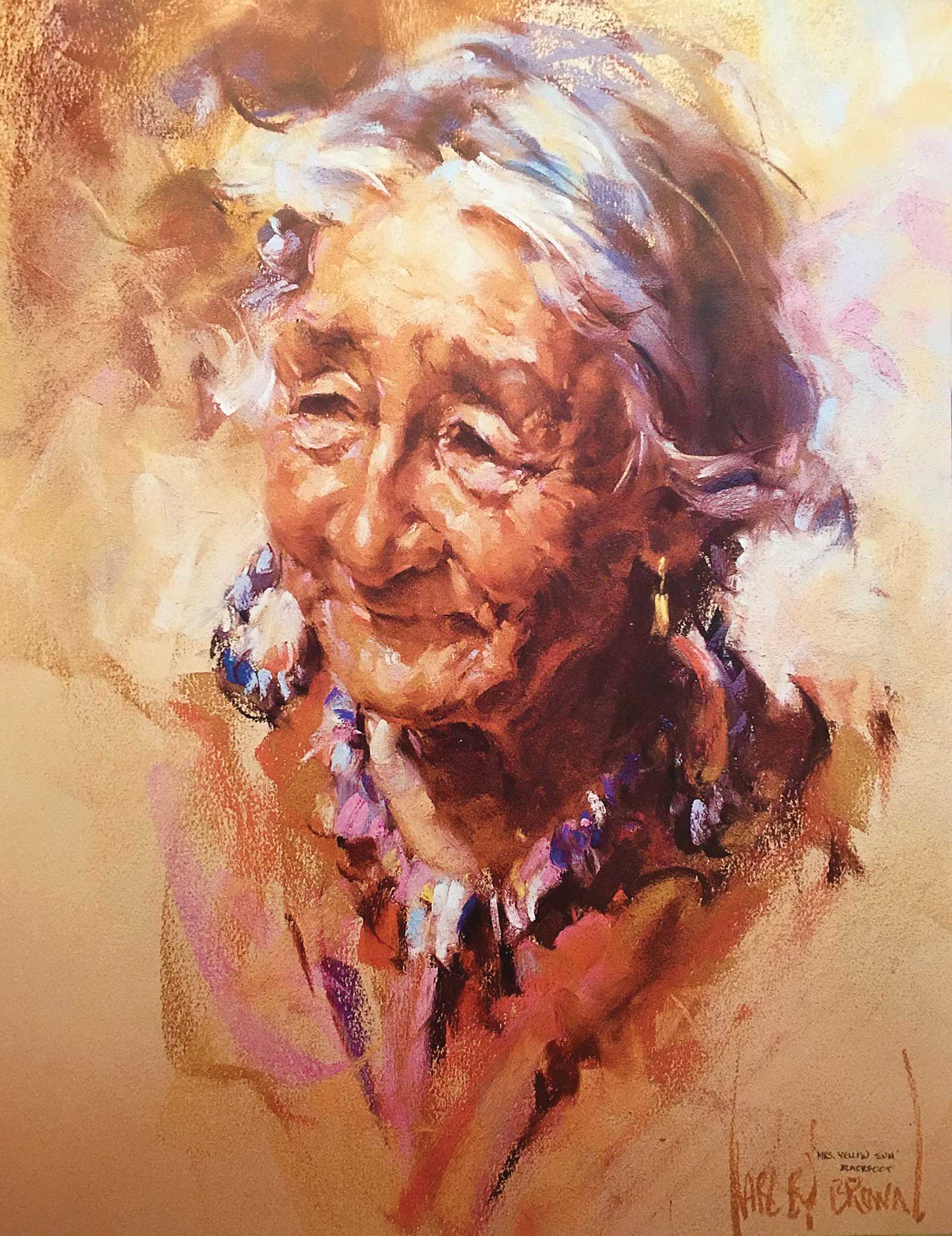
This pastel shows the combination of accuracy and art. “Accuracy” took me many years of observations and intense “practice.” My personal art approach developed naturally on its own over time. As I felt more secure, I allowed the passion within me to steadily find itself onto the paper or canvas.
With Mrs. Yellow Sun’s facial features, you can see the accuracy joined with a spirited approach; like in ballet or playing an instrument. Her hair, her features, background, necklace, all done with the excitement of creating. Her character is there with her joyful expression; features at angle, head turned, lights, shadows, locks of hair tossed, background. All worked on, back-and-forth. I remember the final moment, the dark curved stroke of hair on top left.
A Reveal
I have periodically thought about this and I’m now bringing it here to you: Throughout my life, I happily never graduated into “adulthood.” I remember in my teens, observing older folks doing very grown-up things, like running cities, ranchers, teachers, mechanics and owning galleries. What I’m saying is that after the teen years, we are expected to evolve into being grown-ups.
I surely wasn’t looking forward to that. My mind kept telling me, “Hold back Harley, this isn’t for you. Remain just who you are.” Well thankfully, I listen to my brain. My early 20s were spent in art colleges; gratefully it wasn’t in a chemistry lab or being taught business financing. I was a self-possessed artist, starting out with a peddler’s license and selling my art door-to-door. And from there on, a fascinating trip in life with art.
Yes, there came times I played a “grown-up,” getting a mortgage when buying a house, going to normal functions and chatting in a friendly manner with adults. Most of all, being a loving, responsible, joyful parent. At the same time, I continued having my eccentric existence and not getting too frazzled about worldly problems. I’d keep my thoughts moving in this fulfilling existence of being an artist. So, dear reader…espresso’s on me. —
BALINOFSKI
REMEMBRANCE
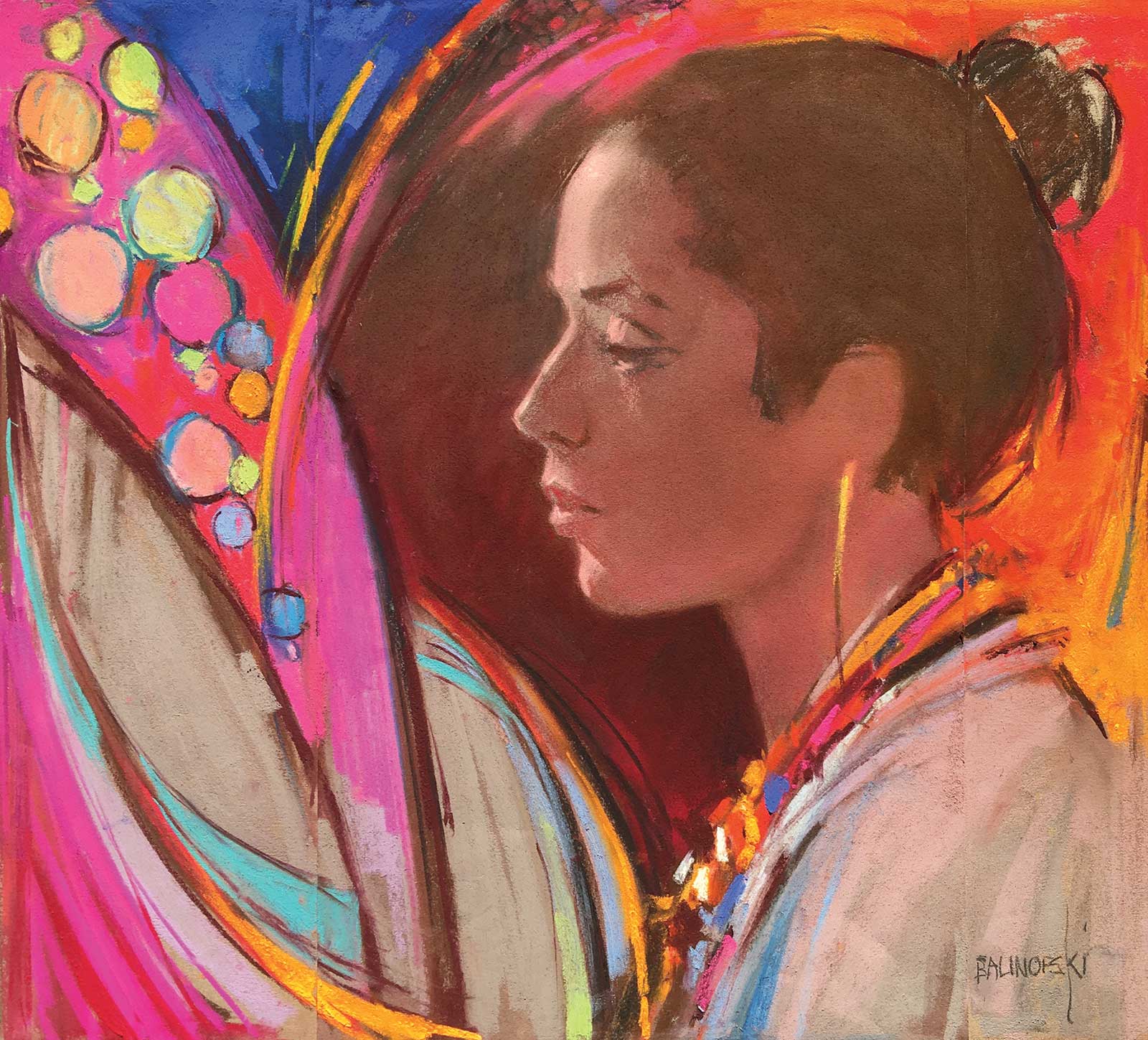
A good while ago, this lady was at an open art class, standing to my right as we drew the model. I got totally enthused looking at the way the light was on her profile. Quickly I grabbed a new sheet of pastel paper and sketched the light touching her face, which didn’t last long as she moved to another part of the room.
I recently found the drawing of her, and the excitement of seeing her original profile sketch got me going, adding lines, shapes and colors. It was a moment of aesthetic enthusiasm where I didn’t ponder what to do, it just flowed from me. The original profile you see was left untouched, except I added a stroke for the earring, symbolically joining her to her surroundings. Here is the result of that particular experience. In a way, this portrayal took 20 years to complete; the profile itself 20 years ago; the added colors and shapes last week. Another moment that will stay with me.