Art can keep us joyfully settled within ourselves, content each day even with real challenges. Challenges are motivating; they keep the brain cells charged and blood circulating. I got into art because from the start it was and is and will be life. What is life? I continue to find that out every day
Once I put the first few strokes onto paper, my inner feeling blossoms, and it stays even if I walk away from the easel after five minutes. Those strokes are reminders of an obsession, keeping our hearts and minds alive in the best ways. Age means nothing to me; my mind is half my age. (Knock on wood.)
Visions are continuations that feed into the brain. I might be observing passengers’ expressions on an airplane or working out the foreground and background in a painting. You, dear reader, and I are different than most; visions are there for us to re-create on canvas and paper. Our eyes go to our subject and over to our developing art piece. As time progresses, the flow becomes more natural, keeping our thinking ready and moving. Many of my art friends are in their 90s and every one of them is continually inspired.
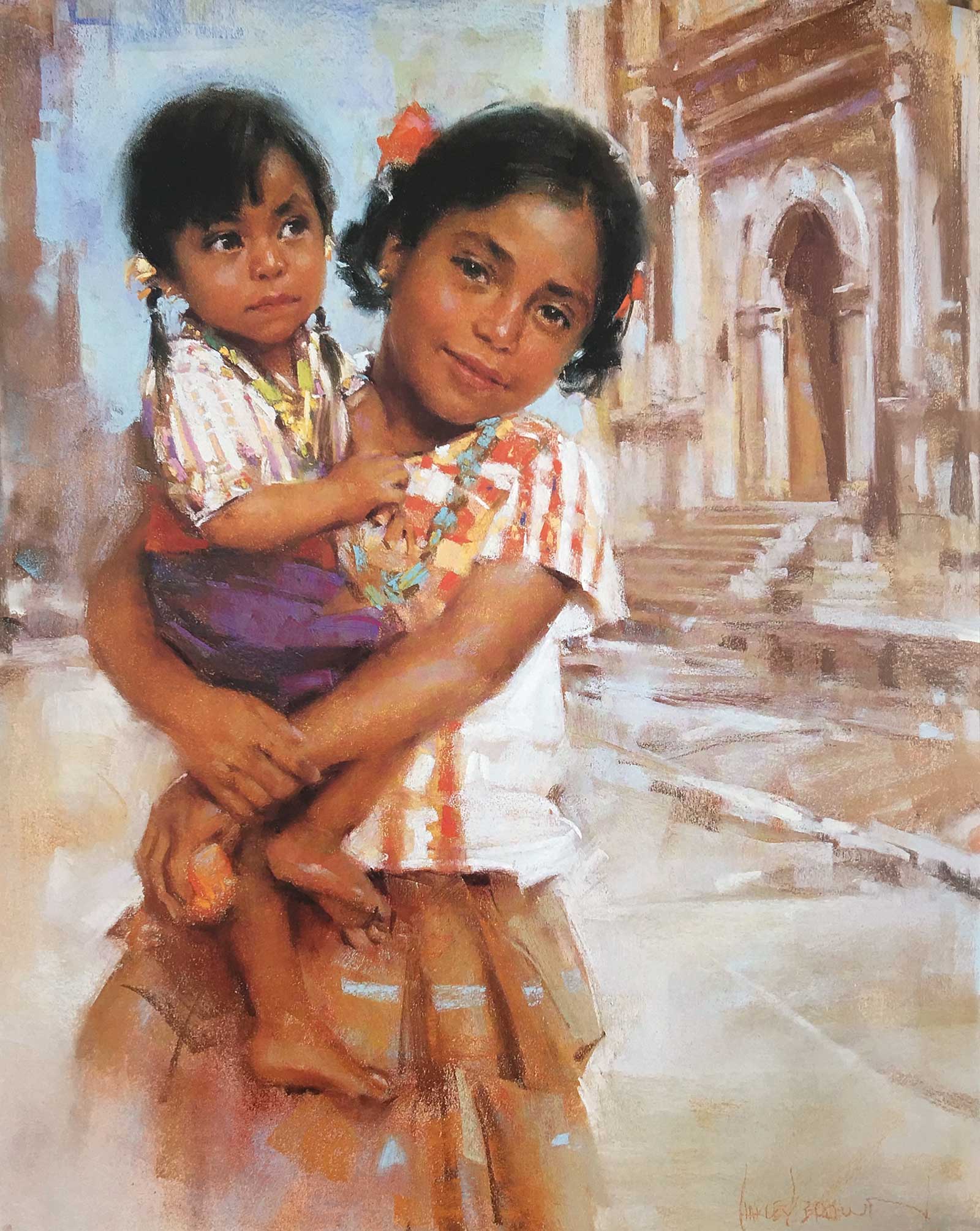
ROSA
ROSA
Young Rosa helped a number of us artists in Oaxaca. For several days, she took us to out-of-the-way places and found wonderful subjects. She even dressed and posed some of the people. In this pastel, she is taking her little sister to church. Grand memories.
You and I, We Create
I received a lot of advice in my early years. In time, I begin to know what wisdom to keep and what to set aside; a natural give and take. We each have our uniqueness, keeping what works for us. I eventually came to a point when I had no doubt of my “artistic direction.” I can veer if I want to; nothing is engraved in stone. Let me put it this way: if I really wanted to spend my future days playing piano in a bar, I’d do it. Most important: my wants are creative.
Drawing What We See
In my younger years, I was able to draw a figure fairly well. I could also draw a dog or tree. I was understanding that we learn to observe and draw what we observe. Putting it another way, I’ve never drawn a kangaroo, but I know if I did, it would be as good as one of my portraits. We don’t learn to draw specific things, we learn to draw what’s in front of us. You and me both. Remember: a subject drawn or painted with accurate shapes and values—you are making it happen.
It is up to you the artist whether or not to lighten halftones and darken shadows. In the same way you want to accentuate that shape or push a color. The well-developed inner mind quite enjoys taking control of those moments. “Representational art” is not from a human camera. It’s our subject being realistically drawn yet with plenty of each of us poured into it.
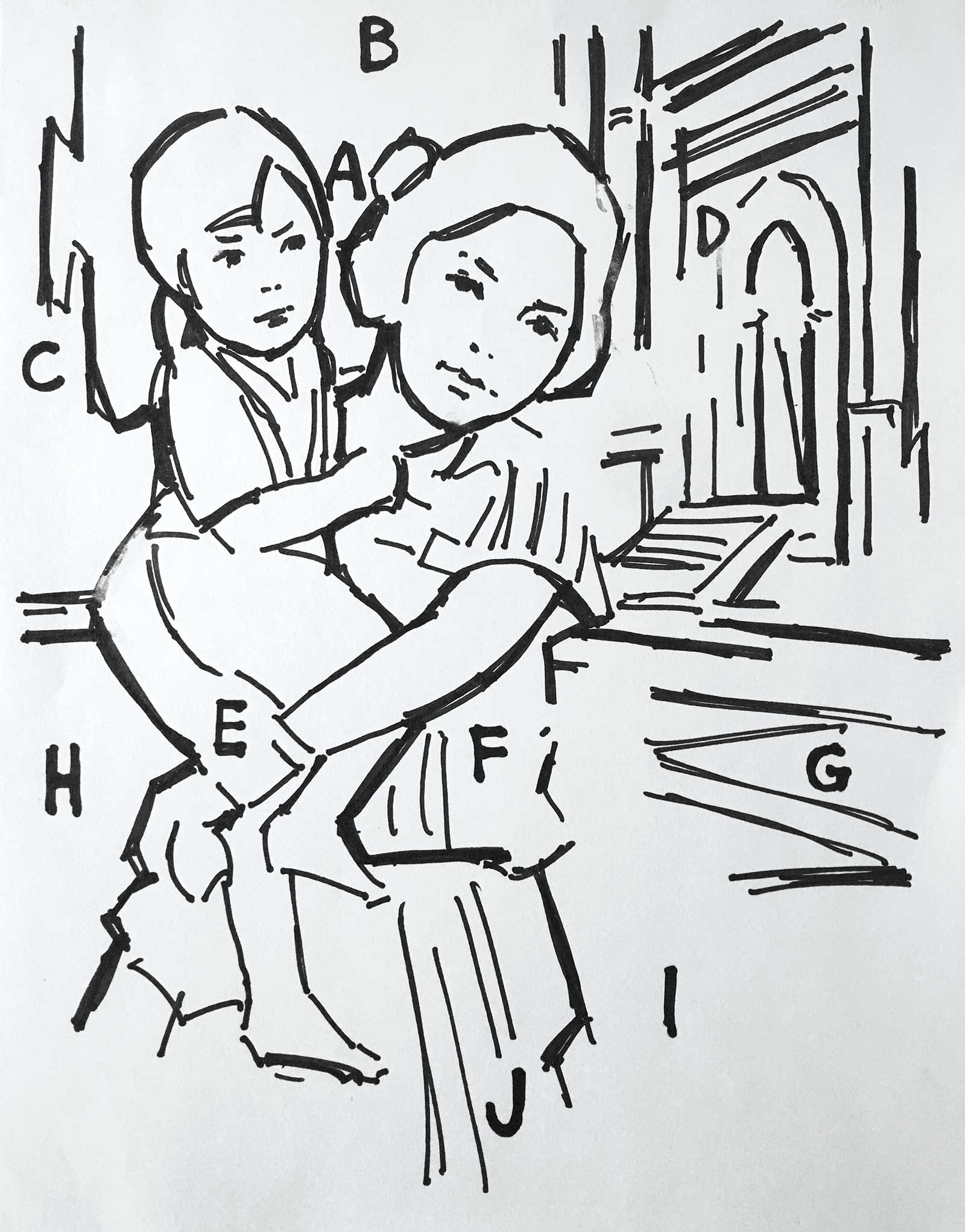
Here, I’m breaking down the pastel Rosa to parts I find important:
Here, I’m breaking down the pastel Rosa to parts I find important:
A. Here’s the center of interest. Rosa is looking at us and her sister is curious about something to the side. Their heads tipped with hair as darkest parts of the work. Blouses the lightest. Strongest colors are in that area.
B. Warmth of their faces is contrast to cool sky.
C and D: Vertical areas helped stabilize with visual movement of angles throughout this work. The steps and arched church entrance show where the girls will be going.
E. A complex joining of hands and legs; quietly in the shade, adding to the sisters’ loving closeness.
F. Angled arm, important in composition. Also, that angle visually continues up those steps to the entrance.
G. Vague street perspective; sense of where Rosa stands with sister.
H. Necessary shape next to girls with cool street color; similar to sky effect.
I and J. The lower part of this pastel fades, less details, allowing the upper part even more importance.
Yes, yes, yes when laying on the pastel, oil, charcoal, pencil strokes, be accurate—something I continually talk about. Eventually you get to the point where your individuality steps in and takes control…knowing just how much you want to make that nose exact, the hand on the hip, the folds in the fabric. When starting out, I tried mightily to get these things just right. In time my mind got stronger understanding accuracy and knew how to subjectively use it. Think Degas and Fechin. Both are great representations of an artist but so very different. Oh, to see the two of them in an art studio painting the same model at the same time. That alone would be a classic film. Every artist and lover of art in the world would want to see it. (I offer myself to pose.)
Details in Art
Keep in mind that the further away a subject is, the less detail is seen. This is in real life and in art. Both details in color are slowly “muted” the further away the subject. Think extreme: a close-up portrayal of a face with mountains in the background. This is a way of giving depth to a work. Closer gives detail, with less and less as subjects recede.
Also think about detail and looseness this way: When I do a detailed portrait, where the work is mostly with the features. I sometimes make areas around the face purposely less detailed, including parts of hair and shoulders. If there are hands involved, I’ll put details in them, but not as exacting as the face. Remember that hands add to the design of the work; everything, including background, are part of the overall design. That sounds obvious but sometimes forgotten.
I so often talk about design; considering what dark and light areas can do to a drawing or painting. Just ask Rembrandt or Toulouse-Lautrec or Rockwell or Franz Kline.
Seeing the Light
Areas that receive light, highlights and reflected lights are of prime importance. Getting those light values wrong even slightly can ruin a work no matter if the overall art piece is well done. Sometimes I’ll see a marvelous painting and then observe all the highlights are the same, as if the artist dabbed each of those spots and areas with the same oil on the brush, one right after the other. The value differences, even if slight, should be observed and applied.
Values and Colors
Nothing wrong with understanding basic anatomy, but early on I began to acknowledge accurate shapes and values against one another. I put a face together by intensely looking at those bold and intricate shapes and values a face visually shows me. I’ve portrayed tens of thousands of human heads with no two alike; so variable that I can’t wait to start my next one today. It’ll be a challenge and will take all I’ve got.
It took me a while to fully realize that value is more basically important than color. In other words, if the values within the work are off and don’t effectively bring forth the subject, then color will certainly not save it. This is true: Understand values, then color will begin to come naturally. (Also with the help of Munsell color theory.) Sometimes my hand will grab an odd color that is the value needed and I go for it. Remember, the inner mind is built upon experience. Right now, lay this magazine down and do a value drawing of something in the kitchen.
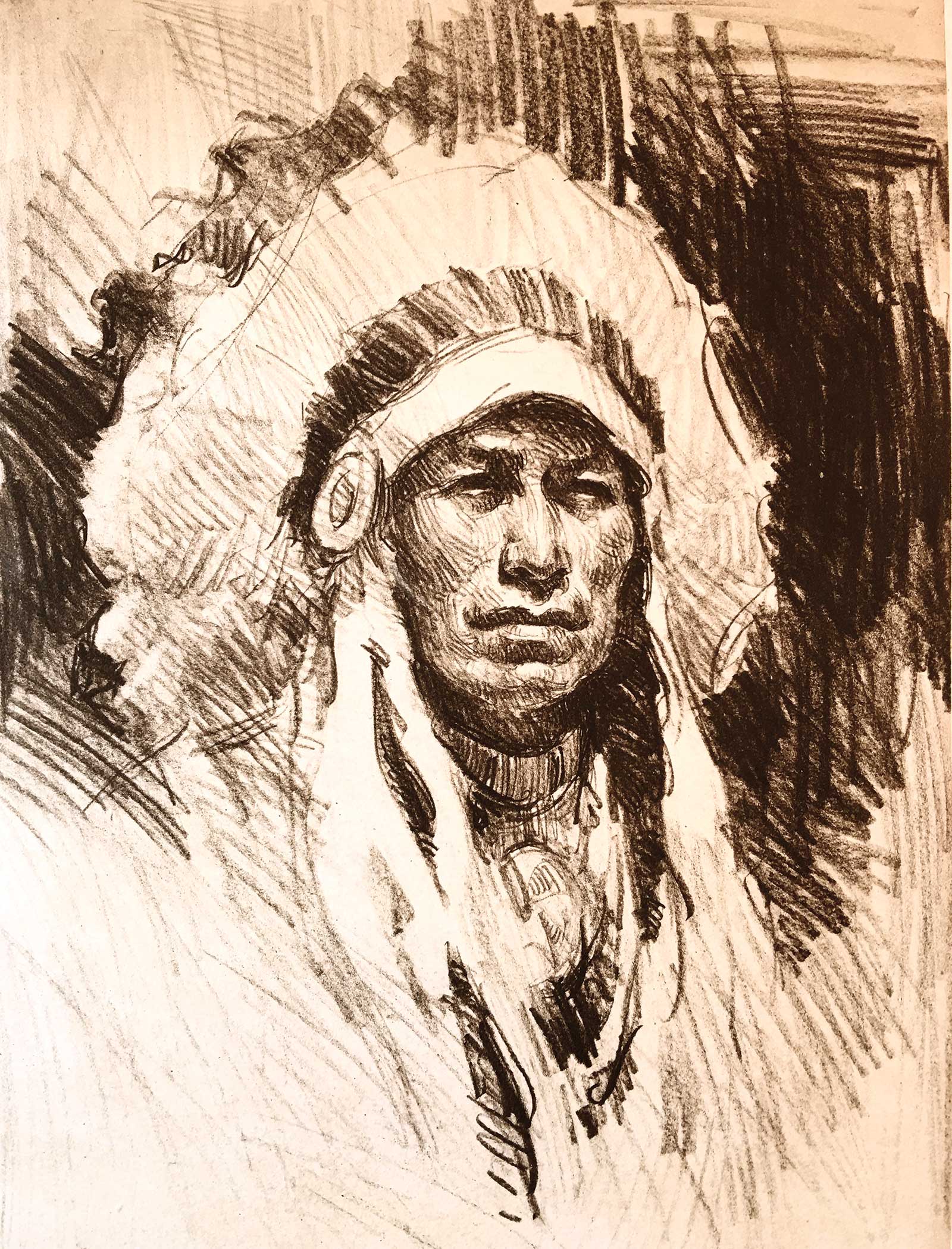
TRADITION
TRADITION
This is a black and white drawing of a man with his traditional headdress in the composition. You can see light and dark valued shapes throughout. Some shapes are bold and flat, some softer. All essentially accurate. They dramatically bring this grand person forth with an overall design that adds visual strength and life to the art-piece.
Grand Dramas
When I work with an expression on the model’s face, I sometimes have a tendency to push a certain look. The furrow in a brow, the questioning eyes, a slight smile. I can ease up on them or exaggerate; the slightest touch can be quite dramatic. The faint smile on a lady’s face can be revealing…Ah, what are her thoughts? A child with large eyes and raised eyebrows…such innocence. A fellow with an expectant squint…an adventure awaits him. We artists are in charge of this area of the arts. Like plotting a grand story—visual drama.
Also…
I’ve drawn eyes all my life. I can tell you that those eyes, to this day, remain a fascinating mystery. Anatomically, they’re basically the same, but when I look at them, the slightest differences are actually monumental differences. What I’m saying is this: take great care with all parts of the face; at the same time, look at those eyes and what they reveal both physically, emotionally and spiritually. I’ll add here that eyebrows need the same loving attention. Do not take eyes for granted. I say this with decades of devotion with the human face; when we look at a person, most of the time we connect with the eyes. Nose and mouth are important, but the eyes silently speak to us.
Purpose of Self
With your art, you want your work to have a reason it exists. Why you painted or drew it. With a face, it could be that dramatic lighting, or the beguiling turn of the head. Quite simply it could be the portrayal of a phenomenally interesting person with distinct facial features. We can see the artist’s total enthusiasm and purpose at the easel. The artist sees and feels something with the model. That alone comes through as the reason this artwork exists. A heartfelt moment we witness both subject and artist.
I Repeat, Don’t Forget:
• Dominant value; not equal light and dark.
• Dominant color; not equal warm and cool.
• Horizontal and vertical areas for stability; angles give movement.
• So very important: design and composition
These basics work in both representational and contemporary worlds. It’s up to the artists. Look more at your subject. Much more. Your subject is giving to you in the same way that Shakespeare gives to the actor and Balanchine gives to the dancer. You take what’s given and respond with yourself.
I remember in my early 20s being told I should be putting “more of myself” into my artwork. In truth, I really didn’t know who “myself” actually was, other than a guy learning how to put the image of a model onto canvas. At the same time, some other artists were beginning to fill their canvases with wild strokes using every color on their palettes. I wondered, were they really putting “more of themselves” into their works? More of their real self?
Picasso, in his early life, created many representational paintings before he went into cubism. I’ll add no matter our approach to art, we’re all part of this world and our cultural environment. I love that we’re each free to go our own way.
Basically This
How I learned my art: I started drawing at 7 years old under my father’s guidance. Then art colleges, art books, mentors. I never compared myself to others. Never thought of myself as good or bad, just concerned with learning and developing. I knew my own approach was emerging. My art was me.
This is All to Say
I’m glad when people like my art, and with those who don’t, I’m really not bothered. In other words, I’m happily settled being Harley. It took a while, and at first, I didn’t understand myself, but in time I got to know me. Not the complex inner mind…I speak of the part that blathers and gets to the easel. And now you know me better. —
BALINOFSKI
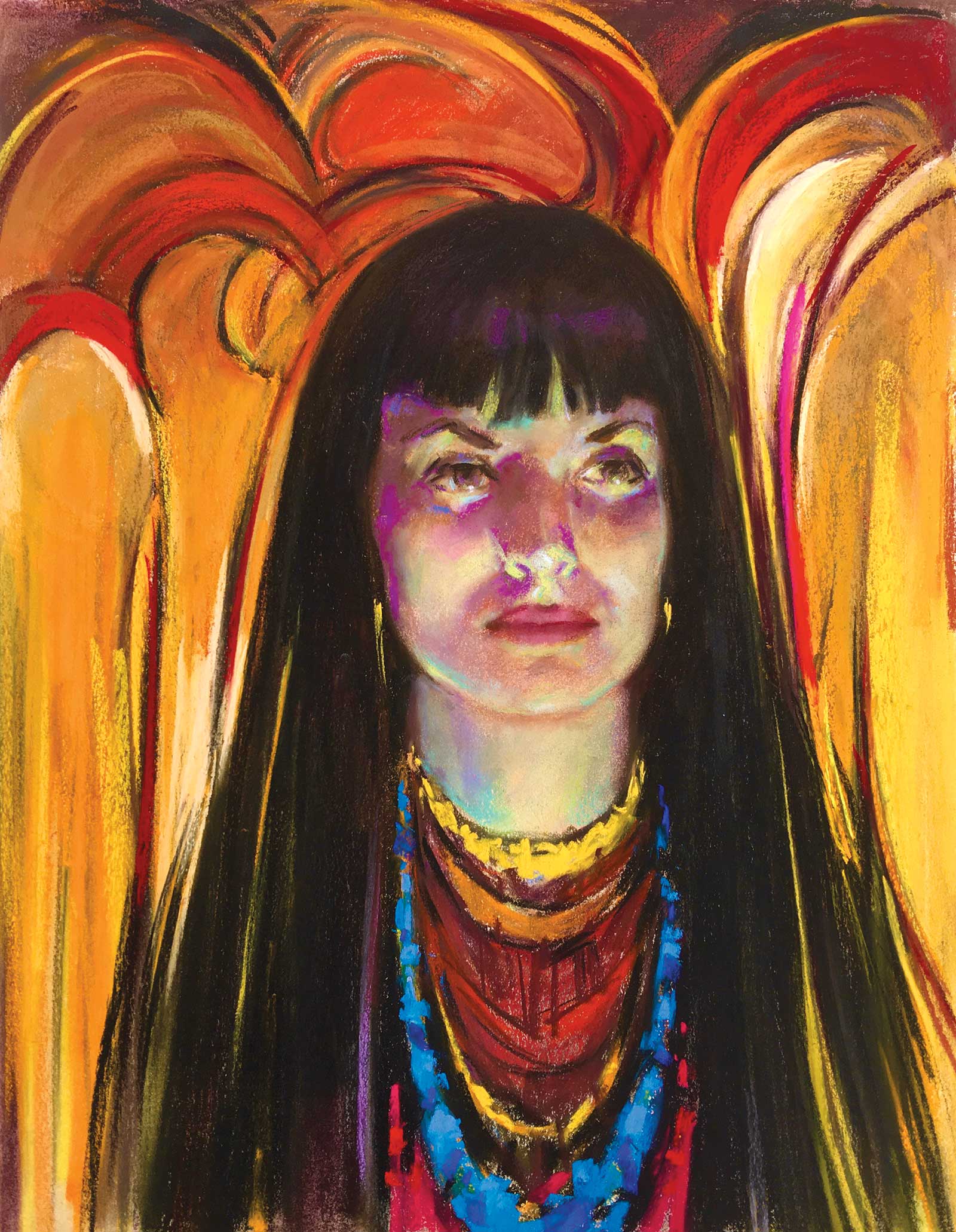
The Blue Necklace
This work is of a lady who sat for both Harley and me. I had seen her years before and the image of her never left me. The colors and motions surrounding her here had been coming into my thoughts for years, and she was perfect in combining my imagination with the real. As with many of the ladies whom I’ve portrayed, she was magnificently memorable. Including her reactions when she would take glances at the work itself. In the end, we parted with me hoping we’d meet again. I will tell you this: that blue necklace itself has great personal importance, and I’ll leave you with that.