As a watercolor artist, I can’t work a painting over time the way an oil painter can. In the moment, as washes dry and wet-into-wet opportunities literally evaporate, watercolors propel you towards the end of the painting. No reworking, scraping paint down to the canvas, or wholesale painting over something. Instead, we have to “think backwards but act forwards.” That means planning. But, as I’m sure many artists have learned with experience, there’s only so much planning one can do. Eventually, you have to get down to the act of painting. We really learn through exploration and experience. And that’s where iteration comes into play. When I’m learning a new technique or working on a new subject, I often work iteratively. Working iteratively allows a number of key benefits as a watercolor artist. Let’s walk through them.
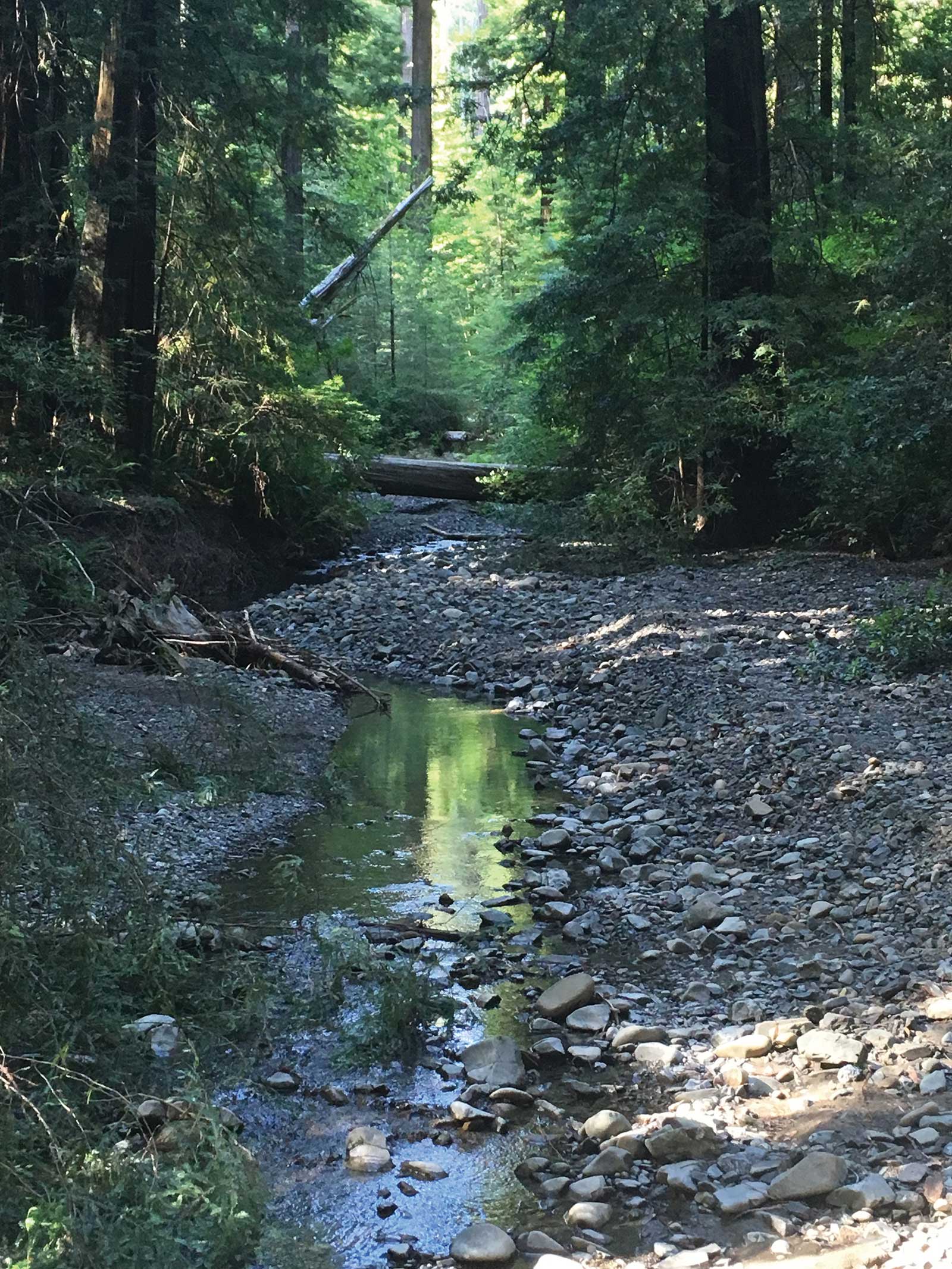
Reference photo.
First is that I no longer have the weight of trying to create a perfect painting on the first go, and that lets me play. This seems obvious but can be incredibly liberating. Exploration and play is really the foundation for learning new things or “self-teaching.” We need the freedom to try things out without the fear of failure, if we want to discover new, unexpected results. Iteration lets me push my limits instead of playing it safe, because I know I’m going to attempt the subject again. Each painting becomes less precious. That lets me change as an artist, discover unexpected compositions and effects, and grow an ever-expanding set of techniques to draw from.
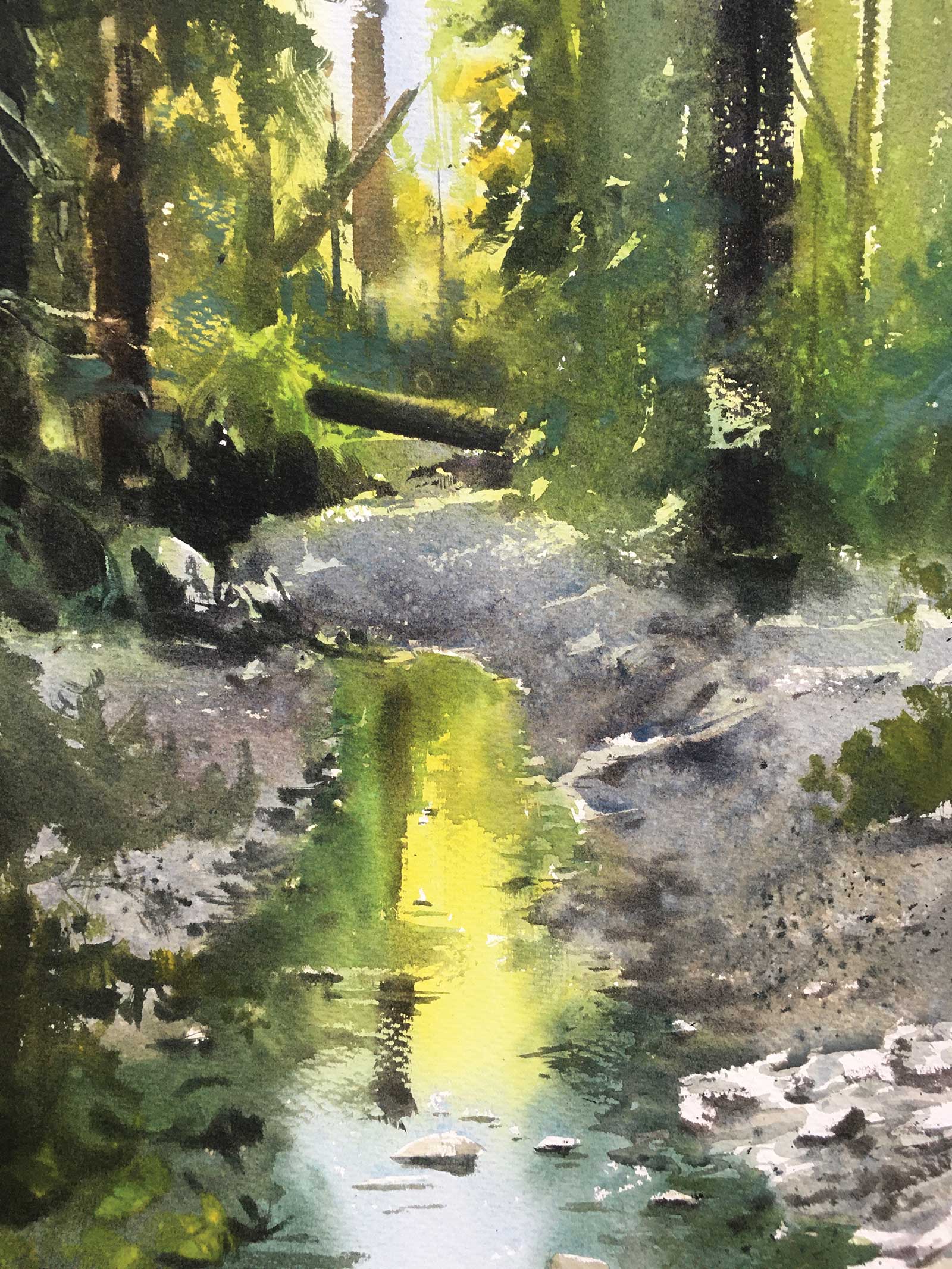
Redwood Reflections, version 1.
Part way through the first draft of Redwood Reflections, I decided I needed mid-valued highlights in the shadows. In the spur of the moment, I decided to splatter an opaque green-white mix into it. This was purely an experiment and came out of play, but I liked this effect, and explored it in each iteration. You’ll see the blue wet-into-wet spatters in the same areas of each version.
Secondly, iteration can help us become better critics of our own work. Of course, everyone hopes to hit it out of the park on the first go, but the deeper goal is to become acquainted with the piece. As my own daughter taught me in 2nd grade, “Mistakes are good food.” Successful paintings are great, but they teach us little. Mistakes are where we grow.
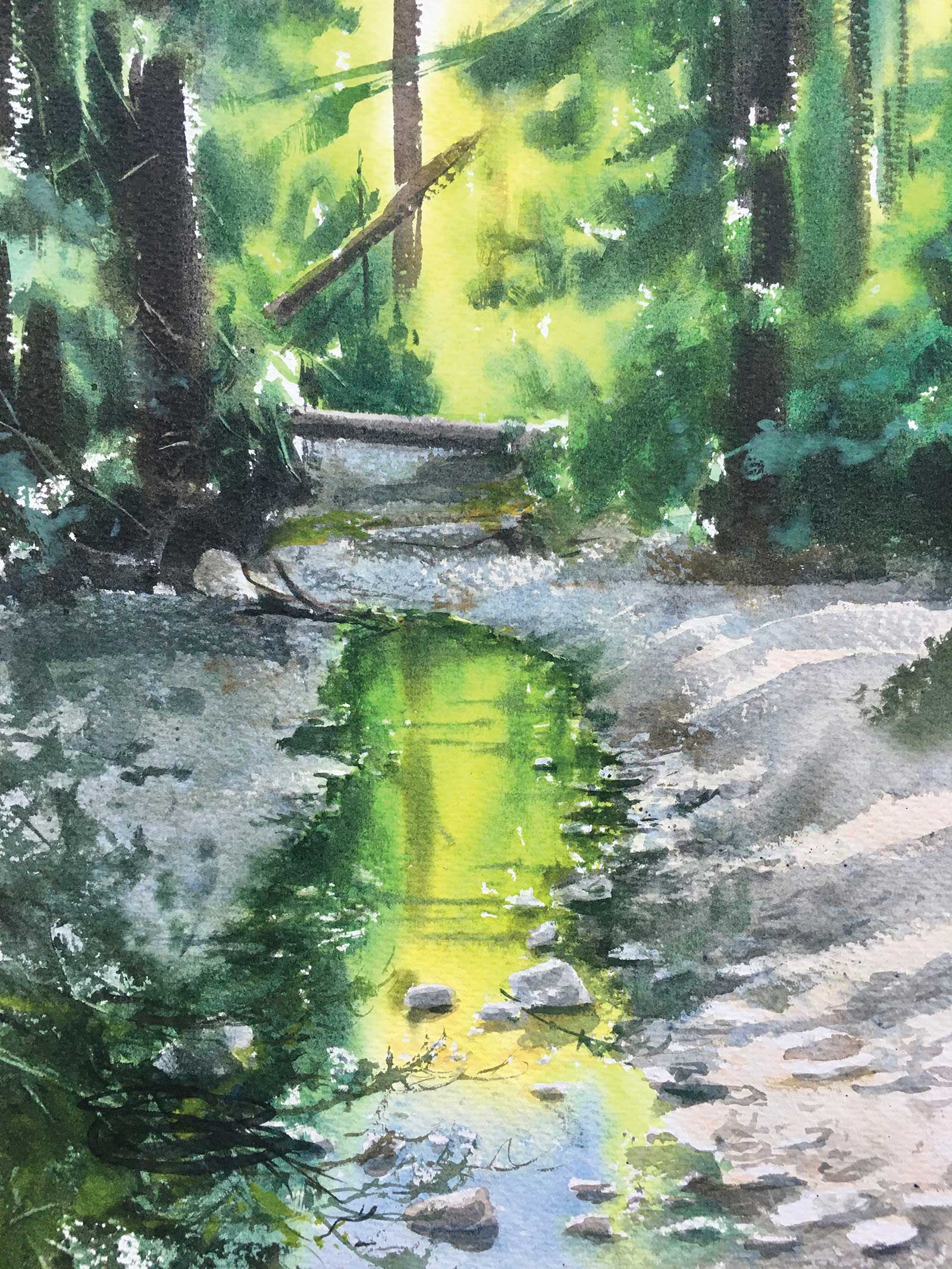
Redwood Reflections, version 2.
In the second version of Redwood Reflections, I aimed to improve the sense of light through a cleaner color application for the trees and water. This was an element of the first version I was clearly dissatisfied with. It was just too muted and dark. I also pushed the warm/cool color contrast in the foreground patches of light. Note how the cast shadows are cooler and lighter in the second version too—a decision born directly from choices I didn’t like in the first go.
Redwood Reflections, version 3.
Iterating allows us to ask compelling questions: What unexpected problems should I be better prepared for next time? How do I want to change the composition to improve it? What color applications would strengthen the lighting? We can dream up ideas before we get going on “the perfect painting,” but answers to these sorts of questions come most easily when we have a finished (not perfect) painting to assess.
Additionally, as I paint a subject more than once, the ability to self-assess grows. Often, I’ll like something better from an earlier piece that was lost in a later draft. But frequently that only becomes clear when we compare it to a later iteration. As we put two or three drafts side by side, we can judge them comparatively, which can help us better see the choices (or accidents!) we made in the construction of each version. This can be a powerful tool for helping us to see our own work from the outside.
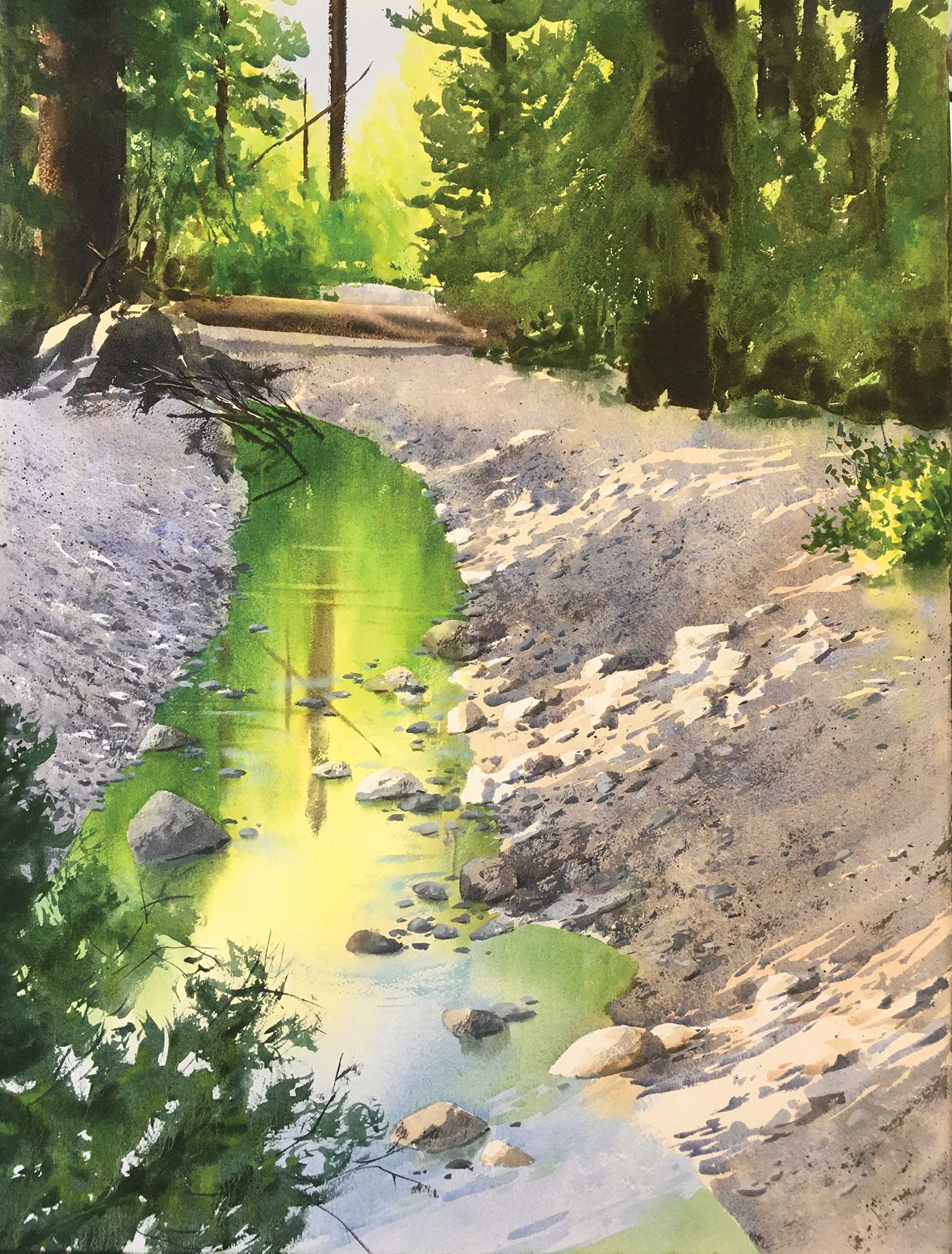
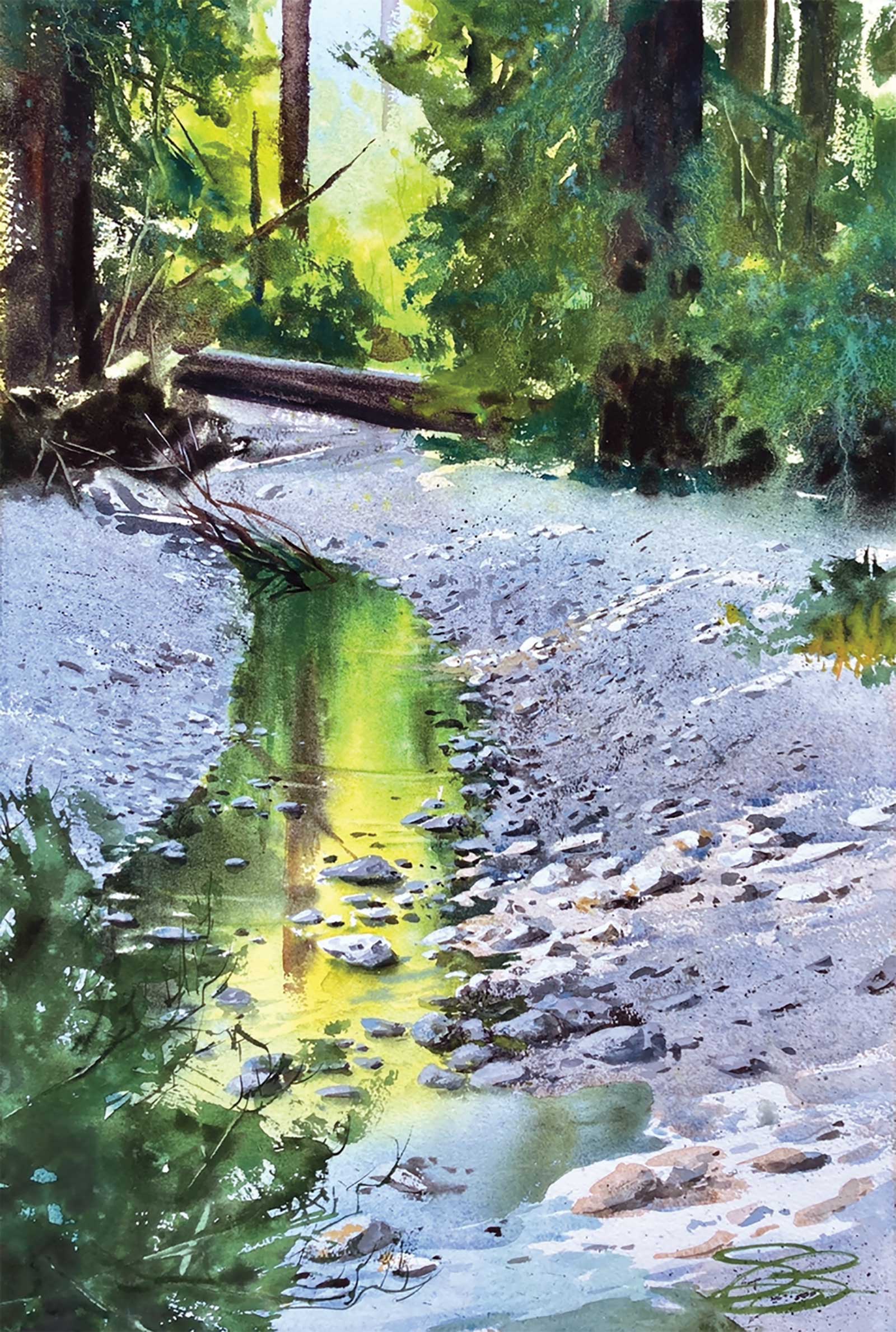
Redwood Reflections, version 4.
For my third attempt, I compared the first two versions and combined elements of both. I liked the hard edges for the trees in version 1, but I preferred the color scheme of version 2. I’ve accentuated the color choices again, with the cast shadows being even cooler and the highlights warmer than version 2. However, both earlier drafts suffered compositionally from being too centered. I want the eye to move around. I shifted the stream left and enhanced the pebbly shoreline to help it read better.
Even at this point, I felt there were further improvements I could do. For the fourth and final go, I got more light on the foreground and that little patch of grass on the right. I also made sure to include a darker shadow under that fallen log in the distance, and preserved more highlights on the shoreline rocks. With watercolors, these sorts of value-based design elements require planning and forethought, which is born directly from working on previous iterations.
If you compare the final piece to the original reference photo, you can see how much the composition, lighting and color contrast has changed. The more I iterate a piece, the more clearly I know what I want from it, and the better I understand what I want, the less I copy what I see. Instead, as I go further into the journey, I take more and more of my cues from my previous painted versions, both in terms of design and technique. They become my guides and teachers. As a watercolor artist, iterating a subject lets me grow an answer organically, so I can have the confidence and forethought to make loose, free brushstrokes with authority.