The inspiration for this drawing is Juan Manuel, the greatest muse who I met from my Mexico City workshop in June 2021. Juan—who at 82 years young, has a great face with a soulful expression, framed by his extraordinary mane of white hair and big white beard—is the motivation of this drawing.
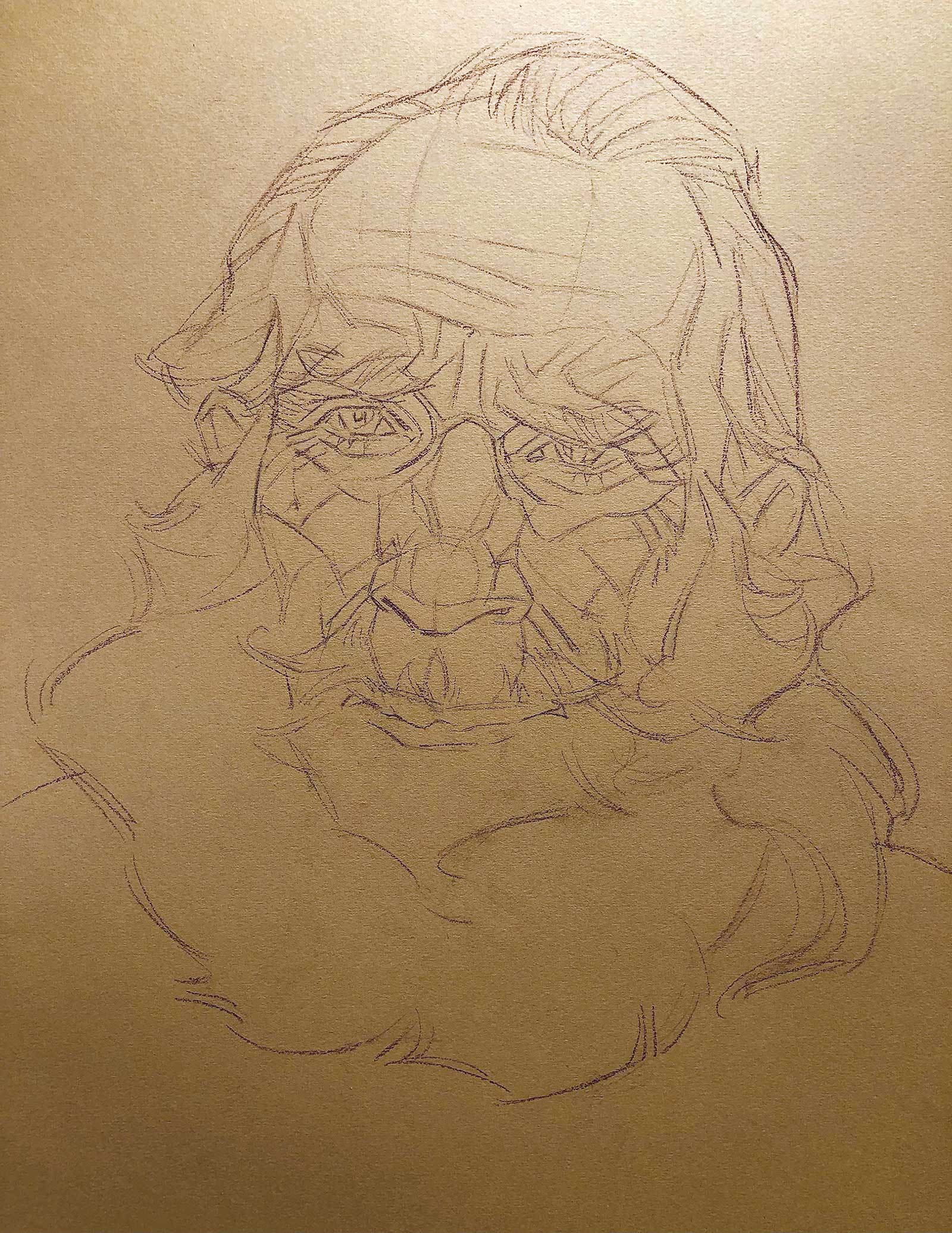
Stage 1: I use a pastel pencil to block in the shapes and plane changes of the head. Keep the line quality extremely light. Pay attention to the proportions of different shapes, re-define the height, width and length of shapes and re-examine the symmetry and relationships. The gesture of the head can establish the attitude of an entire figure and hint at the person’s emotion. I recommend students spend at least 40 to 60 minutes on this stage.
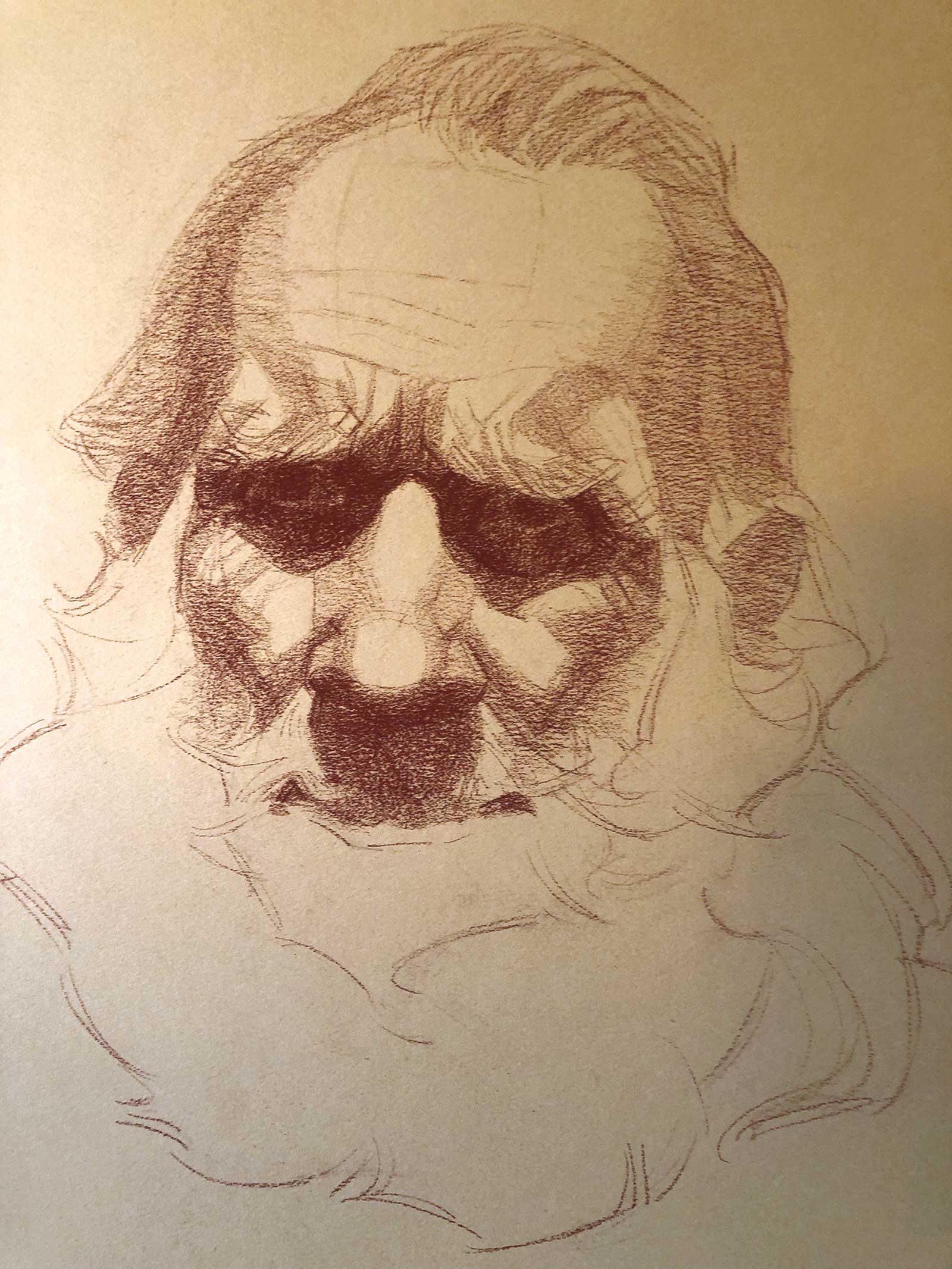
Stage 2: All objects have light, middle and dark values when exposed to light. Blocking-in builds the structure of the head. Darken the shadow shapes by using a pastel pencil. By drawing with the side of your pencil, rather than the tip to apply value to the paper, you will automatically create a soft edge.
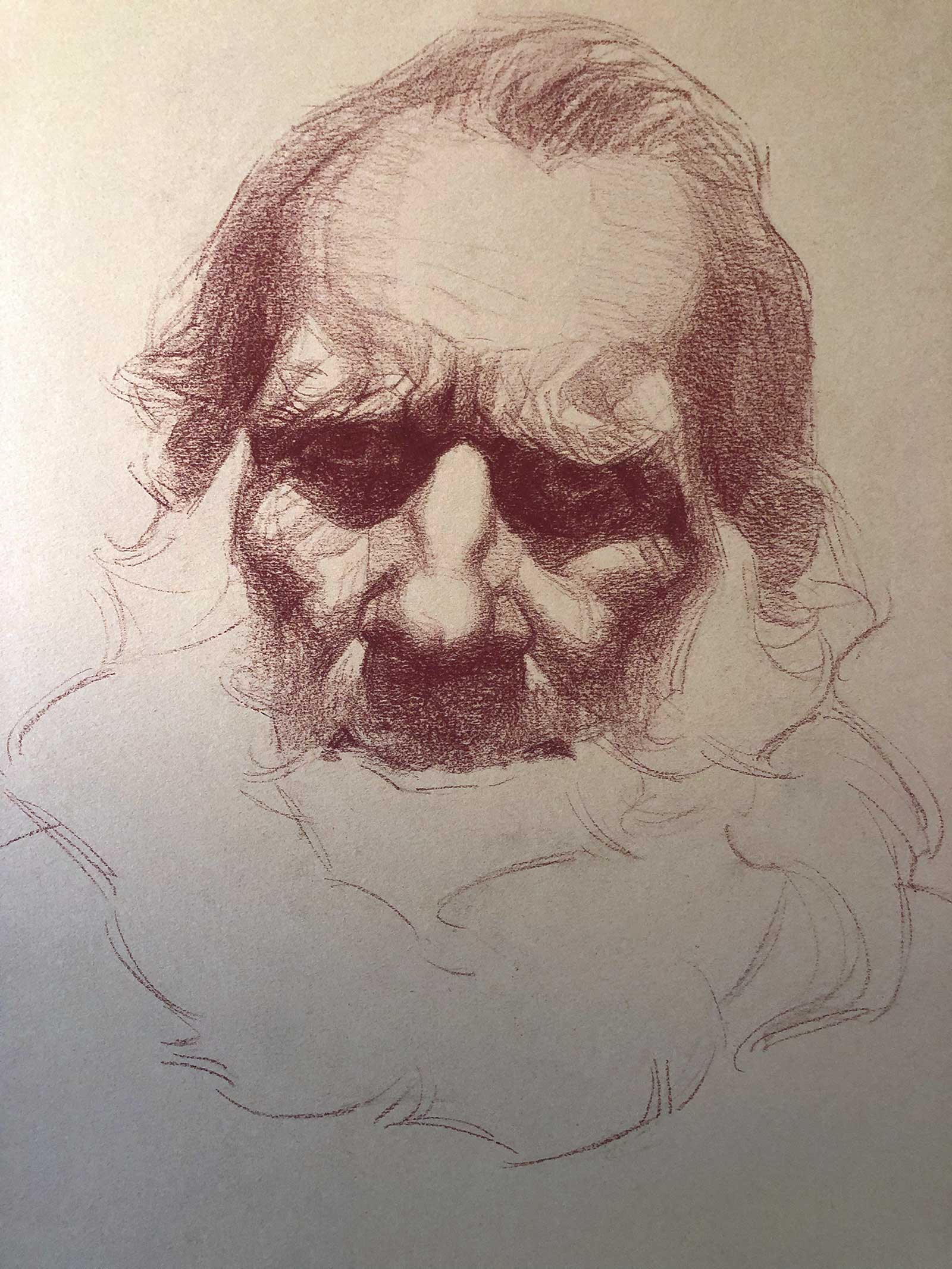
Stage 3: Hatching is a drawing technique in which one draws close parallel lines to build tone and shadow. I recommend either hatching vertically or horizontally to create a pleasing look. Hatch the entire shadow area of the nose, and ignore the nostrils at this point. Don’t darken the light part of the head and let the toned paper be the light part of the head.
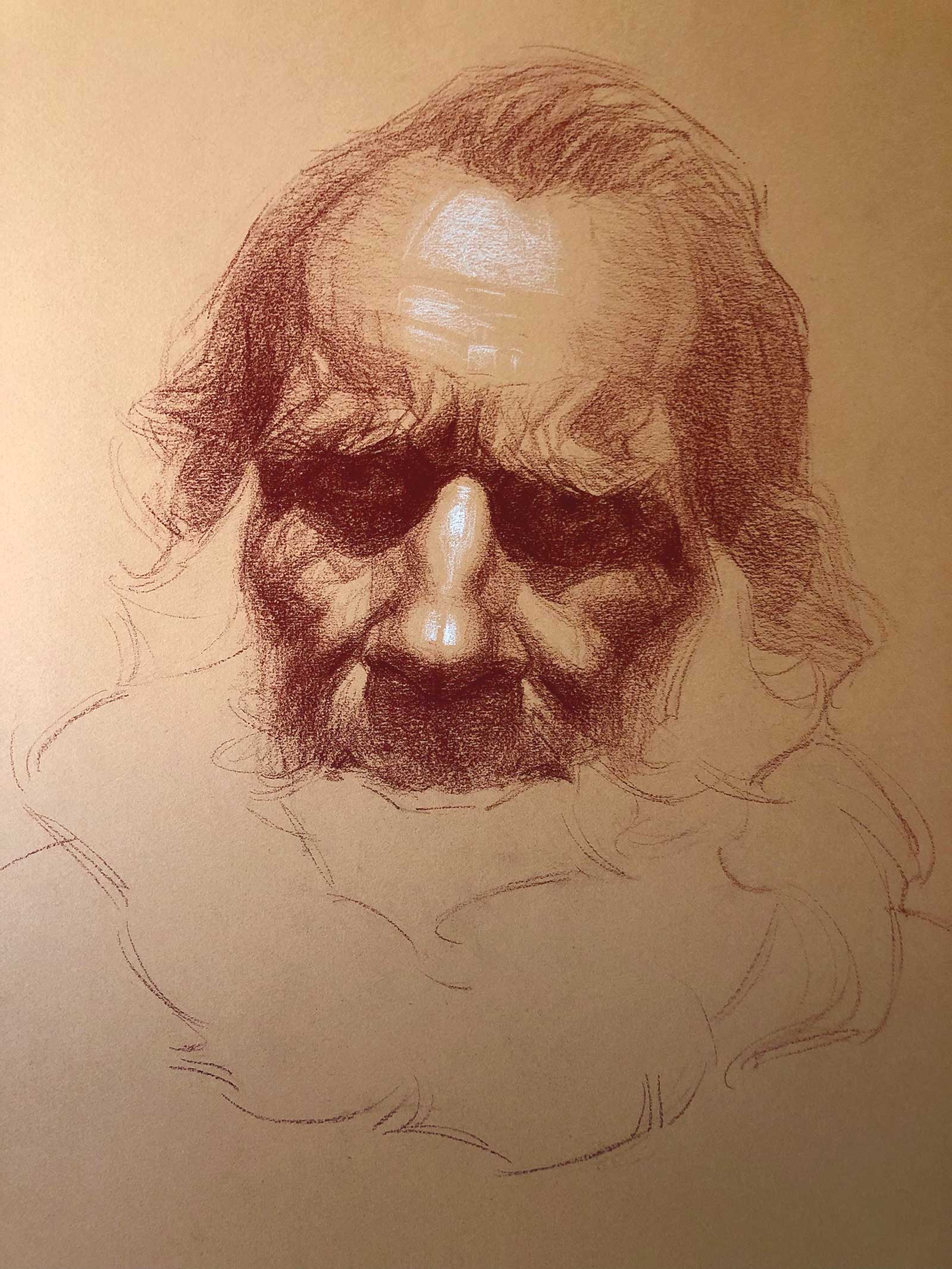
Stage 4: Using white charcoal pencil to add highlights to the light side of the form, I applied highlights on the top plane of the nose and forehead, leaving the paper as halftone and keeping the highlights to a minimum on the face. Remember the paper appears as a halftone value between the light and shadow. If you blend the white and sanguine together, not only will you destroy the middle value of the paper, but you will create a pink color in its place.
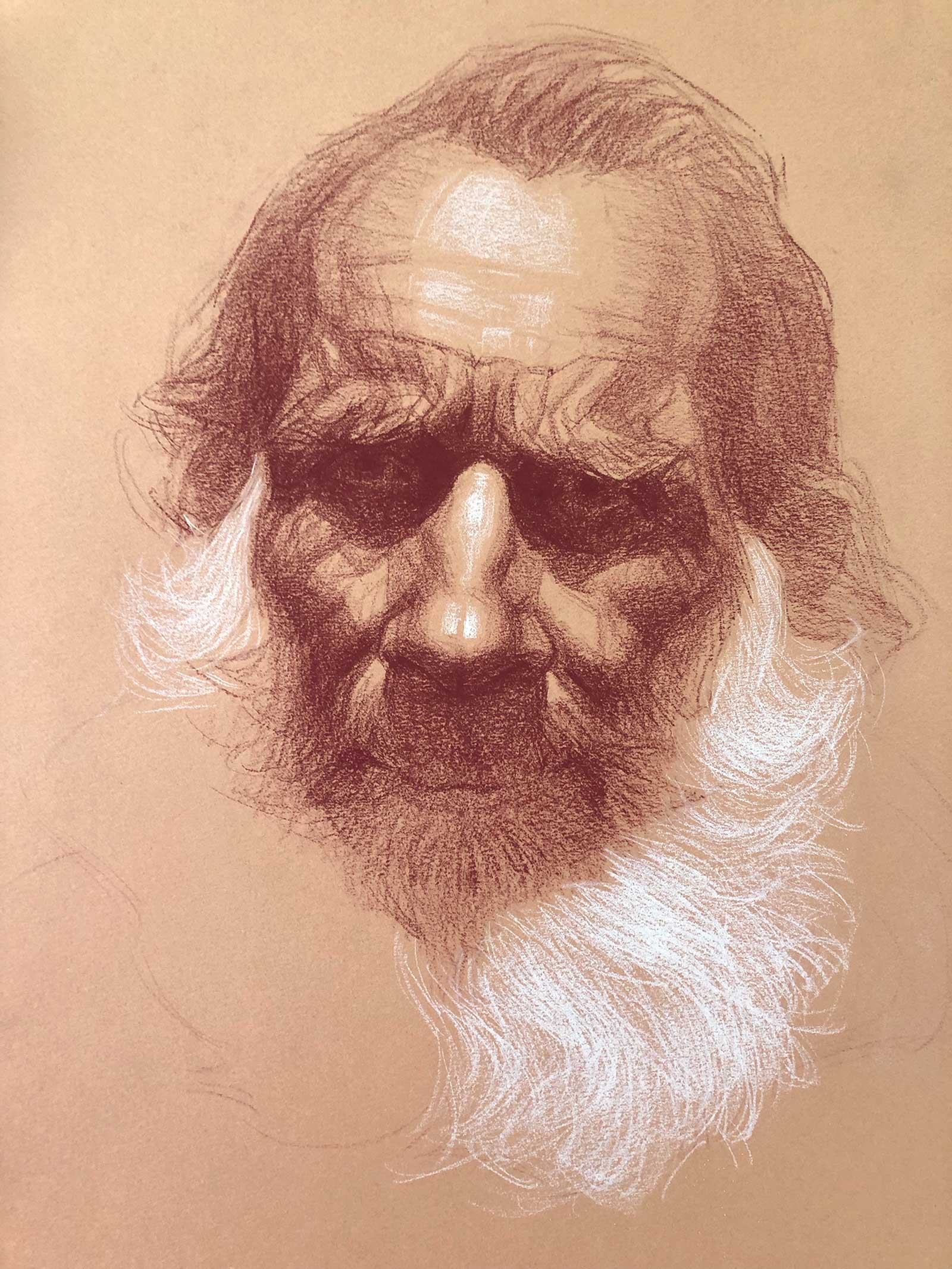
Stage 5: Using scribbling lines to show the form of the facial hair as focal point. We may reach greater truth by simplification and even by subordinating minor truth. Detail may be minor truth but without real significance. Each hair in an eyebrow is detail and minor truth, but carries little significance. Train your eyes to see hair has no definable edge, like smoke. Treat hair as a mass of light and shadow. I would not recommend applying pastel pencils on the white beard.
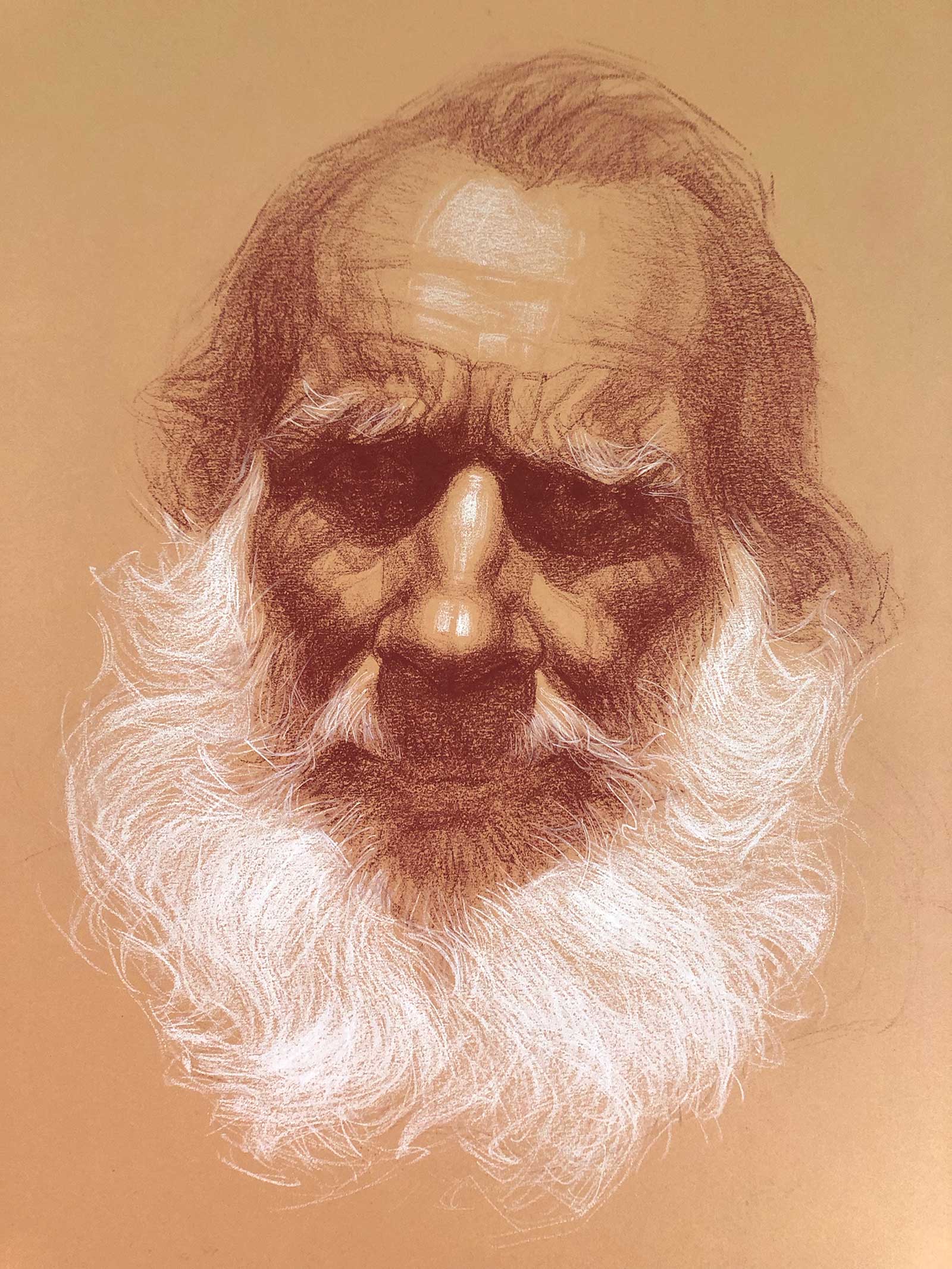
Stage 6: Toned Paper Drawing of Juan Manuel, pastel pencil and charcoal pencil on toned brown drawing paper, 18 x 12" (45 x 30 cm). When you work on details, you may sometimes be overly meticulous and forego broad strokes. Sometimes I purposely sabotage some of the finished areas slightly, as I worry the drawing is too identical to the subject and therefore will lose the aesthetic value, the interesting part of a drawing. Observe the drawing squinting, feel the rhythms in the details and then translate them to a variation of strokes to bring the work to life. Reinforce the shadow areas and examine the drawing as a whole with a critical eye—a drawing will never be exactly like the subject, and it doesn’t need to be. It is a drawing, after all.
Oliver Sin earned a BFA from the Academy of Art University in San Francisco, California, and is an instructor for the School of Fine Arts and 2D Animation since 2001. Sin’s first art book, Drawing the Head for Artists is published by the Rockport publisher in 2019. Two of his vine charcoal portraits were commissioned and featured on the cover of the Time Magazine and his charcoal portrait of his dad won First Place Drawing and People’s Choice Awards in the Portrait Society’s International Portrait Competition in 2020. —
Materials
Stabilo CarbOthello #645 pastel pencil
General’s white charcoal pencil
Canson Mi-Teintes toned brown drawing paper, 18 x 12"