There are great creations in the arts which never leave me. I can name many but will mention two: Mona Lisa and the Rach 3. I’ve sat and gazed at dear Mona since I was 7 years old. Each time totally absorbed seeing her magic aura. Same with Rachmaninoff piano Concerto No. 3; Vladimir Horowitz on piano. I blissfully listened to it for over half a century. I realize I should be discussing visual art, but bringing forth music further illuminates how our needy minds are endless in the arts.
So important are works by today’s brilliant artists that have captured me each time I looked at them; masterworks driven by remarkable talents with abilities to create art both personal and original. Your art can have that.
Humans in Arts
Like all humans, I get anxious and concerned with certain things awaiting me. Well, all those nerve-end moments disappear the minute I begin a dozen creative pastel strokes; walk into the class like a family gathering, and lay in my first “can’t wait” sentence for the article. What happens? Well, I’m going into the world I totally love and dumping unwelcome concerns.
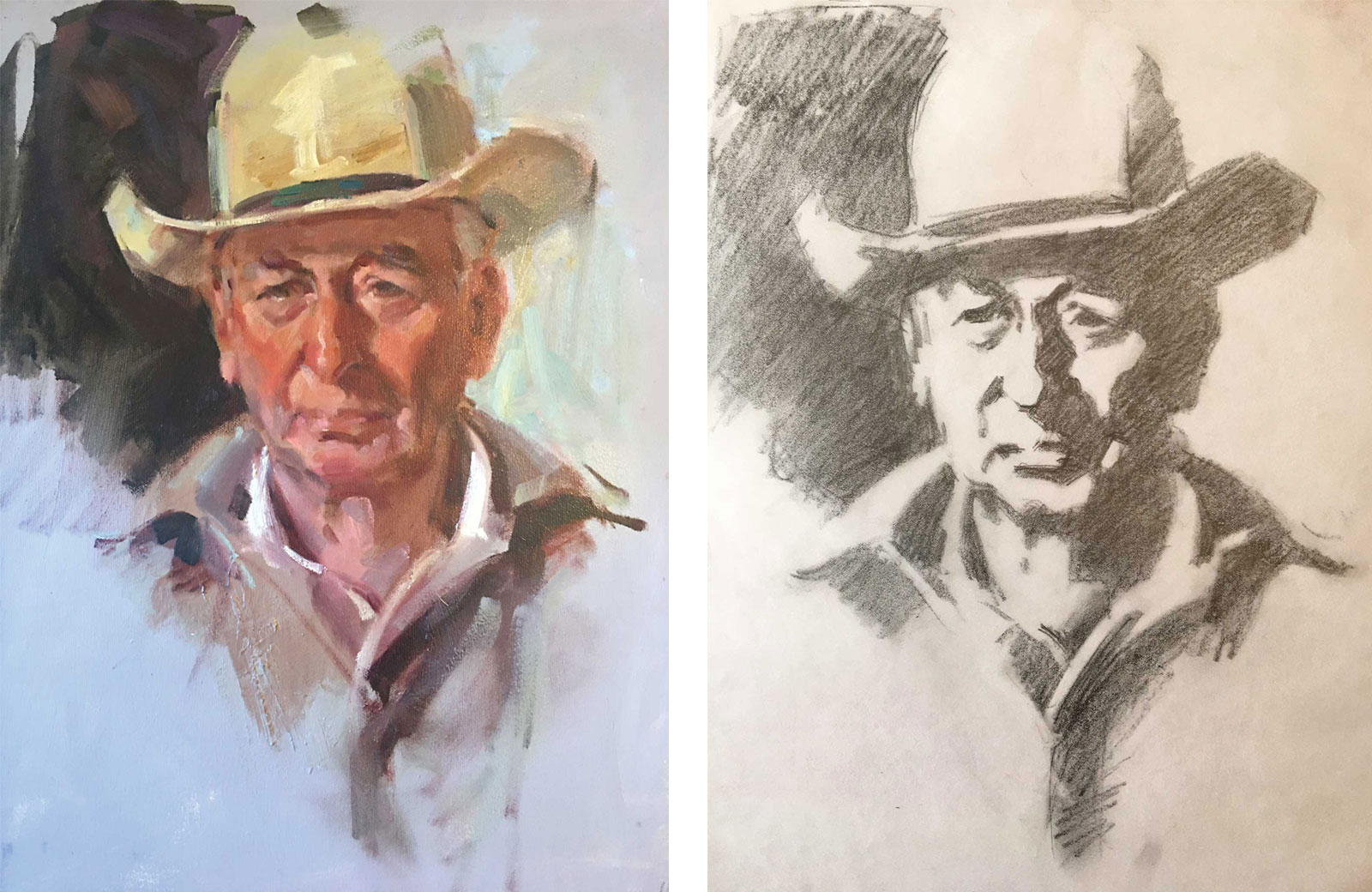
left: COUNTRY MAN; Right: Sketch of COUNTRY MAN.
Working Further
You’re at a certain good level with your art. When you continue learning and working at it, don’t try further developing too many things at once. I remember when I learned about laying in shadows and seemingly abstract shapes throughout the work. While working with these shapes, other elements of my art flowed as well, but those shapes were dominant in my thinking and soon became a natural part of my overall approach. This is like when we learn to walk and talk. What takes time is the basic “walking.” Soon thereafter we’re skipping, running, hoping. As far as talking, well...that’s endless.
In other words, I wouldn’t push different elements equally at the same time: color, values, edges, shadows, design. They would all come together, but I would concentrate more on one while it became a natural part of the approach. That wouldn’t take too long.
Example: For years, I’ve worked on the basics of drawing with a certain accuracy in forms and shadows; putting my observations on paper and getting better over time was good drawing. Then one day I got a major lesson in how to make those shadows as part of the composition. This gave me a grande leap forward and took me deeper into the aesthetic side of drawing. The same with understanding “lost and found edges.” As I was working at understanding the shadow shapes and values, I eventually introduced good fundamental colors within those shapes and with the overall piece.
Here’s What I Mean
Many have mentioned how much they learn from these particular shadow shapes. I’ve done the toned shapes in COUNTRY MAN with accuracy and not just blocked them in. It visually speaks for itself because we see his individuality and character using those two simple values. And actually you don’t see anatomical eyes, nose or mouth. Nor hat nor collar. You are observing a whole variety of shapes while your brilliant inner mind fully understands what those shapes actually are. This is something so important that I wanted it to be seen and re-seen and totally understood. Watch out for too many details and textures. Art is a give-and-take where certain areas of an art piece have importance—areas with those details and having stronger color and contrasting values. Other areas are less complex. Again like music, parts that are allegro and parts adagio.
The End of Envy
Any jealousies I might have had totally disappeared when I joined a prominent art society with well-known artists. From the first moment, I felt we were together joyfully expressing our individual art. There was never a touch of envy, just artists doing the best we could, the positive atmosphere totally obliterating bumps in the road. Sales and awards come and go with no guarantee; what’s always needed is an uplifting life keeping us always strong and inspired. We take the feeling of jealousy, put it in a bag and toss it into a garbage heap. The only artist I want to be better than is myself. And my best wishes for all other artists. Now back to my easel.
A Personal Conclusion
During my first years as a full-time artist, I was convinced that the well-known, deep and serious contemporary, non-objective artists must have IQs of 300 and up! With their indecipherable paintings and words, I felt lost with my simple not clued-in thinking. Many decades later, I am now personally delivering what I’ve observed in life and art: first a bravo to the entire broad ranging art world that is limitless in works and philosophies. I’ll also say that all of us artists, including representational and contemporaries, have generally good normal IQs. Talent, now that’s something else because talent and intelligence are different. No need for me to be told who is a great artist. I’ll “simply” make my own mind up if someone has developed a talent.
Drawing from life is an artist’s version of handling a canoe down a fast river—experienced inner and outer minds marvelously working together. Meaning that if tracing or a projector are used in starting a portrait or horse or whatever, the artist should lay in less detailed lines and allow the artistic self to express the moment. Yes, put the neck in where it should go and the shapes of the shadows around the eyes and nose. Use less intricate details with that preliminary traced or projector stage of an artwork. When creative instincts are allowed to flow fairly freely, the more personal uniqueness is there…on canvas or paper.
Drawing Plus
Yes, drawing is so important. The act of putting on paper or canvas, an image of what you’re looking at, either from a photo or the real thing. Good drawings get you to a grand level in art. We understand it wasn’t just how well Degas did faces in figures, it was how he worked them into the entire painting. Using design and value elements with his marvelous drawing abilities
THE MYSTERY
THE MYSTERY
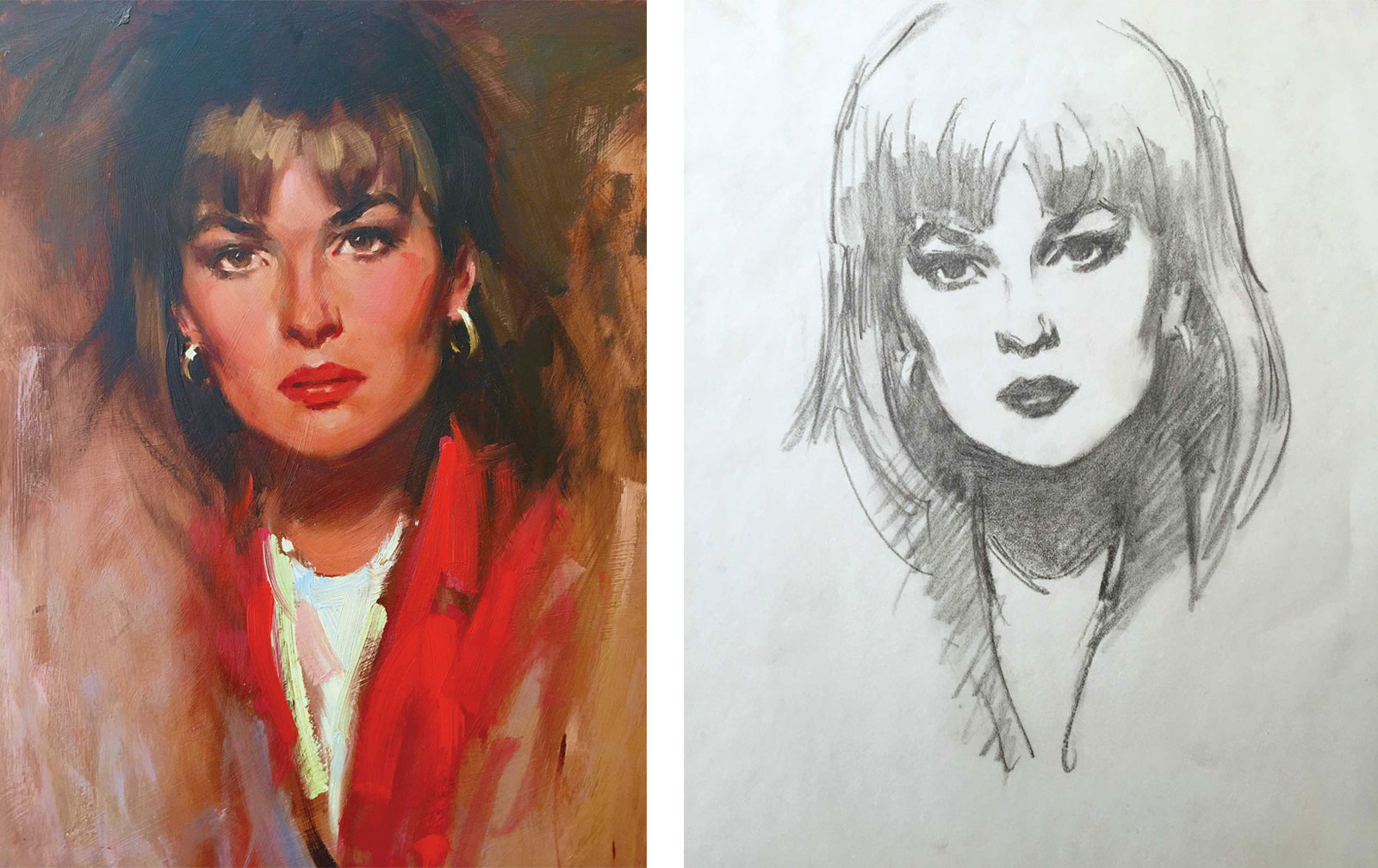 A female face has always been a compelling mystery to me. And here we are, my oil portrait of a lady. There’s a simplification of her hair as it goes into the background. A few highlights on her forehead bangs. The brushstrokes on her face were careful and not fussed. The simplified black and white drawing shows the important aesthetics brought to her face. Simple specific shadow under nose around her eyes. The shape of her lips. The flows and turns of her cheeks and jawline. Accuracy and not photographic. All those areas show as much of her character as she’s allowing; the rest she keeps to herself. She is alive. Every time you look at her, she looks back and is beginning to understand you.
A Powerful, Cognitive Difference
I’ll repeat many things in my art discussions. One of those is the calming, joyful, meaningful moments there are with any individual making any image onto a piece of paper. It works for me in ways so powerful that I feel elated within seconds of scribbling something…anything. Spread this word to all, artists and non-artist alike. Mentally it can be extremely positive, as it has been with many individuals I’ve known through the years. Create images…any images. It will make a true difference. Start with a relative who hasn’t been feeling any joy these days: Paper. Pencil. Kneaded eraser.
Style/Approach
When artists are uncertain about themselves and their art, they often look to other artists to emulate. The stronger we get with the basics and drawing, values, color, design, the more our art reflects us, our very selves. Just like our own character and personality. In art, part of what eventually happens is that our inner mind pushes forward with what has developed in years of insight and doing art.
We don’t necessarily recognize our own “style“ because it is naturally us. Like I don’t know what kind of a person I am…I’m straightforward me. And that goes for my art; it is naturally me on paper and canvas. Individuals immediately spot my art pieces the minute they walk into a gallery and not because of subject matter. The same happens recognizing the other artists’ works. Our art reveals each of us.
And Subject Matter
Remember it’s not the subject we paint that makes our work interesting, it’s how we interpret that subject. I’ve often talked about this because each subject I’ve drawn or painted I very much wanted to paint. This includes commissioned portraits and works for galleries. With a commissioned portrait, I see the interesting features of my subject under the right lighting, including expression and position of the head. Together a good natural feel that I can’t wait to make happen on paper or canvas.
And whether it’s a portrait, a flower or a complex scene, I am very obsessed and want the work to reflect and fill one person with elation, and that person is me. Terrific if others like it but that’s not my purpose. My purpose is to thoroughly enjoy all the precious, self-indulgent days of my life in art.
What We Learn
I’ve always felt that when we learn something in art, it is important, no matter how brief. If I read one sentence in an art book or art magazine that is profound, then that book or magazine has meant something. Same with art events and workshops. I could give you a list of what I’ve learned under the strangest circumstance, many by pure accident. The best part is that I took what I learned seriously. I continually remind myself that it doesn’t mean I’m copying from another artist; some of my best art info was from landscape and animal artists.
I have been and will continue to pass these “artistic messages” on to you dear reader. Not only that, I will give you my version of how each has worked for me and yes, with other artists. I’ve learned plenty by my own “hit and miss” method and letting you know what really can work. Having you be able to find and reveal your very individual self on paper and canvas.
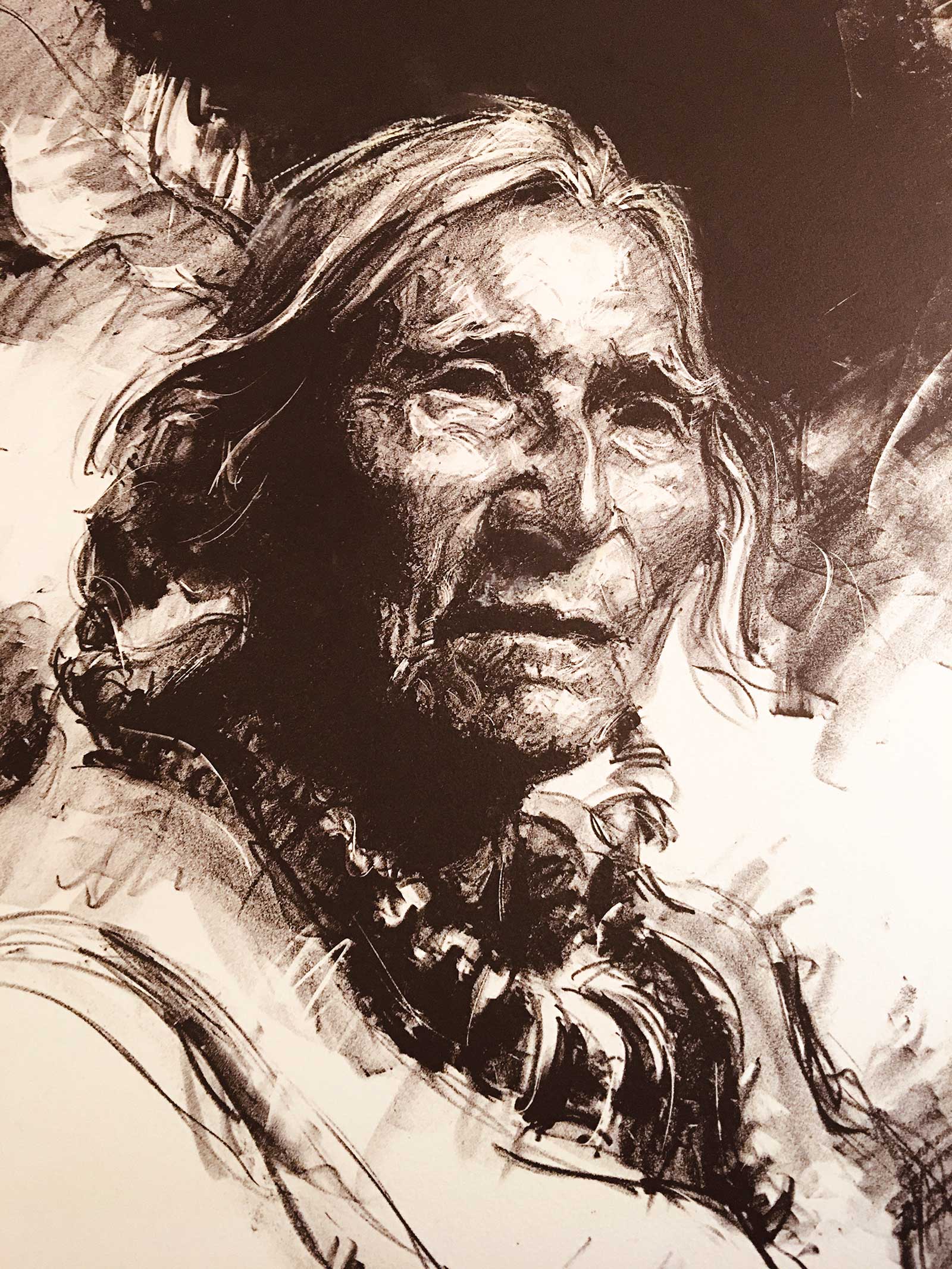
CHIEF POWDERFACE
CHIEF POWDERFACE
This is a portrait of a great man whom I met many years ago. This is a lithograph I did, and I’ll mention a few things about the art.
• Angles give movement: hair, necklace, feather.
• Accurate shadows portray his character.
• Natural. Unposed. Dynamic.
• Lost edges: Cheek shadow into hair shadow.
• Face with details, looser in surrounding areas.
Remember the Unequal
It was so important when I discovered that a work of art should have elements that are not equal. This means that a painting should not be equally warm and cool. It should also not have equal values where there is the same amount of light and dark. A painting needs a dominant value: light, medium or dark. A good example of medium value is generally a French impressionist painting. A dark painting? Take an overall very dark Rembrandt painting, where the smaller light part is the face and collar. Also we can think of looking at the center of interest in the night sky—the tiny moon with the massive dark “background” around it. Light? I don’t have to explain, you get it. I’ll add here that if the light and dark are equal in a work, it’s allowed only if the design is powerful, artwork masterful.
Background, Foreground
Whether I’m sketching or on a complex piece of art, I continue to work backgrounds and foregrounds together. One affects the other as the piece is developing, in value, shapes and colors. Look at a number of my works and you get a sense that yes, that dark shape brings drama to the lighter part. That small bit of cool is perfect in the large warm area. I do love the visual intrigue of going back-and-forth. Like a ballet with the principal dancer dynamically working together with the entire corps de ballet. Such inspiring moments.
The Dream, the Learning, the Doing
What got me going from the start was learning how to draw, which I did with ruthless energy. That drawing ability brought me to the level of intensely observing my subjects and bringing them to life on pads of paper. The more I drew, the more my art reflected my approach. Years later at colleges and with artists/mentors, I was able to push my abilities on paper and canvas much further.
Eventually, into my 30s, I was determined to enter deeper into my chosen world. Like the pianist playing a concerto with skill and passion, a novelist writing a book the reader can’t put down; an actor with whom we can’t wait for the next performance. This was the wishful route I sure wanted. Many side roads, unexpected challenges, successes and mishaps. I never think of failures; I call them “lessons.” It comes down to experiences few would believe, except other artists. I’ll add that you can get it all going at any time, any age. So hop on dear reader, this particular trip will keep you inspired for life. You know it. —
BALINOFSKI: Middle Moment
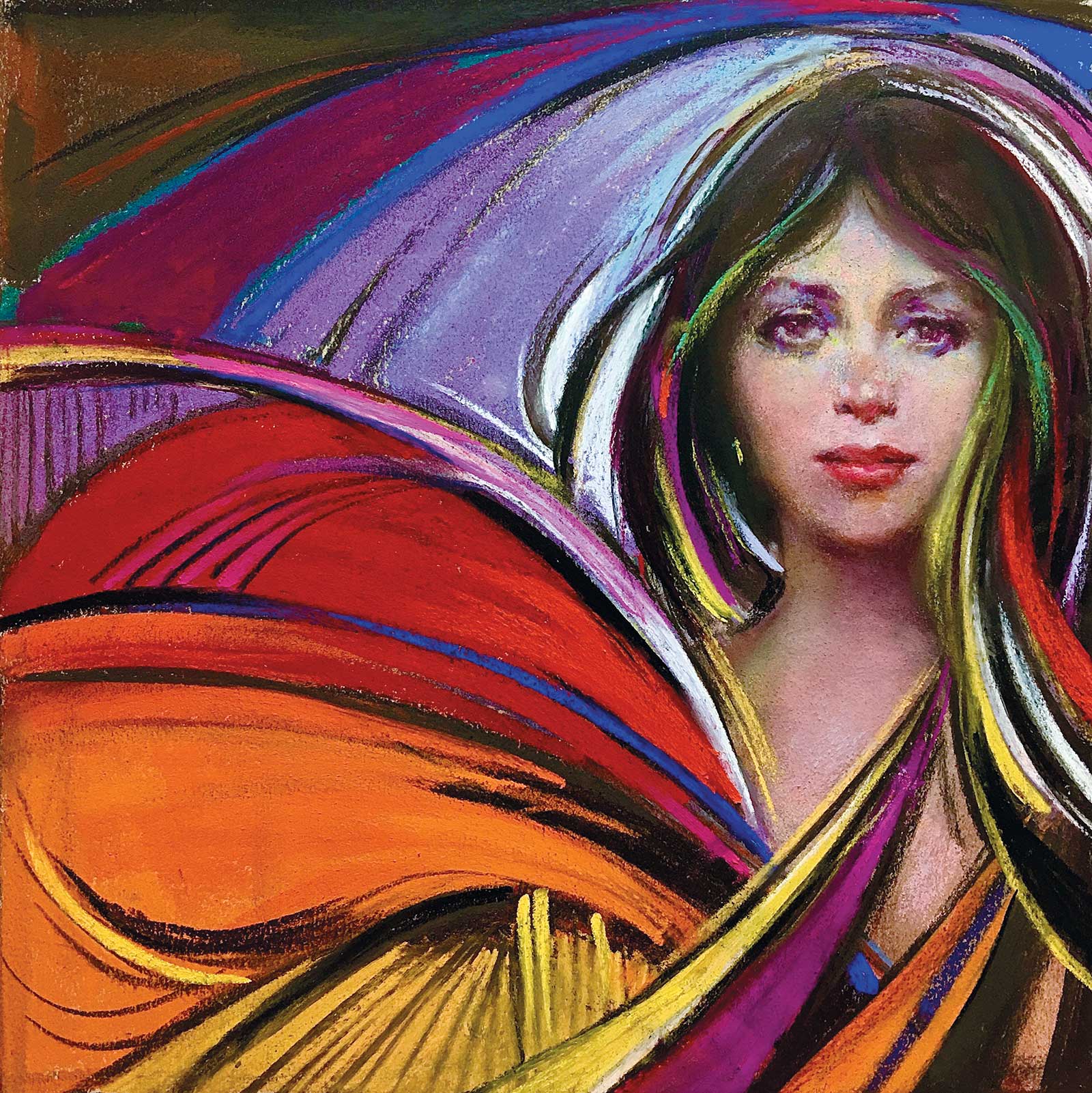
The young lady in this portrait was so very memorable, outgoing with her thoughts and feelings as we talked about everyday life. I’ll add that her “everyday” was not ordinary. I wasn’t able to find out what she did for a living but sensed she should be in the acting business, because various and intriguing personalities naturally beamed from her.
Then as she sat for me, she seemed more subdued. At the same time, her charisma inspired my every pastel stroke. When I finished with the portrait, a final touch in her hair, her “original personas” returned. Her spirit filled the room. She was most interesting, especially about her dreams of where she was going. All of which will remain with me. And here, you see her as she was in the middle of her visit, quietly at ease as I portrayed her.
My art studio felt quite empty when she left. I’ll not see her again; her visit with me was by a very fortunate coincidence. I say all this to give you some sense as to what happened here. To me she appeared on Earth only for this one day, a day that will be remembered.