I am following a family legacy for my father, one brother and two of my sisters, who are (and were) full-fledged artists. Always surrounded by them, I was not going to be the exception.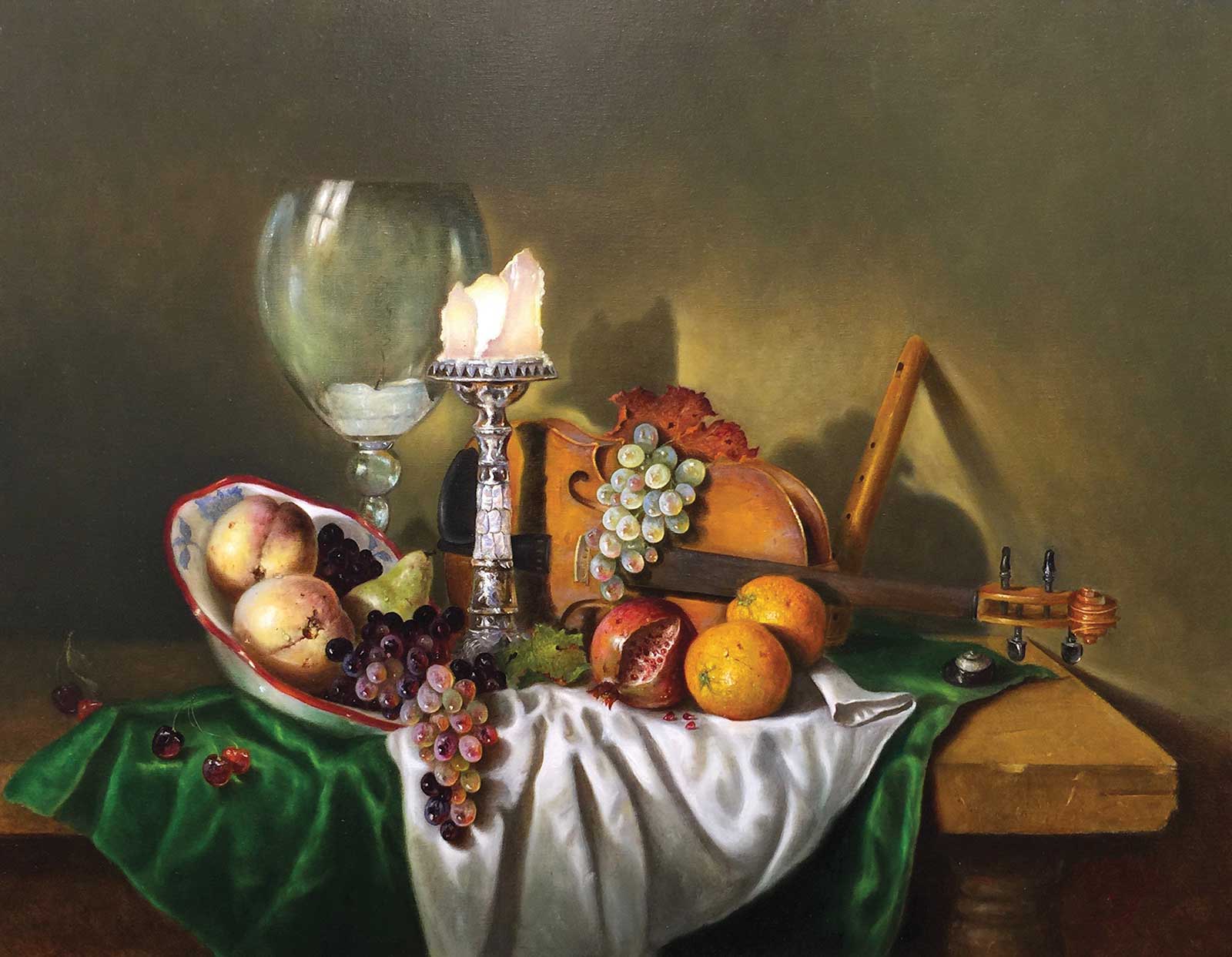 Memories, oil, 22 x 28" (55 x 71 cm) The recently extinguished candle and the other barely lit were juxtaposed one in front of the other to create depth, drama and spectacular background shadows. I love to conjure peaches, grapes and rustics wooden objects. Silver is one of my favorite objects to paint.
I create paintings in which I finish them before they even start. The minute I begin to conceive a composition, whether there are objects that attract my attention or a particular theme I want to explore, I began to finish my painting in the back of my mind. In the very depth of my soul I have already engaged in a very sublime relationship. I spend lots of time considering the setup, arranging and rearranging objects until I am satisfied with the selection of objects and the compositional organization. I do select and arrange my own props, objects, fruits, musical instruments, flowers, textures and contrast of light and shadows source and intensity, thus making me the absolute conductor of my symphony. I do prefer old or used objects for my props. I look for things that have been tarnished by time, for something that I feel has charm and inner emotions—something that I can be in communion with and will propel me and challenge me to embark on a new creation. My approach to painting is a combination of the wonderful and unsurpassed Flemish painting technique with my own innovations, discoveries, experiences and intellect as well. This technique achieves brilliancy and luminosity even at the early stages. In order to achieve a somber brilliance whether I am painting on canvas, linen, panel or any other substrate, I always tone (imprimatura) my support towards a graded dark background. My compositions or placement of objects are carefully planned out and executed. I love the juxtaposition of textures, like tarnished or rusted metals against the delicacy of a fruit or soft cloth, against a glass of wine or goblet on a rustic table top, etc. This will always make my creation more significant and dynamic.
I begin with rolling a kneaded eraser 2 to 2½ inches in length on the palm of my hand, lightly rubbing the surface of the charcoal or graphite drawing until it resembles a ghost image, and a long horse hair brush is used to rid the surface of residue. (This is done just in case there is a need for a minor adjustment after I have applied my first or umbra layer, so it won’t be as difficult to remove or paint over a particular part or object of the composition). At this stage I lightly apply a workable fixative to encapsulate and preserve my drawing. Starting with an umbra layer or value study and its rendition, I apply burnt or raw umber to block in all objects to include the background, simulating a monochromatic underpainting.
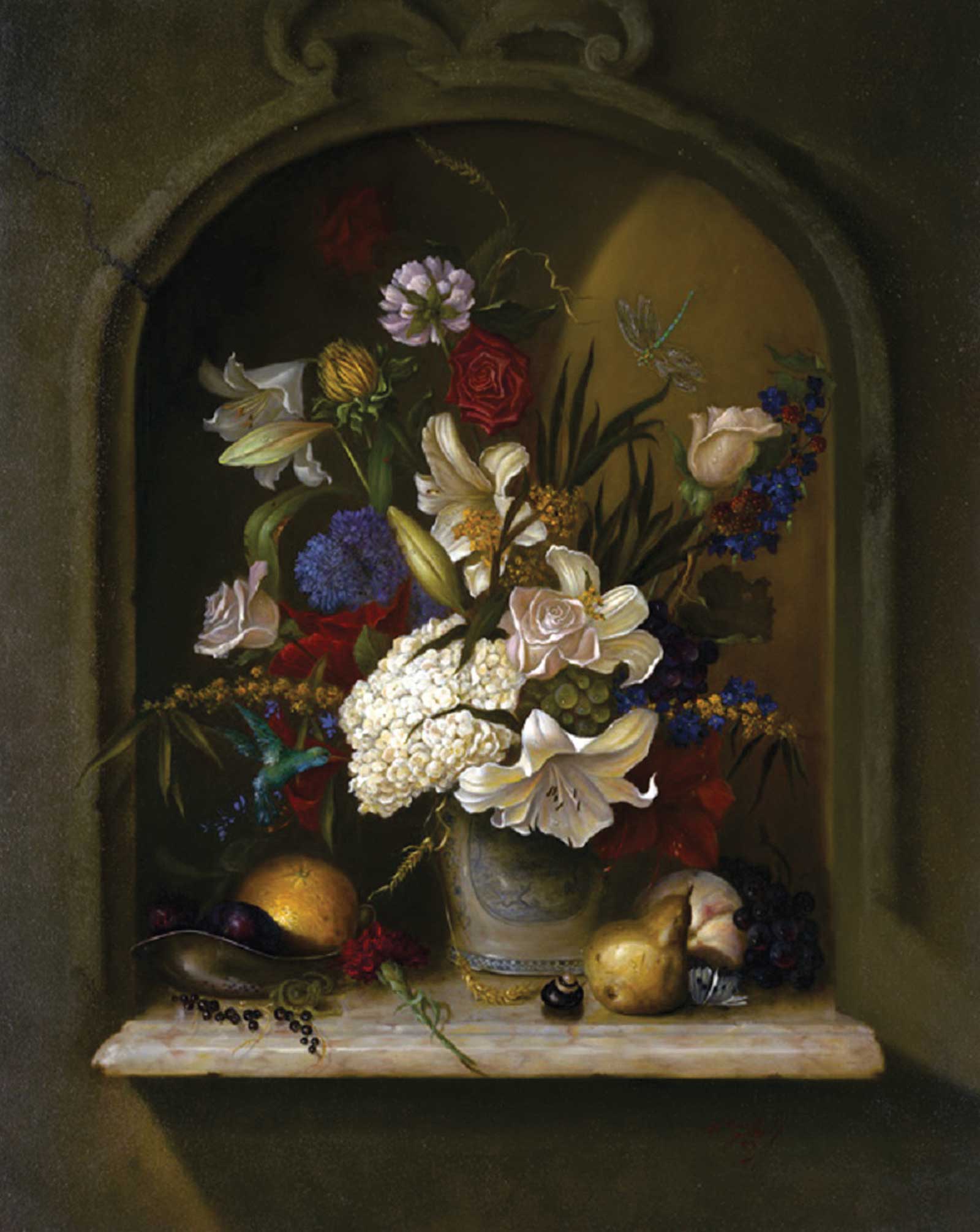
Lucia’s Sonata, oil, 30 x 24" (76 x 61 cm) This crackled wall niche with marble base was essential to showcase this carefully mixed flower arrangement. The freshness of fruits, the butterfly and the silver sugar bowl emphasize human presence.
Before proceeding with my next step and from herein on, a thin coat of straight medium is lightly applied to the painting surface and carefully rubbed on with the palm of my hand; this helps the fresh paint adhere to the dried paint, thus avoiding what is called alligator skin. This is followed by applications of dead colors which are also called lunar effects. These are very tenues yet very beautiful undertones that can easily be mistaken for monochromatic finished works of art. Depending on the tempeture of the painting to achieve these lunar effects I load my palette with flake or cremnitz white, ivory black, burnt umber, ultramarine blue, yellow ochre and vermillion and mix accordingly. At this stage I apply layers of local colors and applications of lights and darks. Then, I add three to five applications of transparent colors (glazes), each to bring out a greater sense of depth and tonal value and to build luminosity and light within the transparent glazes of mysterious shadows.
I maintain consistency in tone and value applications from the very beginning in order to obtain maximum translucency as a final result. As I apply my local colors I keep in mind that dark colors and shadows are colorful as well. Shadows are applied transparent and with delicacy, while light areas are layered with thicker paint. On the following and final stages I concentrate more in refining details and contrasts of highlights and somber glazes, which I typically work out simultaneously. Because of the many applied glazes I wait two weeks or so after completion of the painting and only use a good artist retouch varnish for color restoration and temporary protection.
My Art in the Making Aurora Borealis
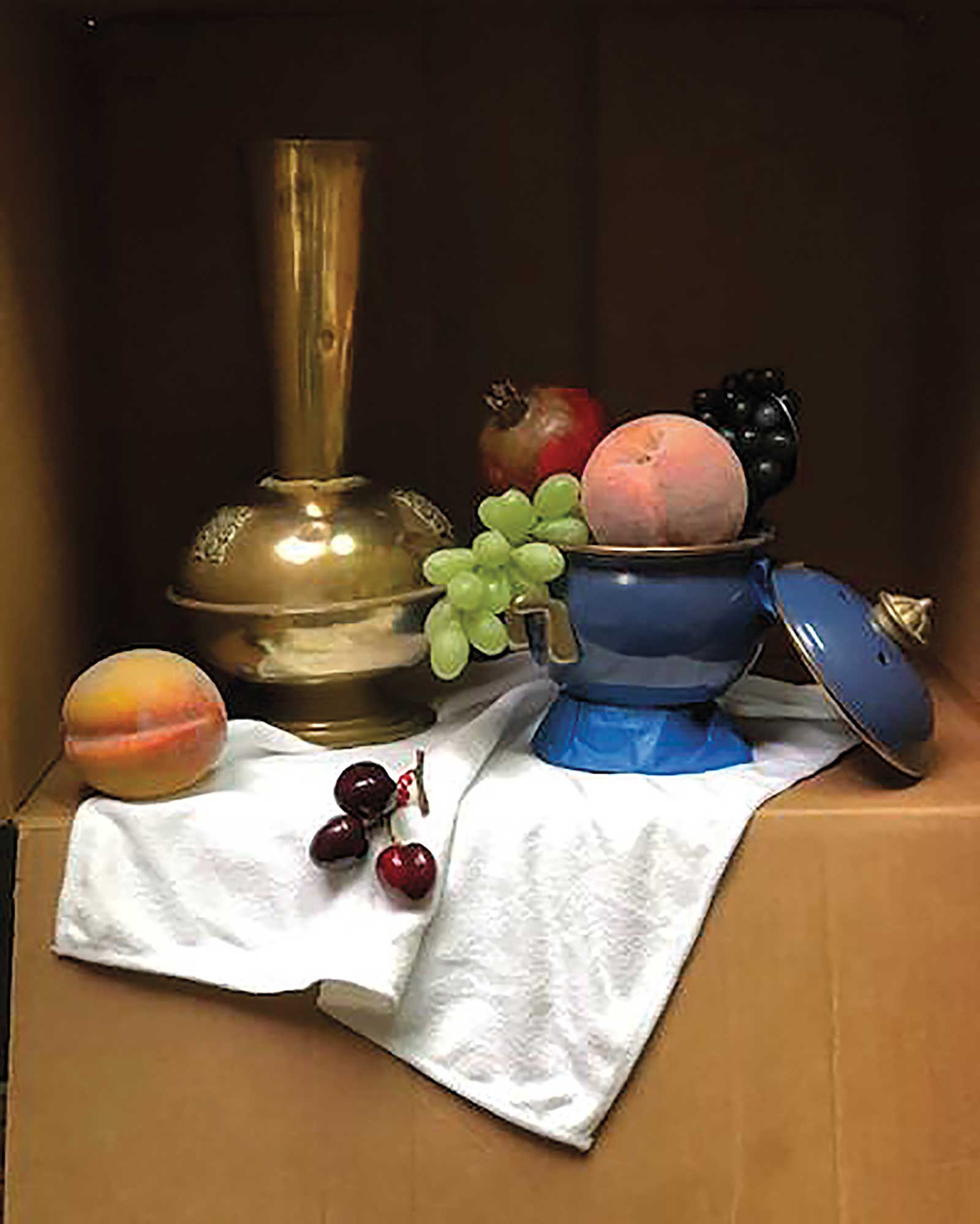 Reference Photo
Reference Photo
For this particular painting I wanted to juxtapose a Colombian brass object with a blue enamel pot and harmonize it with the delicacy of grapes both green and black. At the application of the local colors, I decided to exchange the cherries for an elongated bunch of black grapes to tight up the composition. The silken core of the pomegranate and the color and fuzz-like appearance of the peaches intensifies the diversity of textures, while the soft coolness of the white napkin contrasts harmoniously with the dark somber background, thus becoming more alluring to the viewer.
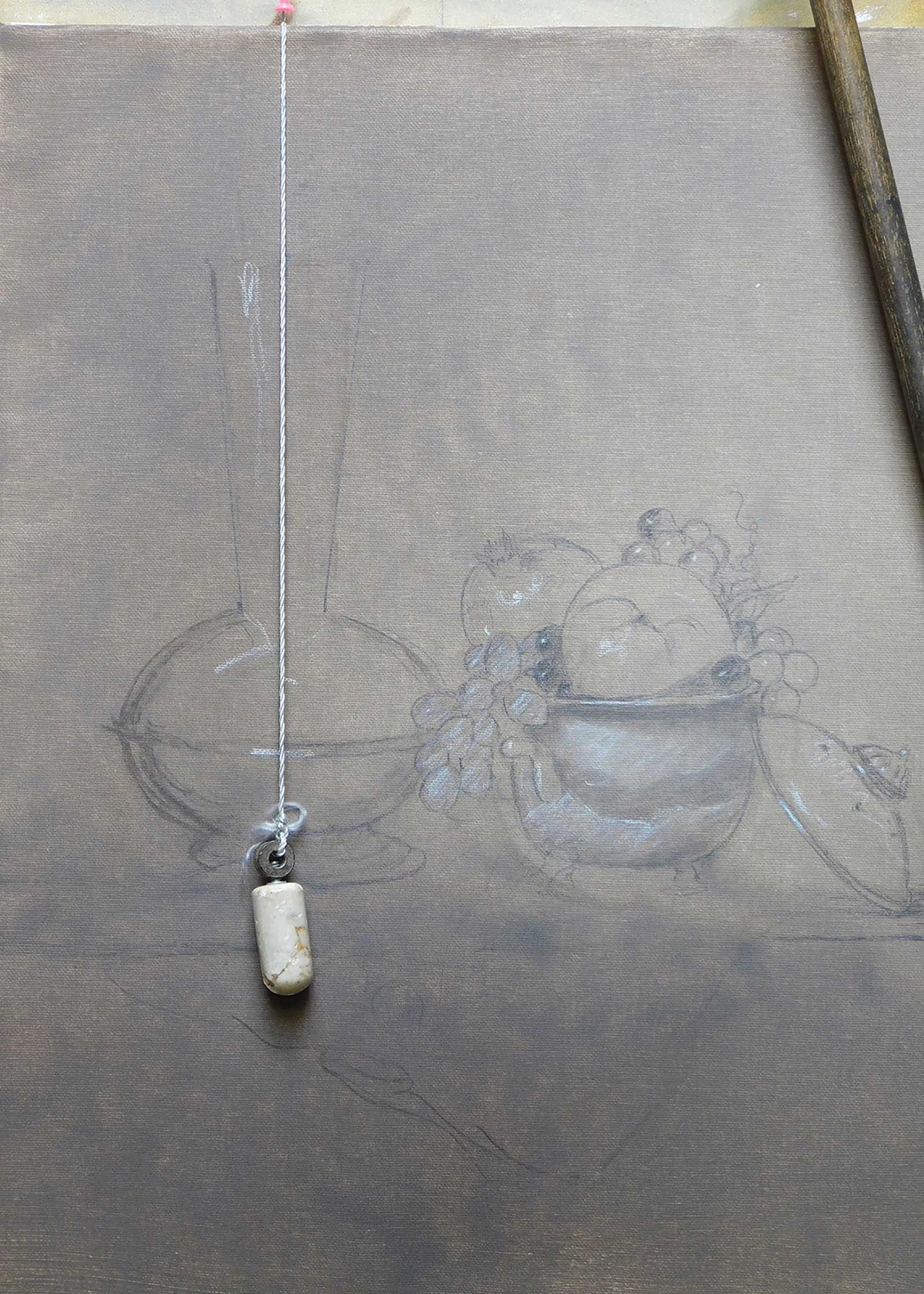 Stage 1
Stage 1 Drawing Orientation
I’m placing the drawing in a balanced area of confinements on the canvas, being careful not to place any objects of interest in the center or lateral extremes of the canvas. Also plumbing the brass vessel for symmetry.
 Stage 2
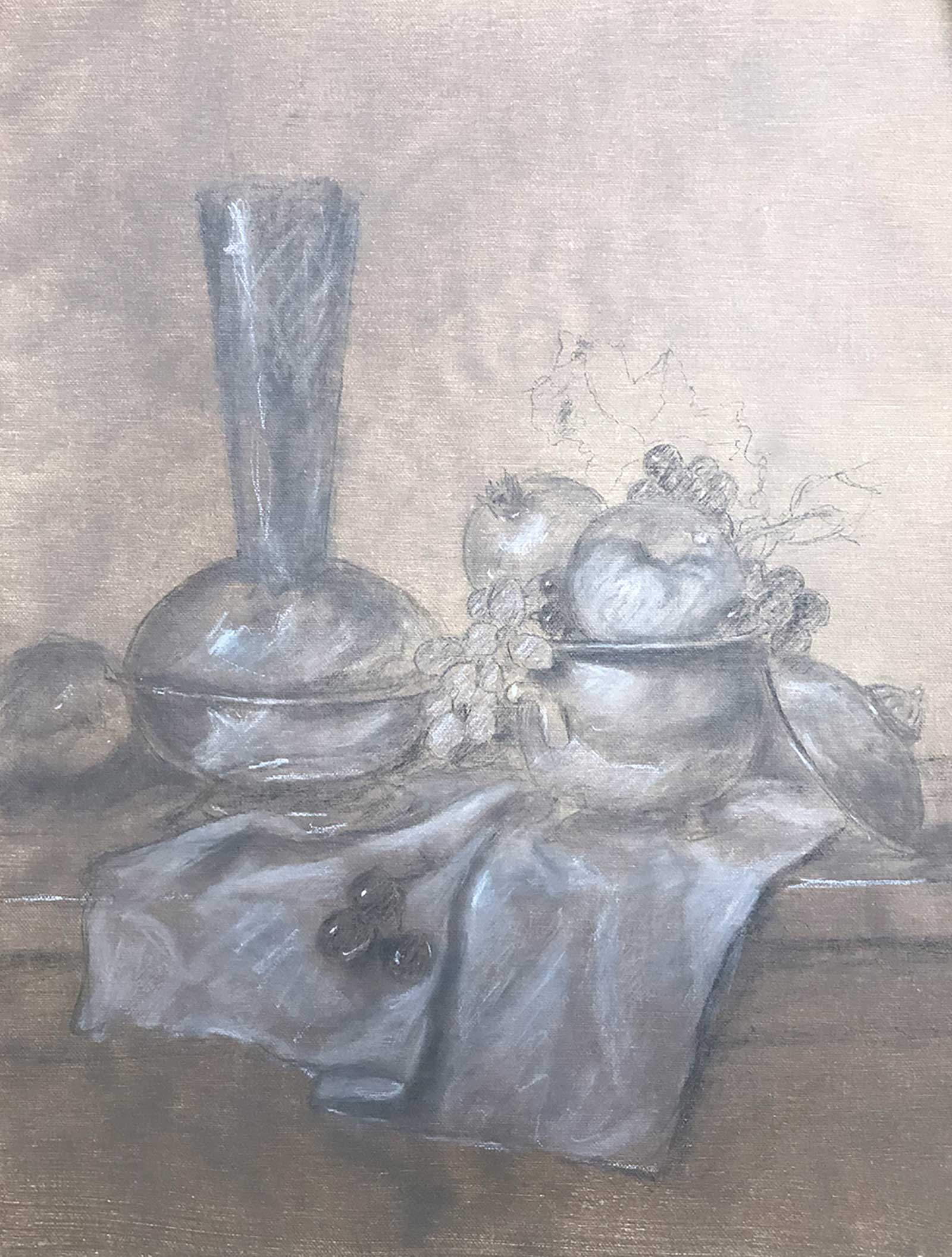
Stage 2 The Semi-Defined Drawing
Toned, detailed and lightly fixed drawing to determine brightness of brass vessel. I don’t want to overpower the main subject. The proportional relationship is established. Thinking of adding grape leaves for balancing and strengthening the composition.
 Stage 3
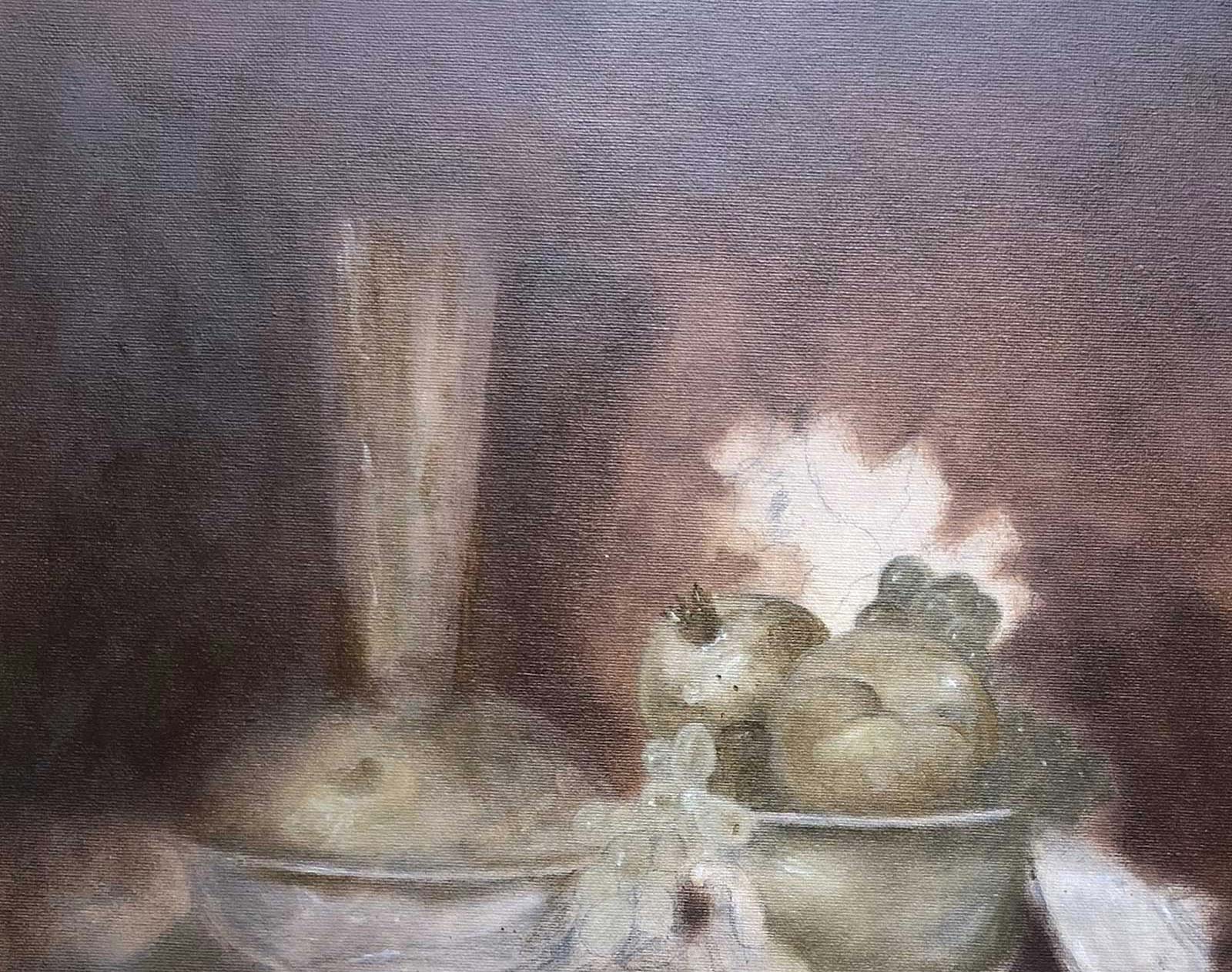
Stage 3 Burnt Umber Layer
A translucent layer of burnt umber is applied for tonal values to set the stage for lunar color application. Oil paintings become transparent with age, umber underlayers do not fade and subsequential oil layers will remain bright and fresh.
 Stage 4
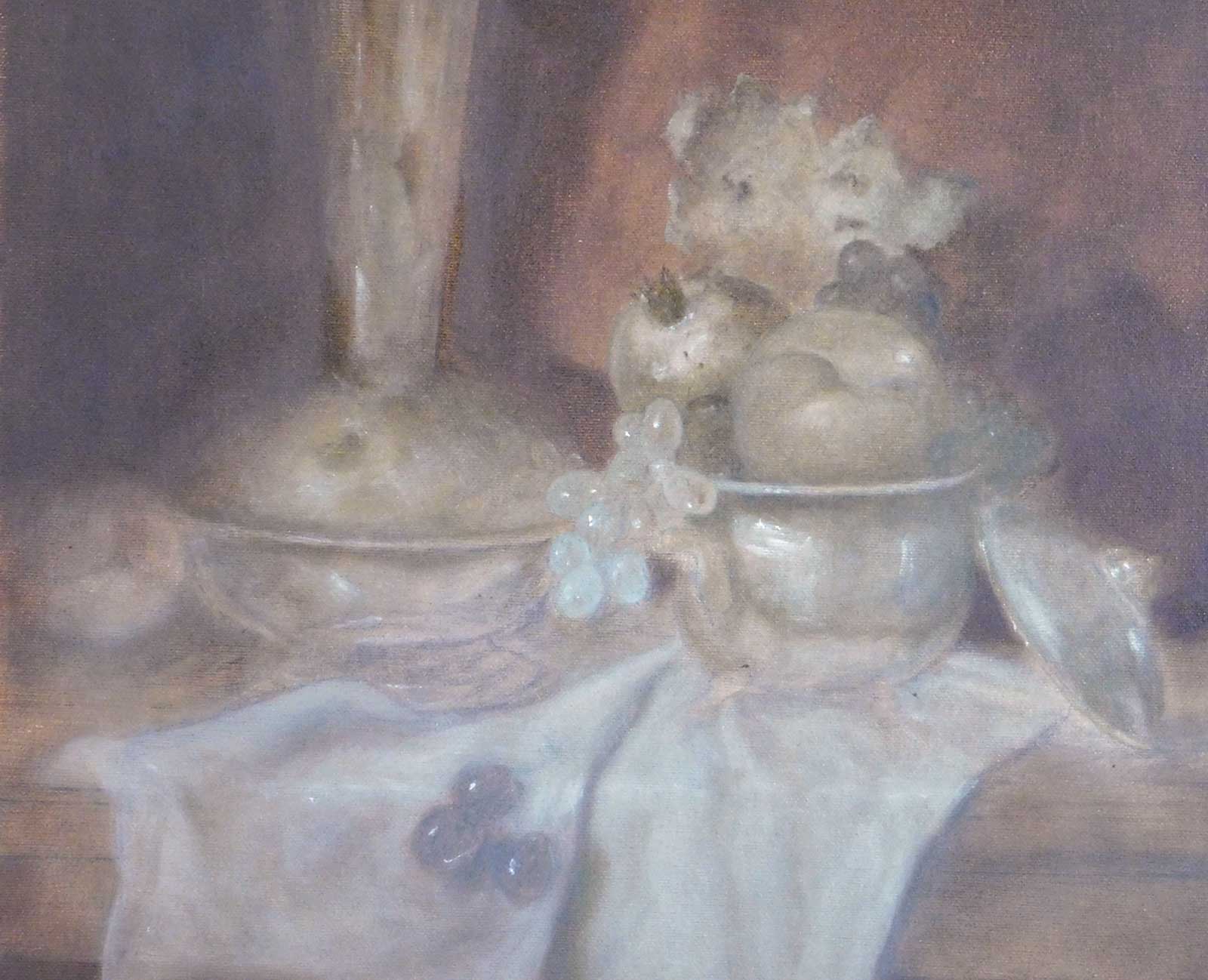
Stage 4 Dead or Lunar Layer
I apply cold half-tones in order to get warmer, brighter colors. As I apply layers of local colors I will begin to see the luminosity of objects and concentrate more on the modeling stage.
 Stage 5
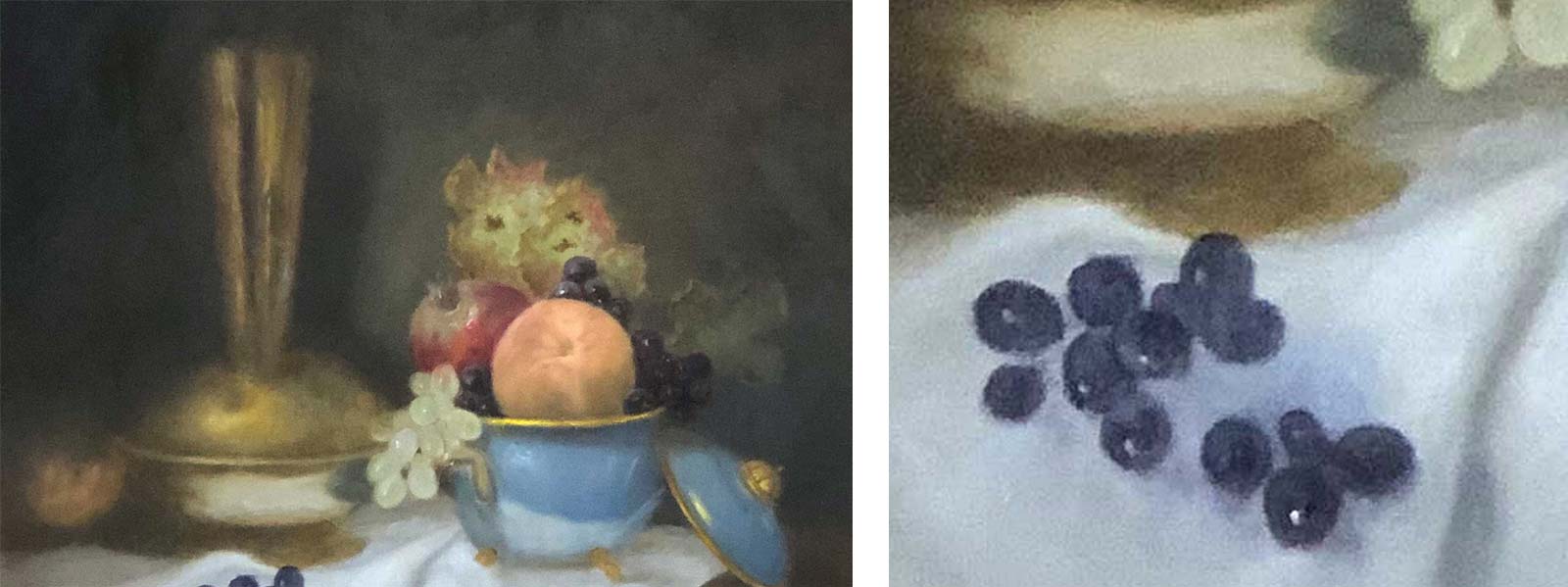
Stage 5 First Local Color Layer
Now I make shadows darker, as this makes my colors brighter. I determine at this stage how bright I want the brass vessel. I begin working light tones and highlights and also change fruits in the left front.
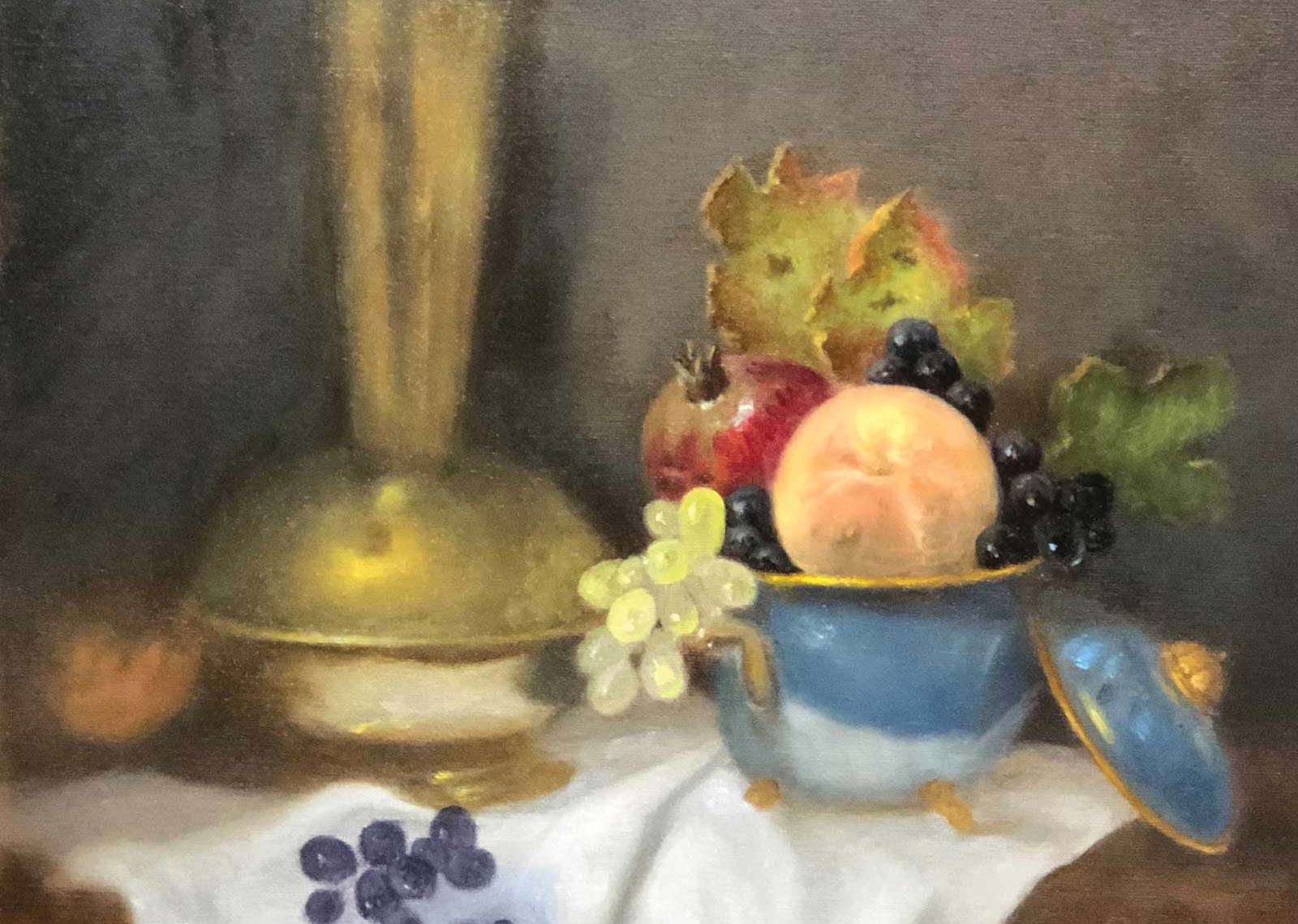 Stage 6
Stage 6 Second and Third Local Color Layers
Now I have more color and light, thus luminosity increases at this stage, and I can see more nuances in mid-tones. I’m also being careful the brass vessel won’t overpower the fruits. Keeping an eye on the pot’s lighting.
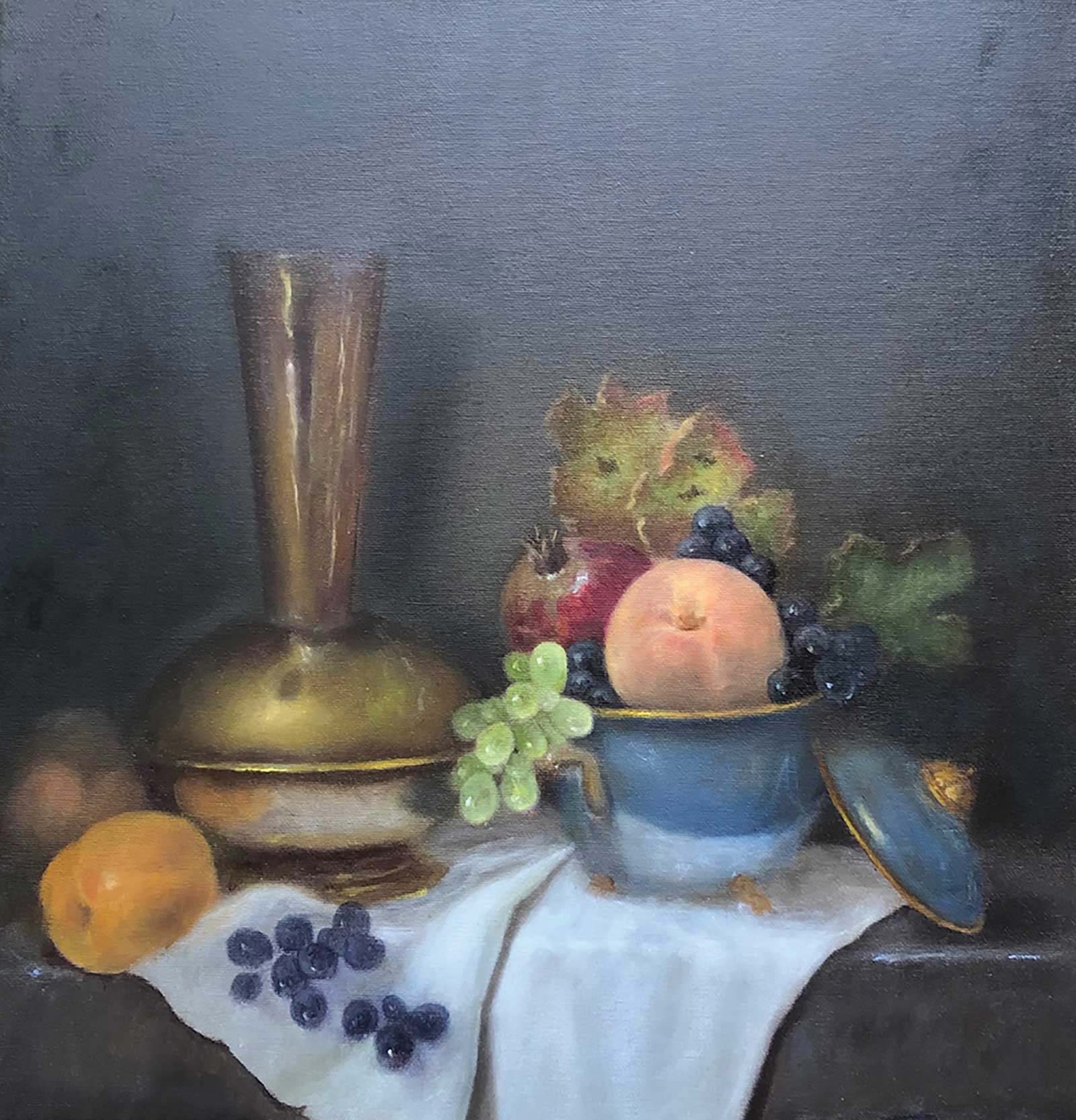 Stage 7
Stage 7 Adjustments
Here, I adjusted the background graduation to increase the intensity on the pot and fruits. I also added a peach on the left for balancing, and the cloth was trimmed. I needed to maintain desaturation on both peaches on the table.
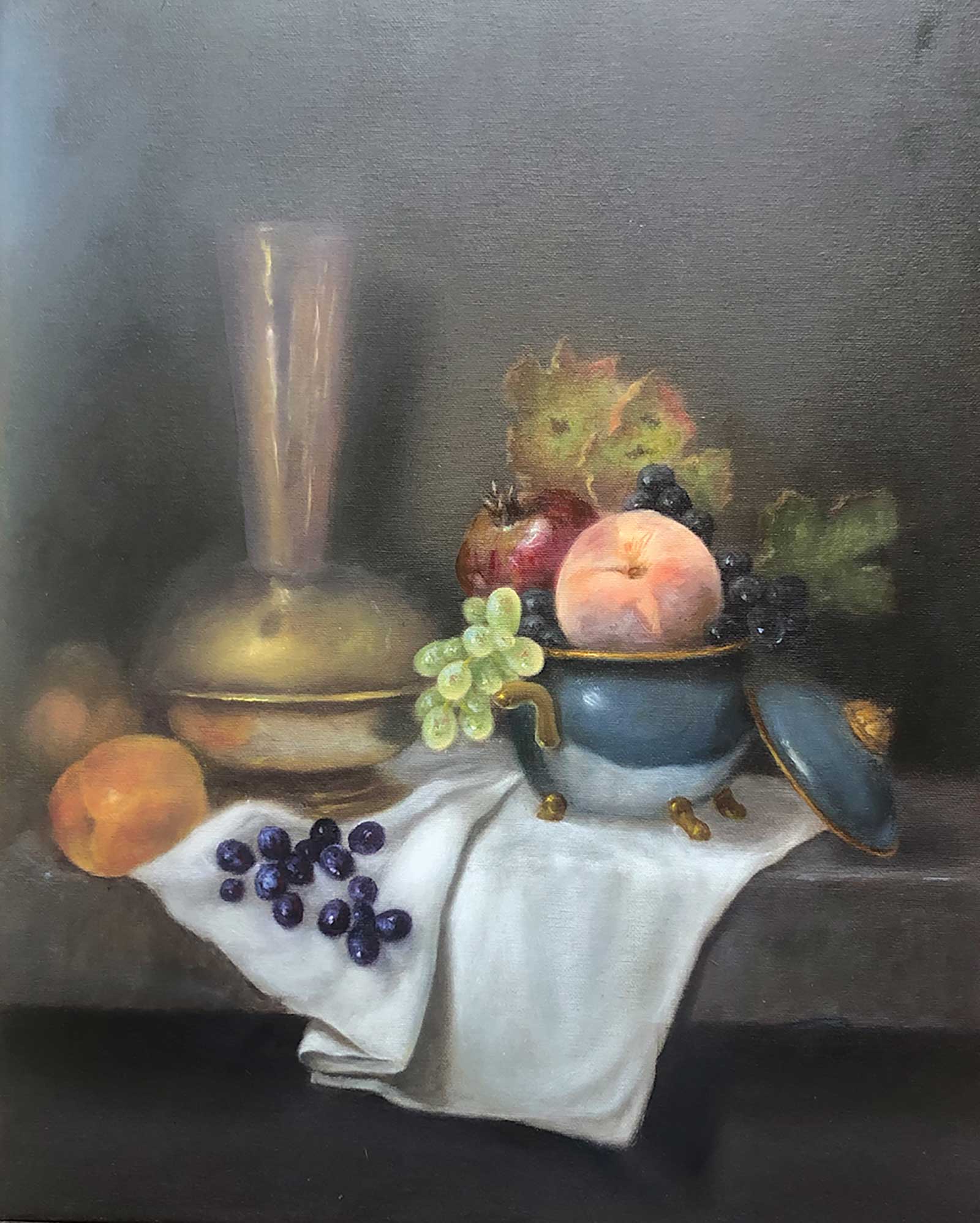 Stage 8
Stage 8 Textures
Having stablished textures, I zeroed in on the metal differences of their brilliancy. The freshness on fruits and lost edges are carefully maintained. This is an integral part of my methodical process in detailed representational painting.
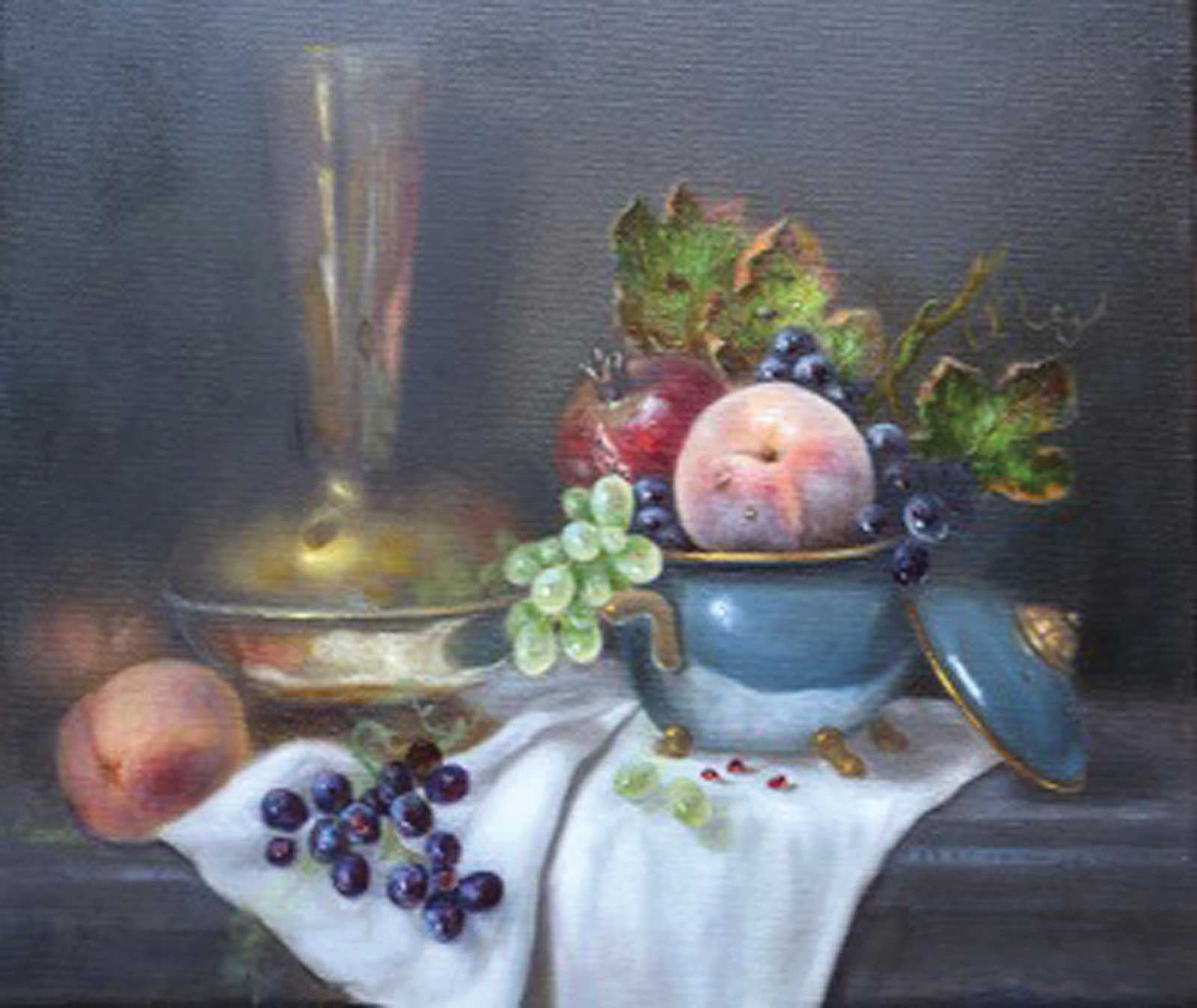 Stage 9
Stage 9 Detailing
I challenged myself by juxtaposing metals, brass and enamel, and was able to create a harmonious relationship. Grapes and pomegranate seeds on white cloth evolved while blending the pot. The peach and grapes on table will be finished next.
 Stage 10
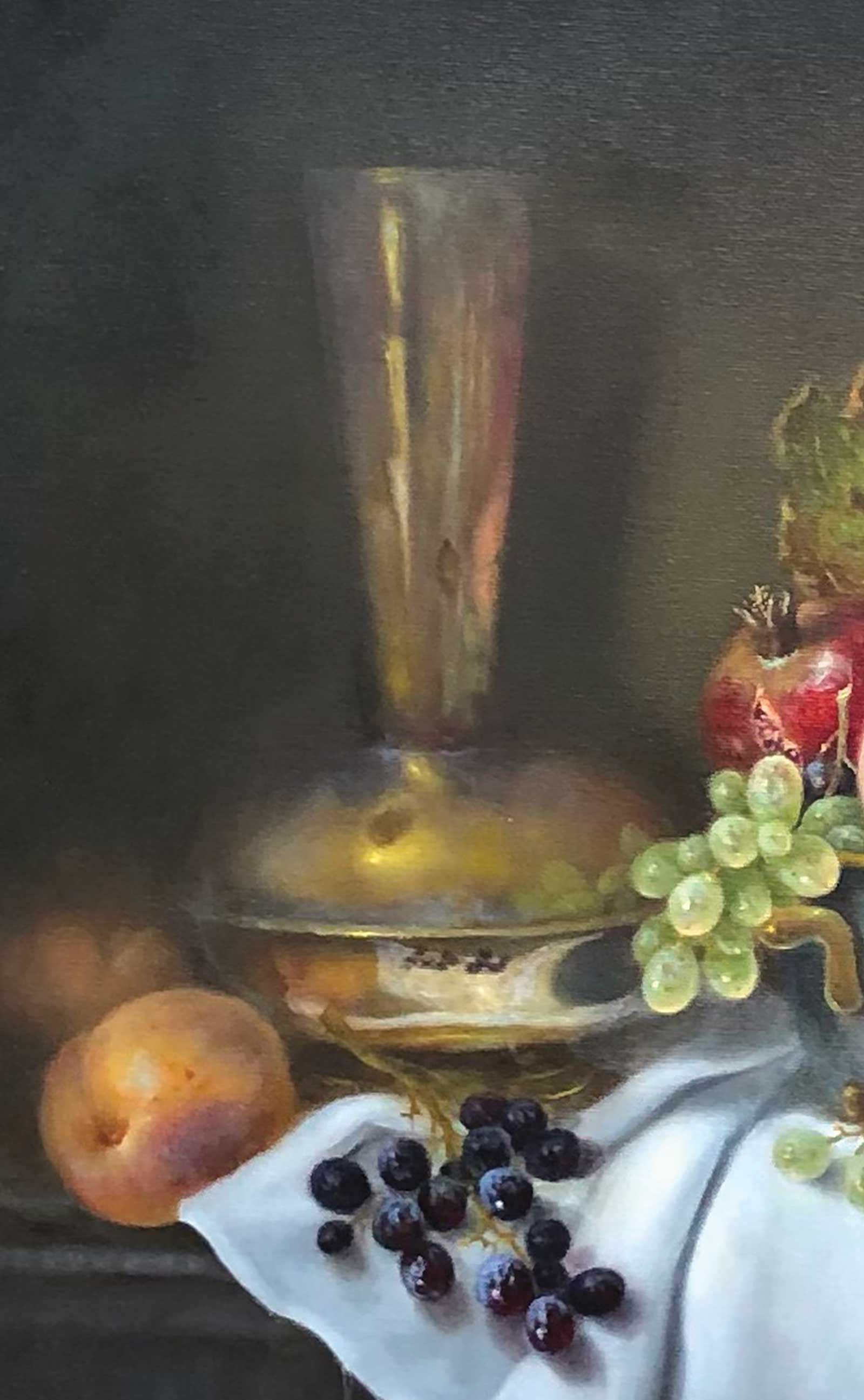
Stage 10 Brass Reflection
Fruits are reflected mutedly on the brass vessel though maintaining a somber brilliancy, giving a 3D illusion. I am keeping the vessel somewhat desaturated with all its nuance in order to bring forward the fruit arrangement.
 Stage 11
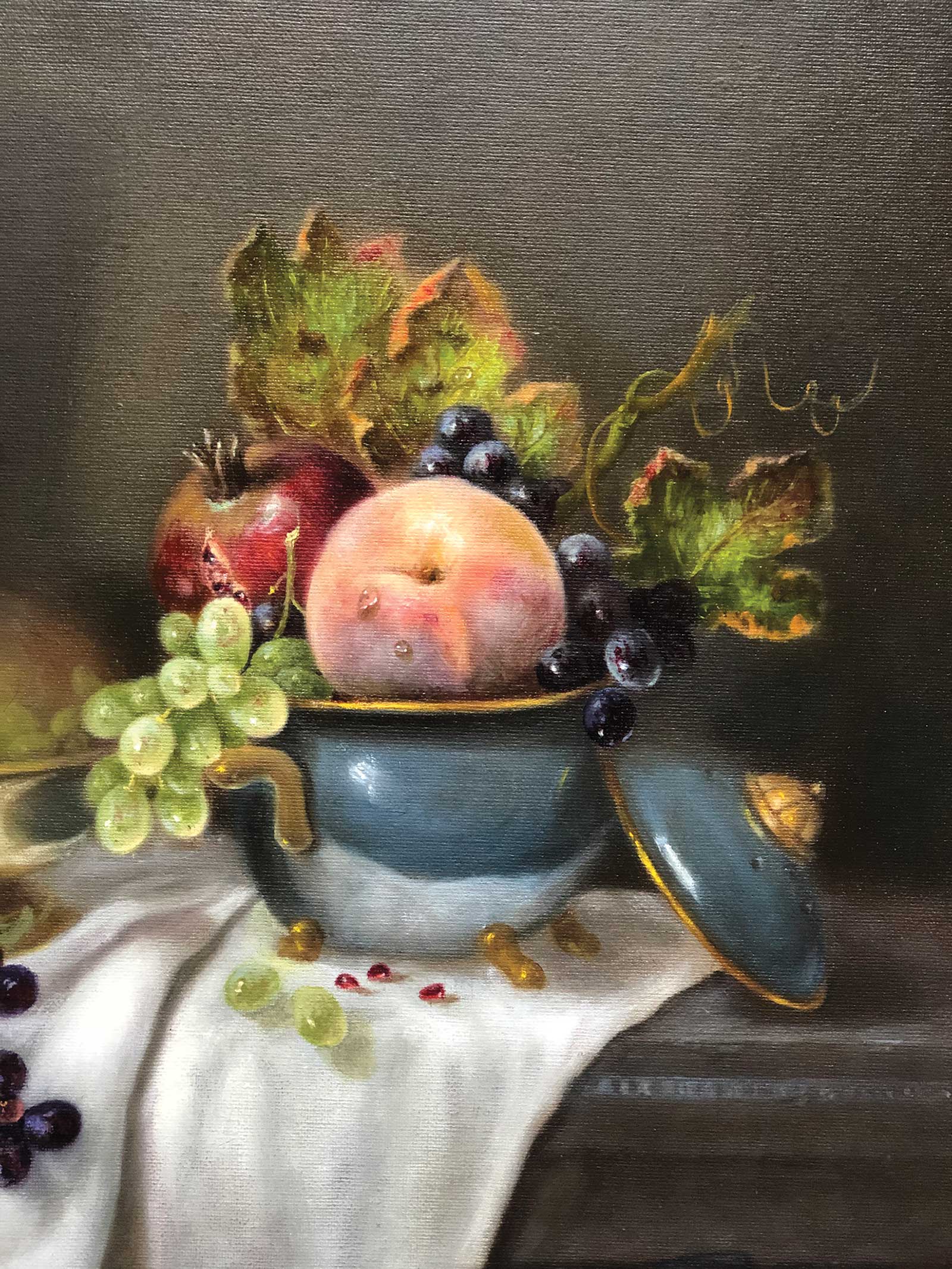
Stage 11 Fruits and Leaves Detailing
Although the fruits and leaves are apparently finished, without over working them, I will accentuate lights and darks and minute details such as veins and dew drops. Grapes, pomegranate seeds and cloth will be finished simultaneously.
 Stage 12
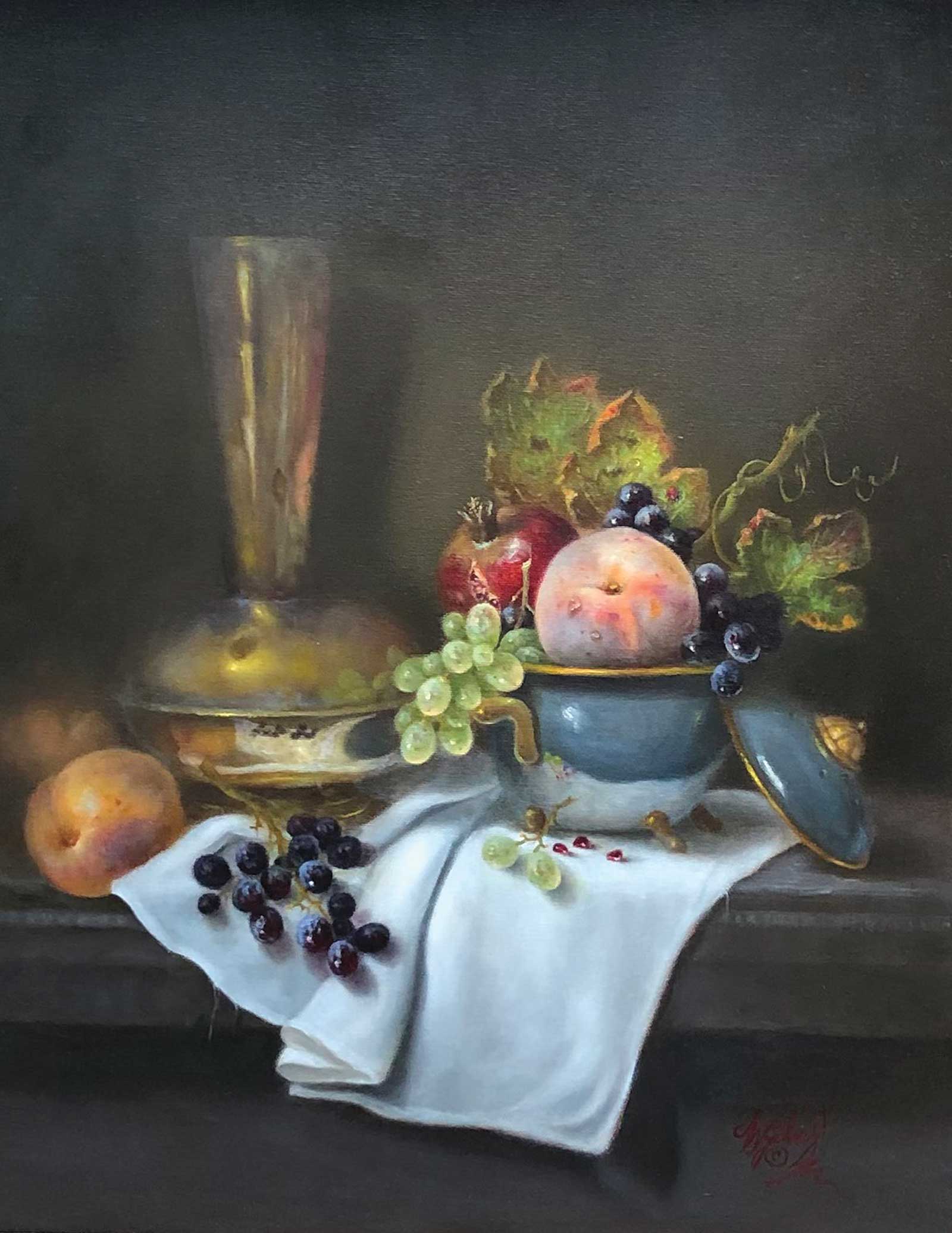
Stage 12 Final Result
Aurora Borealis, oil, 20 x 16" (50 x 40 cm)
I exaggerated the gray tarnish on the brass to desaturate its brilliance, complementing the coolness of the pot. The black, green grapes and red seeds on the table tightens up and envelopes the whole painting harmoniously.
About the Artist
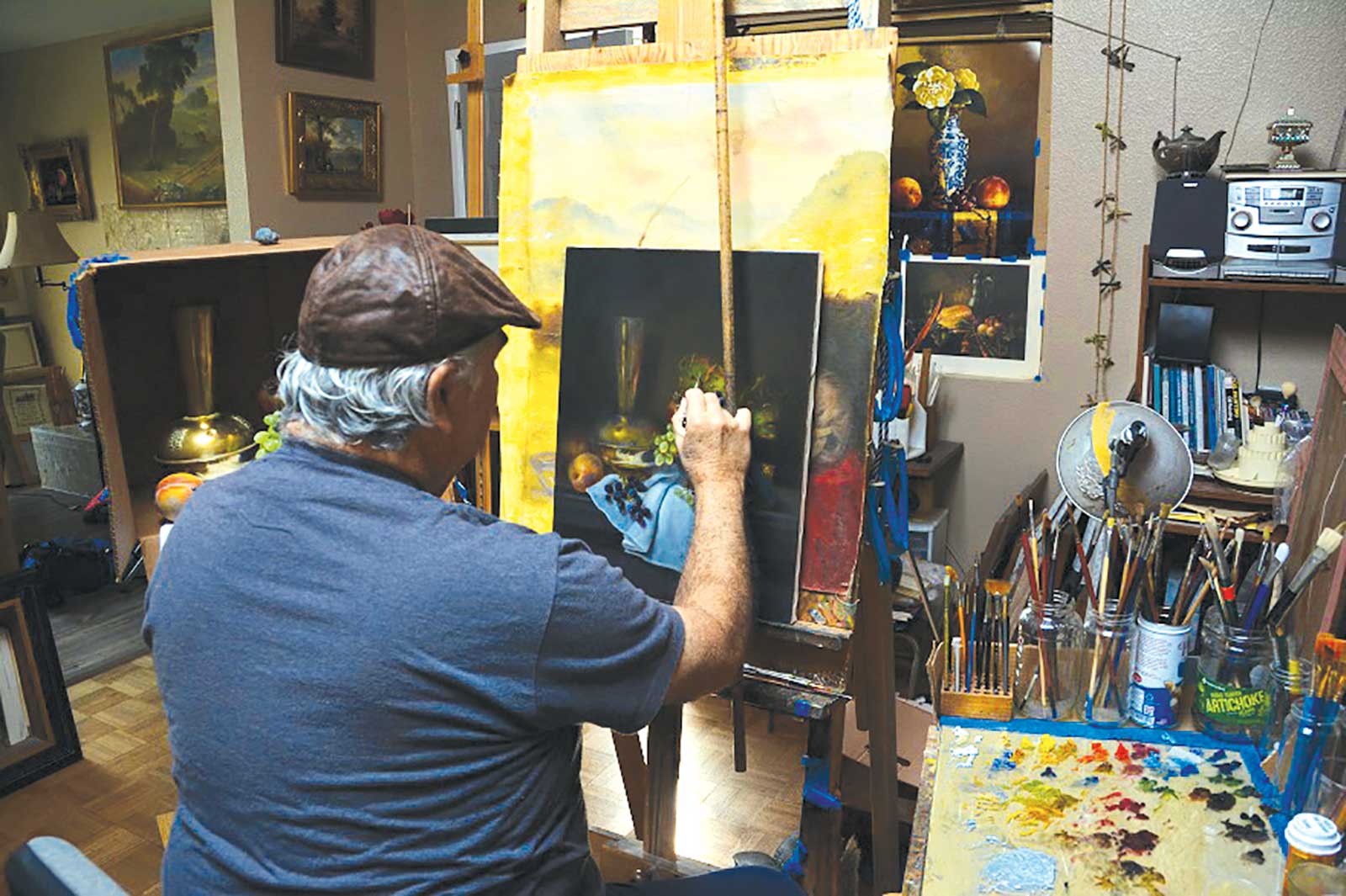 William GalvezA classical painter with Renaissance overtones, Colombia native William Galvez was born to an artist’s family. For years, he experimented on his own with different styles, mediums and techniques until he fell in love with the magic of European art, and he has been devoted to the still life genre for years now. Galvez’s works reflect the style and grace of the Old Masters in strength and composition. His award-winning paintings are on display in galleries and private collections. This naturally talented artist exhibits his skills with precise and detailed still life representations from his very own and carefully selected objects and arrangements. He makes no claims of providing hidden meanings and subliminal messages in his renderings, but rather attempts to portray realistic scenes in a graphic manner on his canvas. He lives and works in Southern California.
Represented by
Gallerie Armsterdam, Carmel, CA, www.amsterdamfineart.com
Innovation-Gallery, New York and Puerto Rico, www.innovation-gallery.com