



Margaret S. Livingstone, a neurobiology professor at Harvard, said that “artists are vision scientists; they just call themselves something different.” She’s right: we have a professional interest in being aware of how we see, and we are experienced at translating what we see into techniques for drawing and painting.
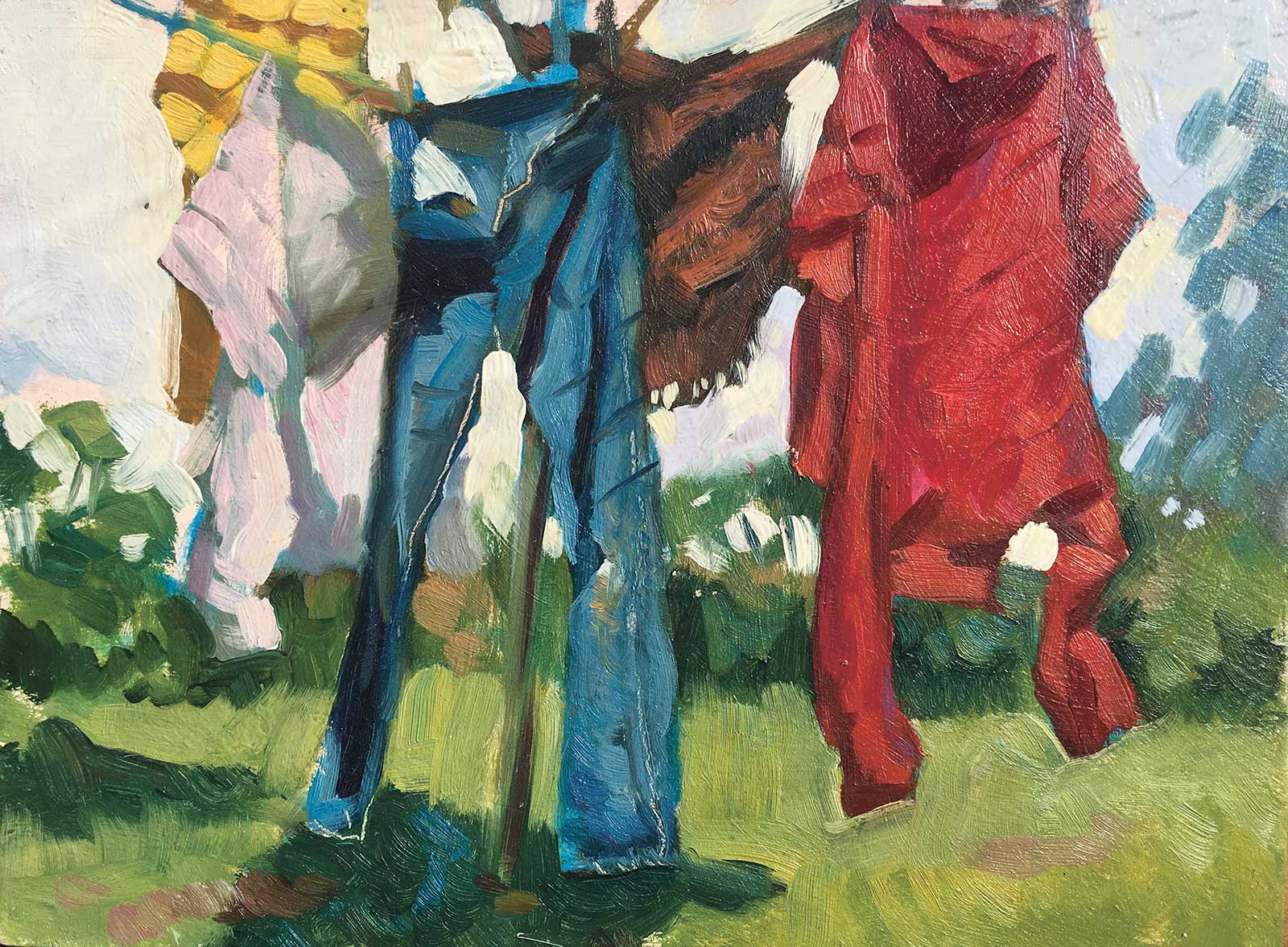 Clothesline, oil, 6 x 8" (15 x 20 cm) Every artist has a different style of painting. Is that just a consequence of habit and training, or is it a record of a different way of seeing?
 Understanding how we see is an essential key to painting well. Fortunately, in recent years there has been great progress in the scientific understanding of visual perception. In this article I’ll share some of the new insights and consider how they can help us as painters.

Stored Sunlight, gouache, 5 x 8" (12 x 20 cm) The sketch is painted from direct observation. It has less detail, but more color variation than a photo of the subject.

Reference Photo
Do Artists See Differently?
Does everyone with normal vision see about the same? It’s hard to be sure how our vision compares to others, because each of us is locked inside the prison of our own consciousness. But experimental data has revealed some general patterns. Artists do see differently—differently from non-artists, differently from each other and differently from cameras.
Let’s consider each of these distinctions in turn. Trained artists, compared to non-artists, spent less time looking at the focal points, such as a face or a figure, and more time scanning the overall image, according to an eye-tracking study conducted by Stine Vogt and Svein Magnussen in Norway.
What about men vs women? National Geographic published a study showing that men and women generally don’t see the same. Women tend to be better at distinguishing colors, particularly in the blue and green range of the spectrum. Men excel at tracking fast-moving objects and discriminating details at a distance. The difference in men’s vision apparently comes from how visual neurons develop in a high testosterone environment.
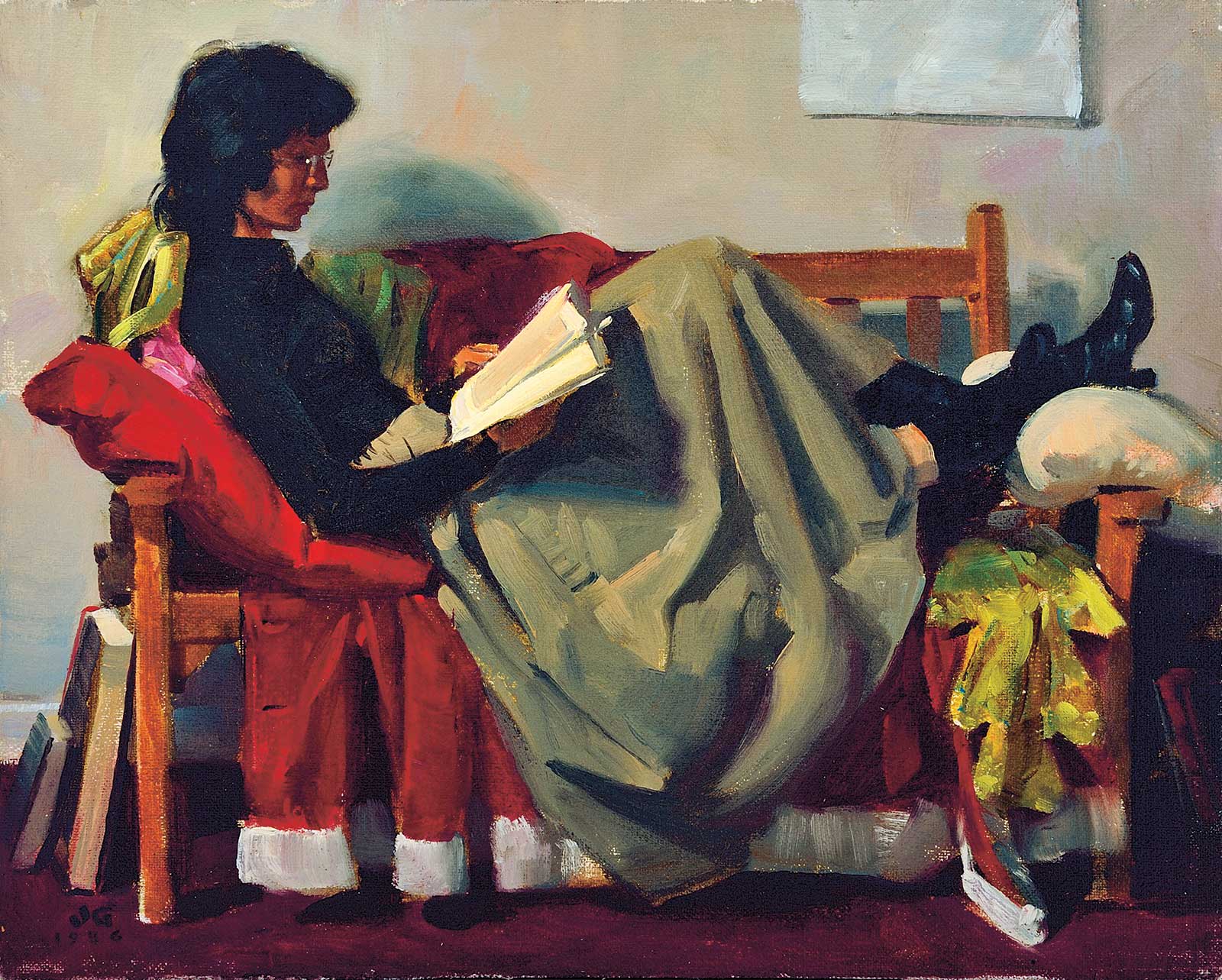
Jeanette reading, oil, 8 x 10" (20 x 25 cm). The brain’s preconceived models play a large part in what we see.
The Eye is Different from The Camera
The eye may seem like a camera because it has a lens and a light-sensitive layer. But seeing things is not like taking photos. Equating them leads us into a circular “homunculus argument,” where we’re forced to imagine a little person inside our brain looking at the movie screen of our perception.
Research in visual perception suggests that the human retina is more of a “pre-brain.” Some groups of retinal receptors bundle visual information into packets describing linear boundaries. Other receptors bundle information about tonal shapes. These packets are then processed downstream in the visual cortex. The retina transmits data at a rate of 10 million bits per second, which is about equivalent to an Ethernet connection. That’s not a gigantic data transmission rate, given the impression we have of a detailed world that appears smoothly stabilized and at a fast frame rate.
How is it, then, that we perceive the world in such elaborate detail and texture, even though the eyes don’t actually take in very much information? The magic happens in the visual cortex, which receives information from the rich connections to the rest of the brain.
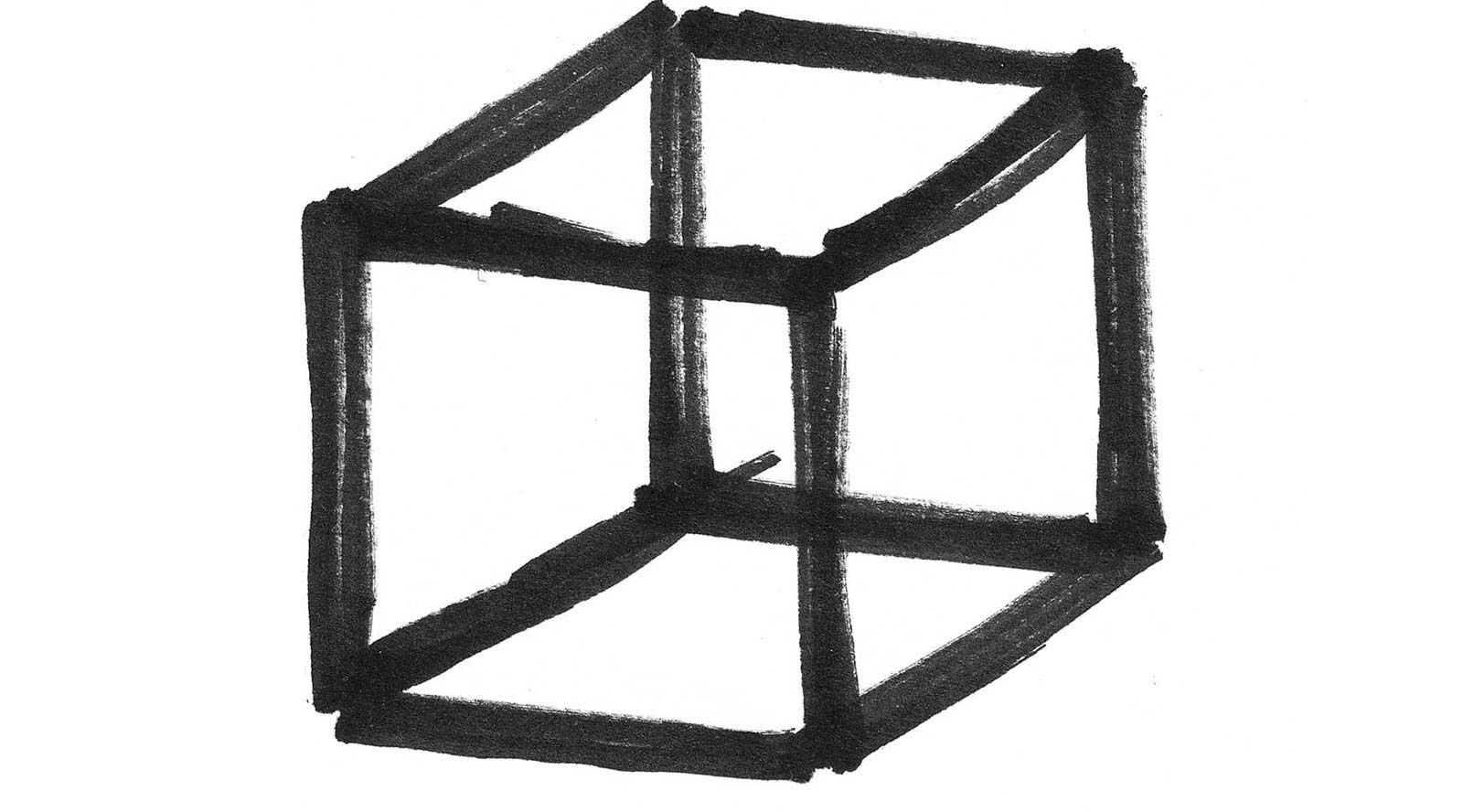
Box or lines? It may at first appear that this is a set of two-dimensional black lines, but it doesn’t take long for the figure to automatically pop into a perception of a three-dimensional box, seen either as an upshot or a downshot. Those three-dimensional interpretations are an example of top-down processing.
Vision is More Top-Down Than Bottom-Up
As the brain begins to sort out the relatively meager information it receives from the retinas, it elaborates the data into a more complex representation. Until recently, scientists thought this process happened in a bottom-up direction. They thought it was a one-way trip from the retina to the higher vision centers in the brain.
But it turns out that a great deal of information comes down from higher to lower levels of processing, amplifying weak signals to give them the impression of detailed images. The brain generates predictive models of what it thinks we’re seeing. This happens largely unconsciously, and sometimes inaccurately, such as when you suddenly mistake a black garden hose for a coiled snake.
Our visual system also automatically deletes elements of a scene, removing things you’re not expecting to see. When I’m painting, I often notice objects suddenly appearing in my visual field—things like wires or poles or foreground fences or branches—after more than an hour of not seeing them at all.
Cognitive scientist and philosopher Donald Hoffman has gone so far as to say that all we really see are our mental models. They’re like desktop icons, which our brain constructs to give us a representation of the infinite complexity of the world around us. As psychologist Lisa Feldman Barrett puts it: “Your view of the world is no photograph. It’s a construction of your brain.”—
 James Gurney
About the Artist
James GurneyAbout the Artist
James Gurney is the author of two Amazon-bestselling books: Color and Light and Imaginative Realism, which is now also available in Russian, Spanish, Japanese, Korean and Chinese. His original artwork has been featured in over 30 one-man museum exhibitions.
Contact at
gurneyjourney.blogspot.com