
It bears repeating, the moment I decided to be an artist at seven years old. It was a feeling deep within and it happened in one particular moment: My dad, who loved to draw, showed me a drawing he did. The power of that moment has stayed to this very day. That very drawing remains on the wall of my studio.
The reason I mention this is that I’ve seen similar instances happen with others and at various ages. I remember well in one of my workshops. At noon, a lady came over to me and said she’d had art in her mind since she was a child and now she decided, “I’m 78 years old and I know how I’m going to be spending the rest of my life. Art!” She smiled and walked over to the lunch area. That moment stayed with me, and I kept track of her over the years. She was as good as her word. In fact, a few years later she came to one of my workshops and her art pieces were absolute wonders. This is what art can do for someone when the light hits them...in any way and at any age.
I’ve observed artists with various levels of talent from all parts of the world. Many of them were obsessed with what they were doing. Making money is always a plus, but every one of them created works because it was something they wanted in life. That’s why I got into this particular world knowing there were no guarantees to go with it. I simply needed and loved art even when my young mind knew it would not be a “practical” career. I’m still here and couldn’t be happier with my impractical existence.
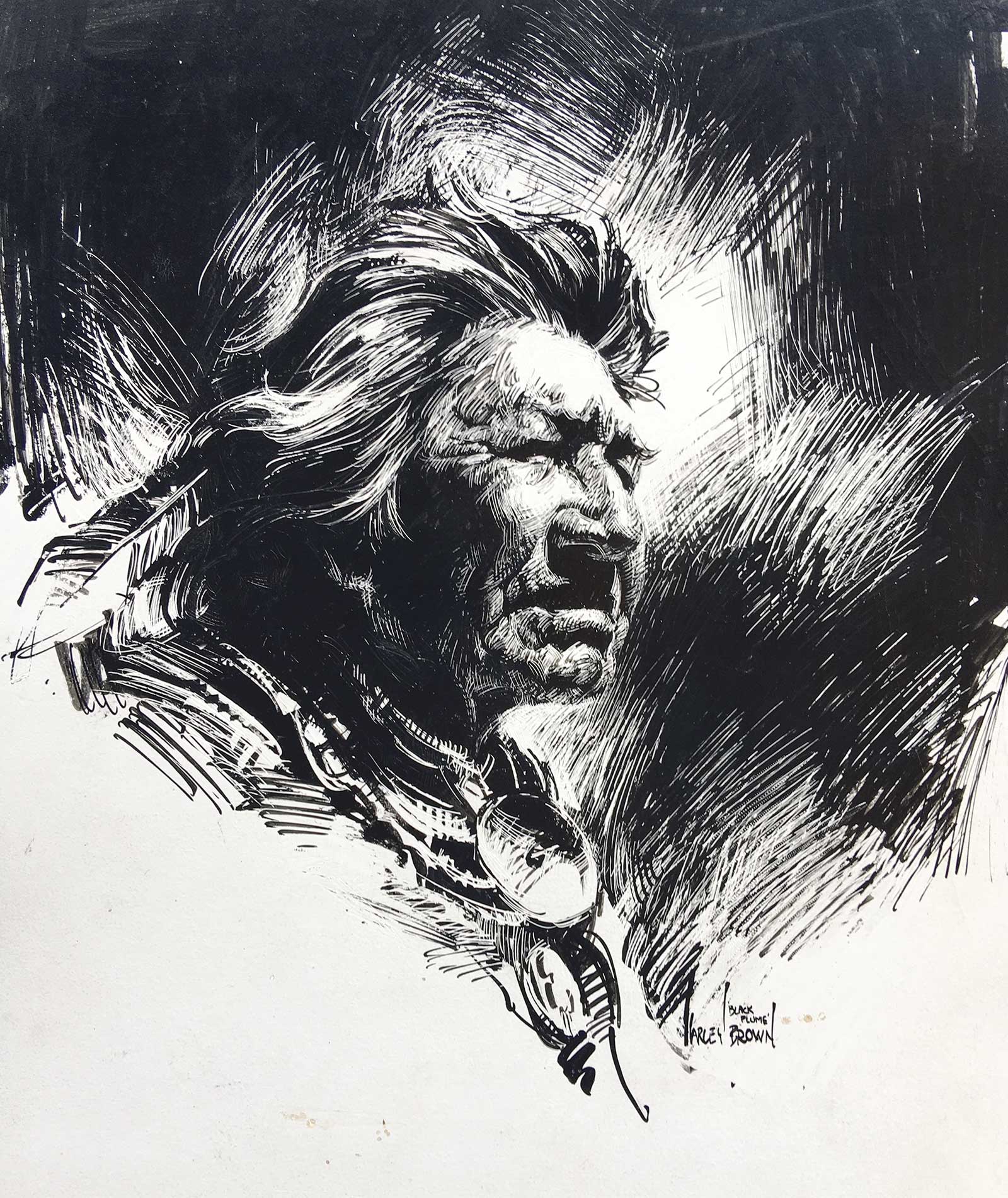
Another Way
Another Way
Part of my joy being an artist is going to extremes within myself: works I’ve done with colorful impressionist daubs to black and white pin strokes as seen here. No photographic details, but finely bringing life to my subject. This was done on white scratchboard. I applied the ink in specific areas, combining basic design and form. While doing that, I applied a tool with an extremely fine point to scratch in the light areas. Back and forth with ink and scratching. The aesthetic side included soft, hard, lost and found edges. Not once did I feel I was fussing, but constantly developing a portrait. I’m not sure where the final scratch happened, but I do remember sitting back and thinking...done! Dear reader, I suggest you get some scratchboard and try it. This will bring out another part of you and when completed can bring you a smile.
After a good while, I started towards a period when I trusted myself and my skills in art. So much so that I didn’t need someone to advise me that my artwork was okay. I don’t need that any more than asking someone how I can better my personality. It took a few years to be a confident “Harley Brown” both personally and artistically. Not overnight but a steady, joyful trip that keeps giving and inspiring. I will add that I surely don’t mind others saying, “Hey, you did good with this piece.”
In Art, Who Do We Hear?
Take it from me: Don’t give a hoot about people who grade or criticize your art; their imperious attitude means little. When I started out, I was demeaned because my art often looked like something seen on birthday cards, but I made a living. Most important, I chose who I’d listen to and work with, mentors and masters. It was a steady and energizing period. Most important was the pathway I took, knowing there was nothing that would discourage me. Nothing. If it helps as you read this, I’m with you. Other artists are with you.
Laying in lots of color does not mean the artist is a “colorist.” The skillful use of color is like piloting an airplane; absolutely knowing what you’re doing with the ability to handle surprises, exploring new areas and grand revelations. One word suggested: MUNSELL.
Some people ask when we artists are on top of our game. I’ve talked about this with many of my art friends and we agree: We do gain a strong confidence that happens in time, but we keep finding something new under unexpected circumstances. I always get the feeling that I’m learning, simply because everything I paint or draw is different...always freshly interesting. Including each of those thousands of faces I’ve observed and portrayed.
Putting it another way: I never saw my face age day by day, and I never saw my art “improve” each day. All I know is that every time at the easel, I put all I can into each piece and it’s motivated every minute in the studio. Once in a while I’ll look at an early photo of myself and often see my art from half a century ago. I can say this: beginning at a certain part of our art lives, there is a long, long period of “steady going.” Steady, fascinating and deeply inspiring.
BALINOFSKI
 She
SheShe - I’ll Show You
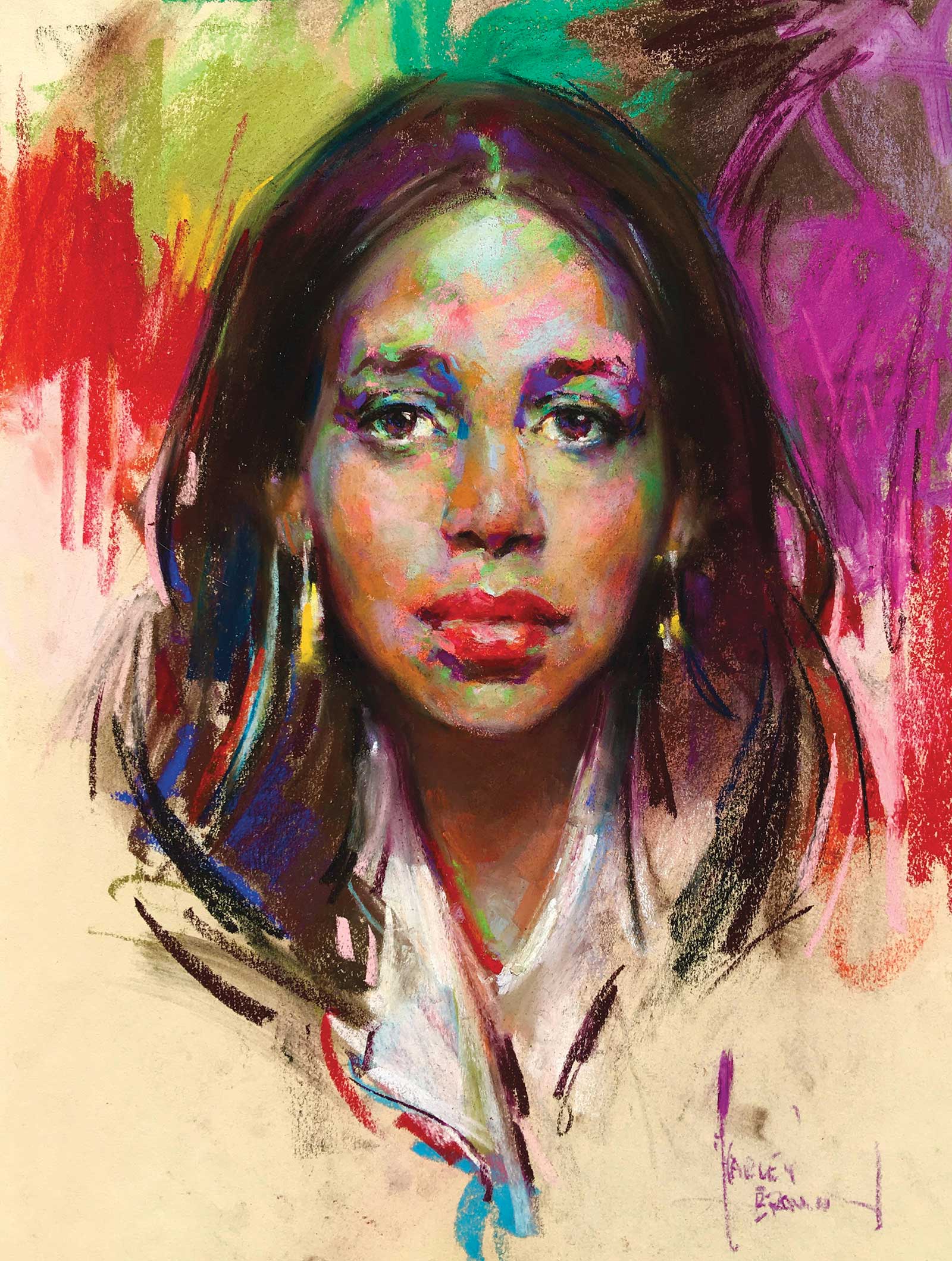
Here I go with something that I hesitated showing. Let’s just say it’s your day with Harley at his easel. Here’s what happened. This young lady was very comfortable when posing for me; she had a compelling, ethereal presence. I knew she could only be there for one sitting so I went straight to the easel. The lighting was simple, overhead and she wanted to sit with her face and eyes directly towards me.
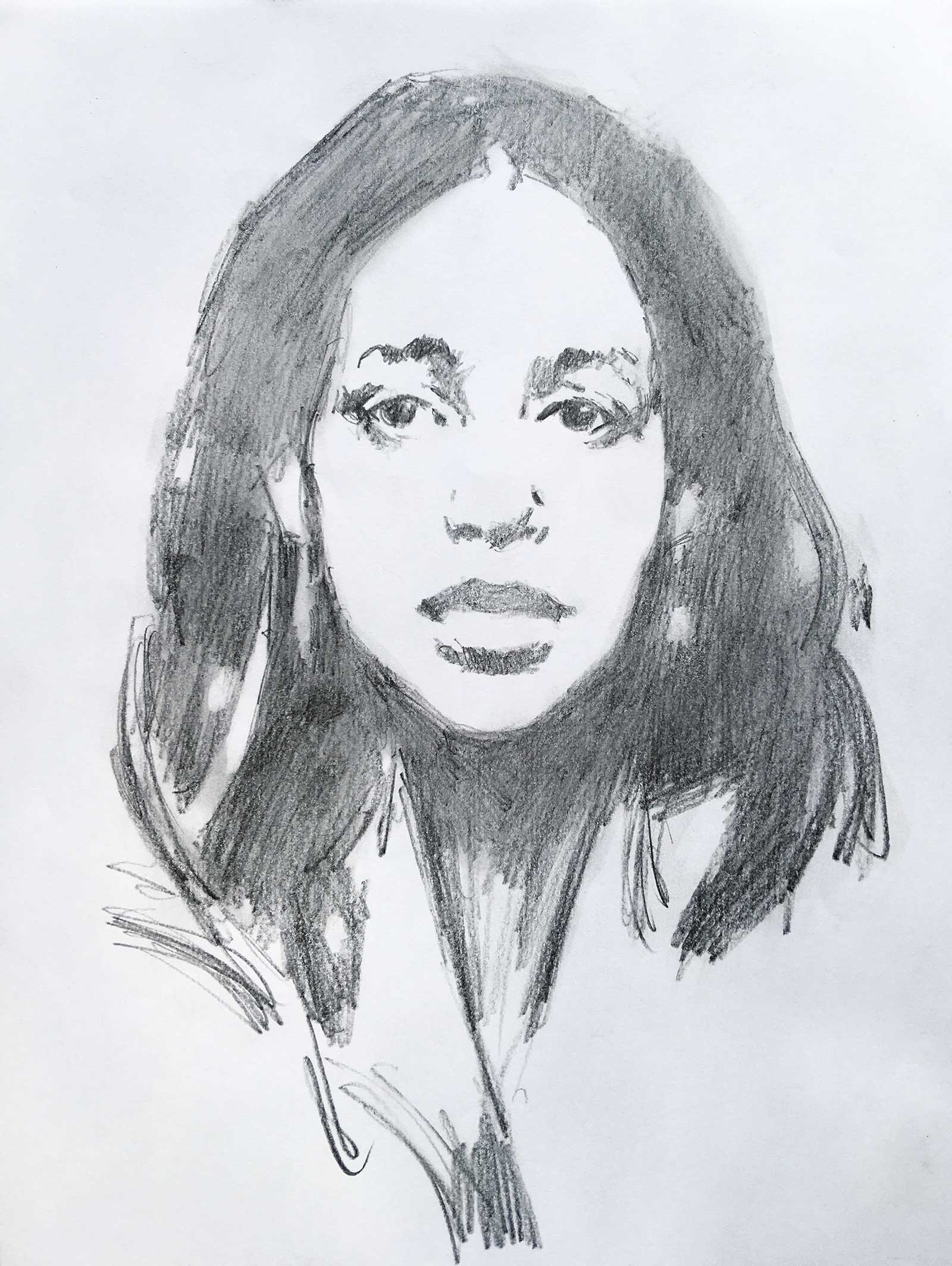
A two-tone version of She.
You see I went eccentric with the colors, it just seemed right—a freedom with colors making sure their shapes and values were right throughout her features. My outer mind saw those shapes and values needed; my inner mind grabbed the right valued color. Getting those shapes accurate was prime; the two tone drawing shows them. I wanted to touch this piece up, work on “errors.” But you’re in the studio with me and you see my final stroke...that earring on her left ear. An artist’s moment.
There’s no doubt you who are reading this can draw those shapes. Take a few minutes and draw that two tone work. That’s the basis of this full colored pastel. Get the shapes accurate with the right values and your art will happen. Do it a second time with colors. (Don’t forget: Munsell).
Happy is as Happy Does
It’s impossible to be bored if you are an artist and you allow your inner mind to take control at certain times and in certain areas. That part of our mind is loaded with knowledge and abilities that need releasing and where better than on a canvas or sheet of paper? This I can assure: your mind will thank you as you retire for the day.
Once in a while, I’ll go through a day with no desire to go to the studio, and that’s okay. Still, I always do a quick sketch or two just to keep my brain cells moving. But if that dull feeling goes on any longer, I know there’s the answer that always works. Always! I go to the studio and within the first stroke of anything, I’m a deliriously happy artist, ready to create anything. I do thank my inner mind for helping guide me. When you’re finished reading here, give it a go. It’s like magic.
Consider the use of pure black when painting. Sometimes when I use black, I’ll mix another color into it just to take away its harsh gloom. Same when working with pastels. I have pastels besides black that are extremely dark.
Often when there is an outside subject I want to paint, I’ll wait for the position of the sun, when the shadows are ideal for what I’m after. Yes, there are those moments when I don’t have that privilege but take what I can get. For instance photographing a face or figure when we’re all on the run. I have boxes of those from years of travel. Ready and waiting, enough that would keep me going for at least 100 more years. I just painted a child from a photo taken years ago. That child is now a grandmother.
Paintings love to have larger, negative areas, sometimes without sharp edges or textures and sometimes without strong colors. This brings to focus the center of interest which can be a smaller area within a painting.

Chenoa
Chenoa
This piece was done from a photograph that I took many years ago. Chenoa is now a grandmother.
Personal Accuracy
Make sure you get it correct when you’re measuring or finding the right angle of an area. Think of all those hours wasted correcting that arm that’s too long or the head not at the right angle on the shoulders. I learned that I better get my art “accurate” from the start. “Accurate” in art means human “accurate” with personal passion, as with playing a piano concerto.
I’m not necessarily a humble person but I’m definitely humbled by Mother Nature. She hands me what she wants with no argument. It’s up to me in interpreting her with my personal but loving care. She welcomes us all, and I wish her well each morning and bid her goodnight as the sun sets.
Basics
I don’t draw things, I draw shapes. For instance, the shape of a shadow under the nose, the shape of a dark area behind the shoulder. Understanding shapes has allowed me to paint people, burros, pots, cabins and anything else that connects with me. Of course with those shapes goes that crucial understanding of values. Think three words: shapes, values, design—and then color.
With that in mind, one of the biggest problems I’ve seen with artists is getting the values right. Lights to darks. For instance, a work can be ruined when the reflected light on the subject is too strong. Or the background is not the right value for the subject. I learned a lot about values with years of pencil drawings. I continue to squint my eyes to see if my values are working...a never ending must. A major plus is that when artists are getting their values right, they can play and experiment with their colors. Go and ask Monet, Sorolla or Fechin. —
BALINOFSKI
Always
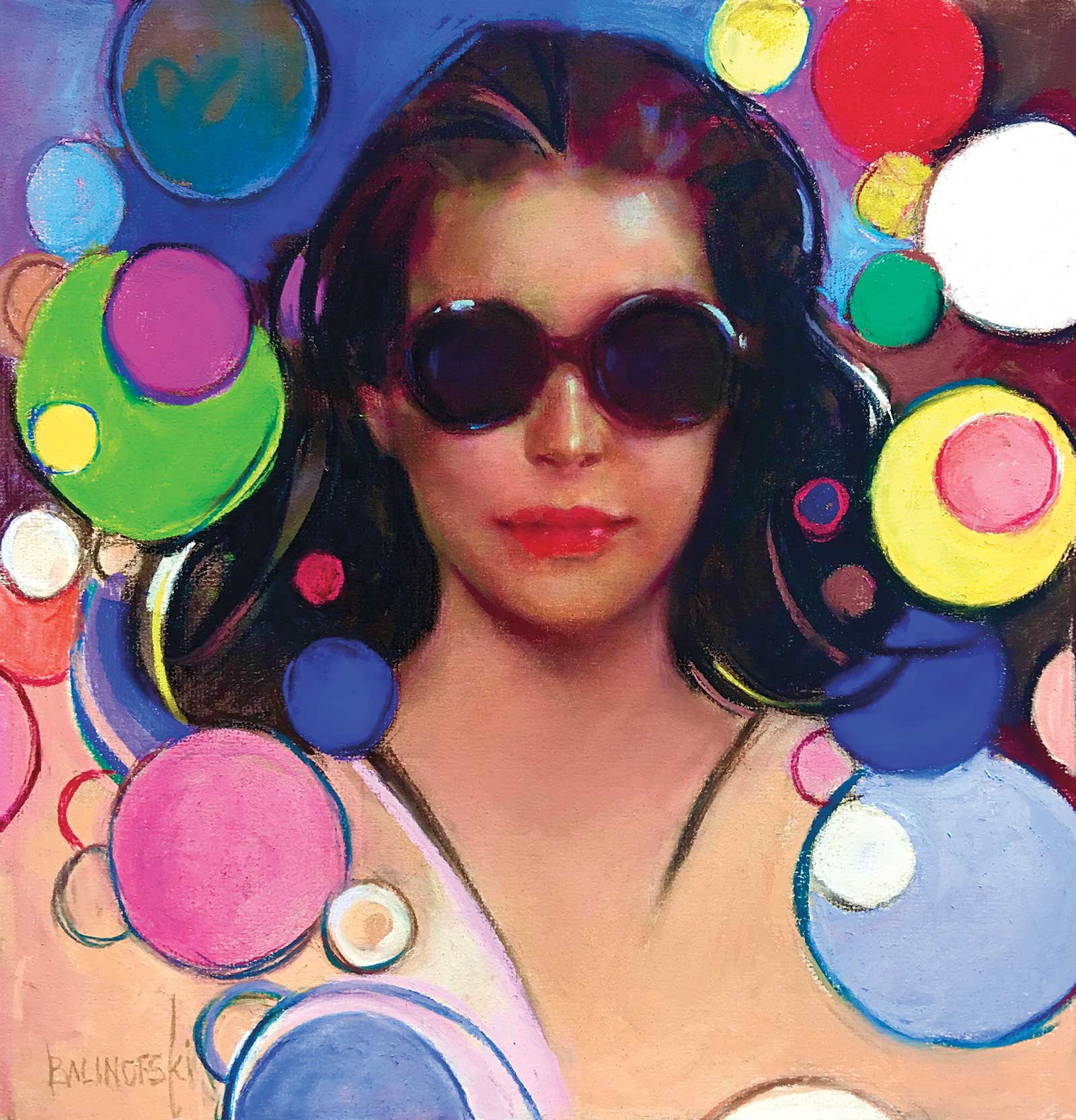
You know that women are a great mystery to me. Yet, I continue to interpret women in my own eccentric, personal way. Here, I couldn’t control myself while this portrayal was being created...I kept laying in circles. One after the other, as if there was a message coming through my hand. Then an understanding flowed into me while drawing the pink circle on the left: the line making a circle is perpetual. It never ends, always moving ‘round and ‘round. The title here expresses that aesthetic combination; an enigmatic lady wearing those sunglasses, encompassed with circles. All joined together naturally.